Daniel Paquette has taken over Westfield Technical Academy with the language of someone who already knows the building: shops and academics need to feel like one school, incoming ninth graders need a smooth start, and demand for WTA has to be managed inside a facility with limited space.
The state's current school profile lists Paquette as WTA's principal. In June, the district's official live feed described Bruce Hastings as retiring and Paquette as the incoming principal.
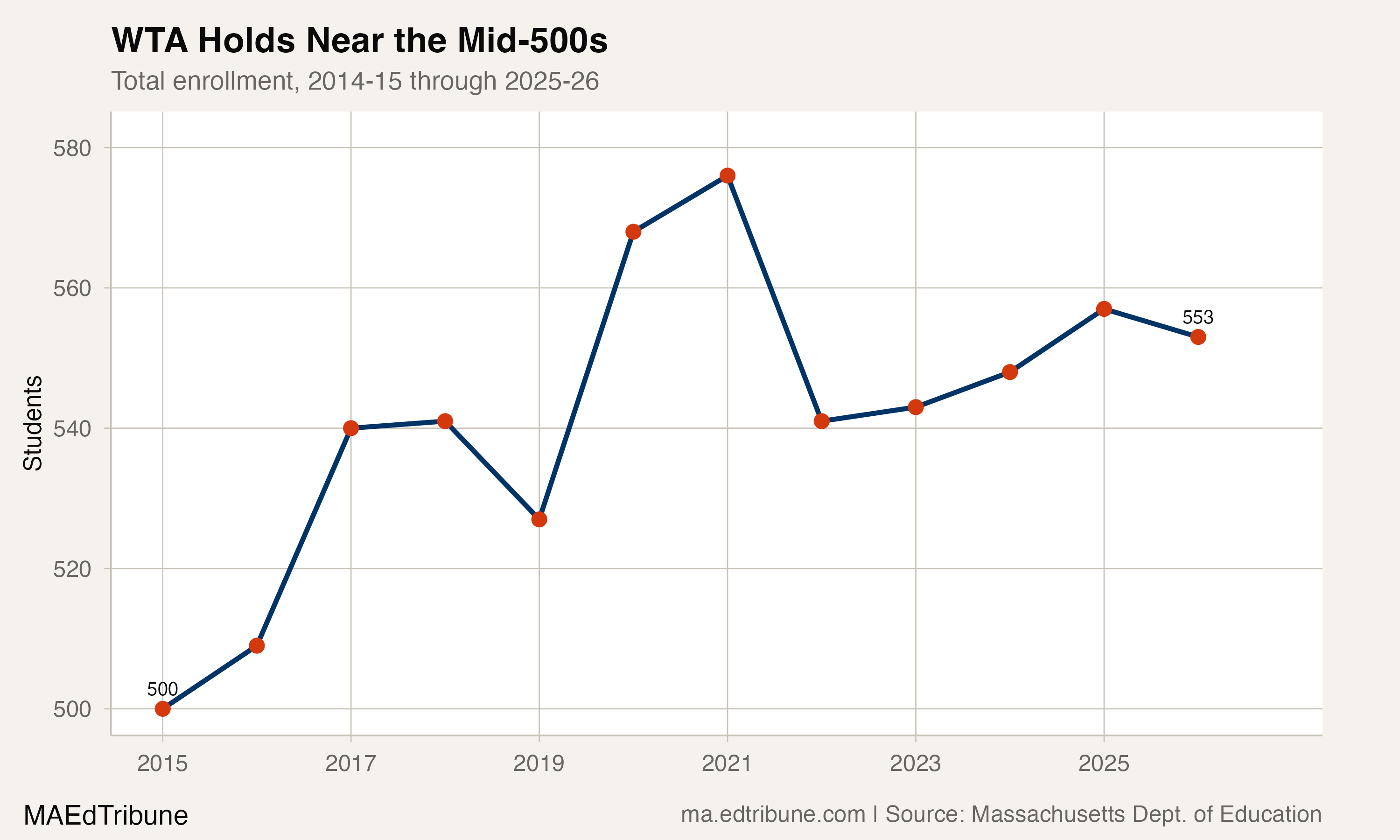
The Massachusetts package's most recent published total for WTA is 553 students in 2025-26—the prior school year, not current 2026-27 enrollment. That was almost unchanged from 557 the year before. Over the longer period from 2014-15 to 2025-26, enrollment in the broader Westfield↗ET district fell by 17.0%.
A leader already inside WTA
Paquette's path to the principal's office runs through WTA itself. "There is no other place I would want to be principal at than WTA," Paquette said in an email to The MAEdTribune.
Paquette's comments are direct evidence of his stated priorities, not evidence of outcomes. His first priority is not a new slogan or a sharp turn. It is continuity. For students and families, Paquette said he is "hoping for a smooth transition, especially for the incoming 9th grade students." For teachers, he described the work as building a more unified school.
"As for CTE and academic teachers, my goal is to build a collaborative atmosphere that helps bridge some of the gaps between CTE and academics," Paquette said. "Academic and shop teachers will work to be consistently aligned, help to reinforce each other's lessons, and create a culture of one school and not two separate programs."
Stability under pressure
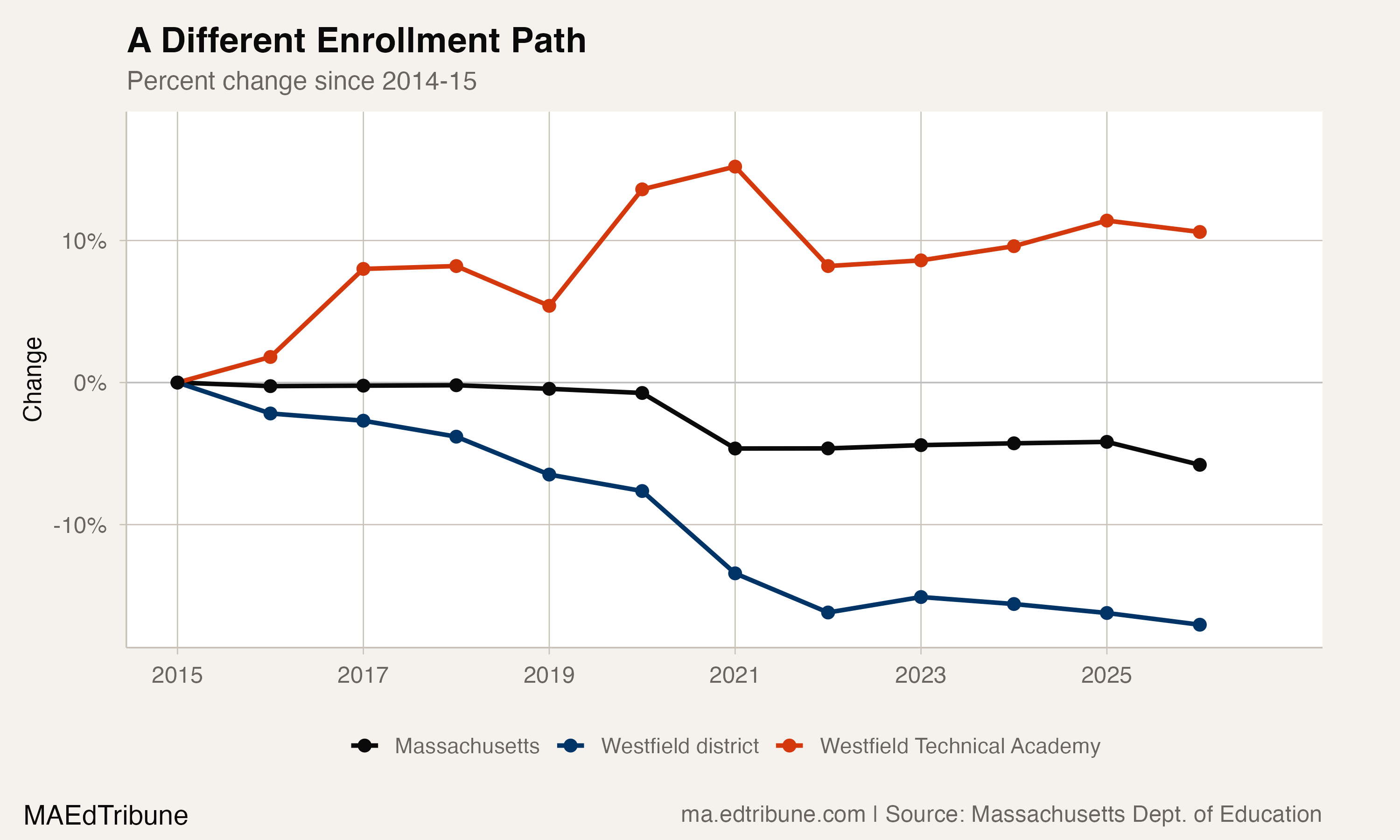
The enrollment pattern is suggestive context for Paquette's emphasis on capacity, not direct evidence of applicant demand. WTA enrolled 553 students in 2025-26, up from 500 in 2014-15. That is a gain of 53 students, or 10.6%, across the same period when Westfield district enrollment fell from 5,696 to 4,725, a loss of 971 students, or 17.0%.
The school has not grown without limit. Since 2021-22, WTA's total has stayed between 541 and 557 students. Paquette described the same period in terms of an aging building, finite shop space, and sustained demand.
"WTA's enrollment has stayed consistent due to the limited space in our aging facility and the growing popularity of our school," Paquette said. "WTA has had a waiting list for many years consecutively, and this will be our first year accepting students through the state-mandated lottery system."
He did not soften his view of that change. "I'm not a supporter of the lottery system, but I do support the opportunities that WTA provides to every student who walks through our doors," Paquette said.
That is the balance he is stepping into for 2026-27: protecting a school culture that Paquette described as popular while adapting to lottery-based admissions and a building with limited space.
The students he will serve
WTA's 2025-26 enrollment is 78.1% White and 16.6% Hispanic. About 40.3% of students are economically disadvantaged, and 20.6% receive special education services. Those service groups overlap with the race and ethnicity groups and should not be added together.
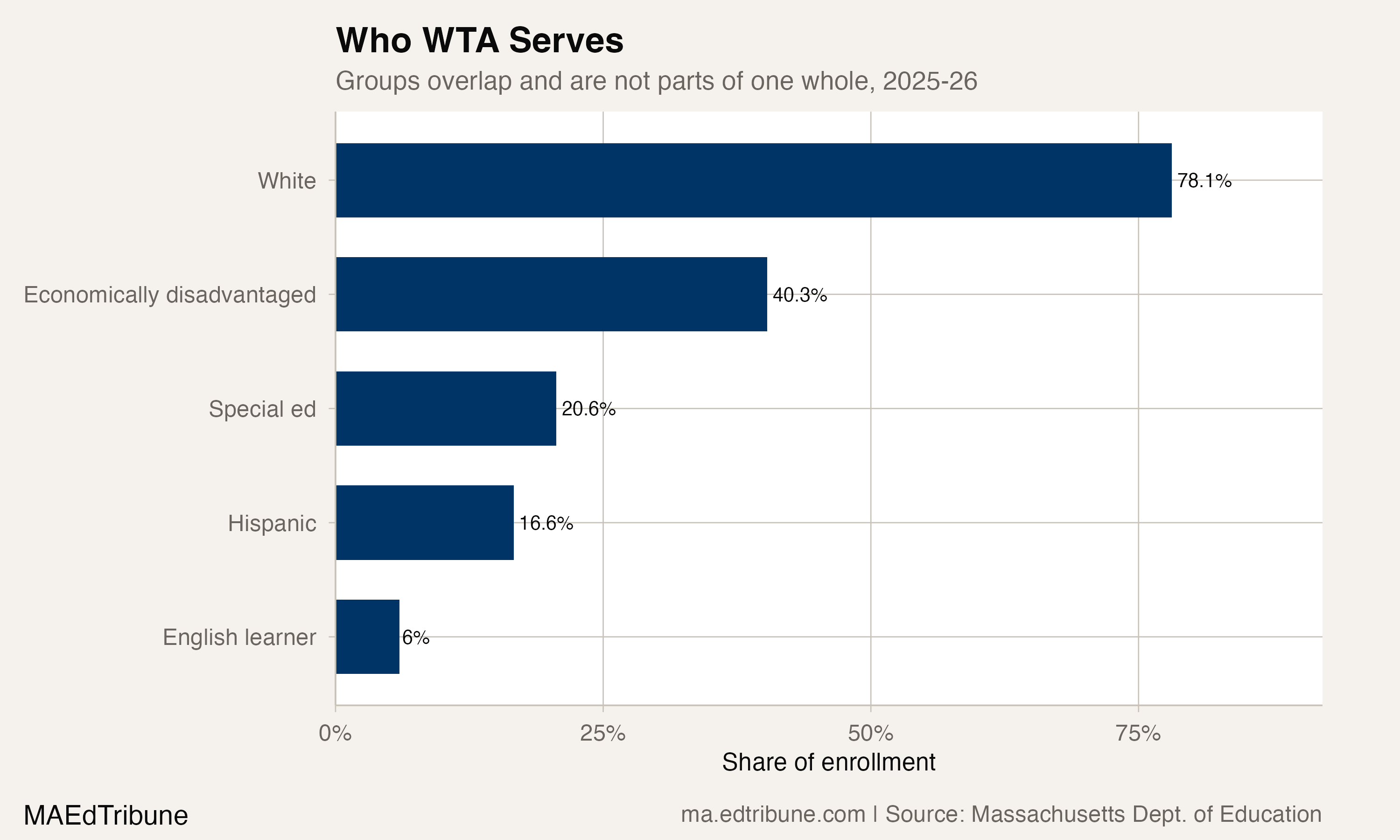
Those figures describe the published student groups Paquette is inheriting; they do not measure service intensity. His stated priorities are aligning academic and shop teachers, reinforcing lessons across settings, and helping incoming ninth graders make a smooth transition.
"There is a shop for everyone at WTA, but space is limited," Paquette said. He also described WTA's staff and students as a strength of the school community.
For Paquette, the test during 2026-27 will be whether WTA can keep the feel of a small, high-demand technical academy while bringing a new class through the school's first year of lottery-based admissions. His answer at the start is to make the academic and shop sides harder to separate.
Enrollment and student-group figures come from the Massachusetts Department of Elementary and Secondary Education's School and District Profiles.
Detailed code that reproduces the analysis and figures in this article is available exclusively to EdTribune subscribers.
Discussion
Sign in to join the discussion.
Loading comments...