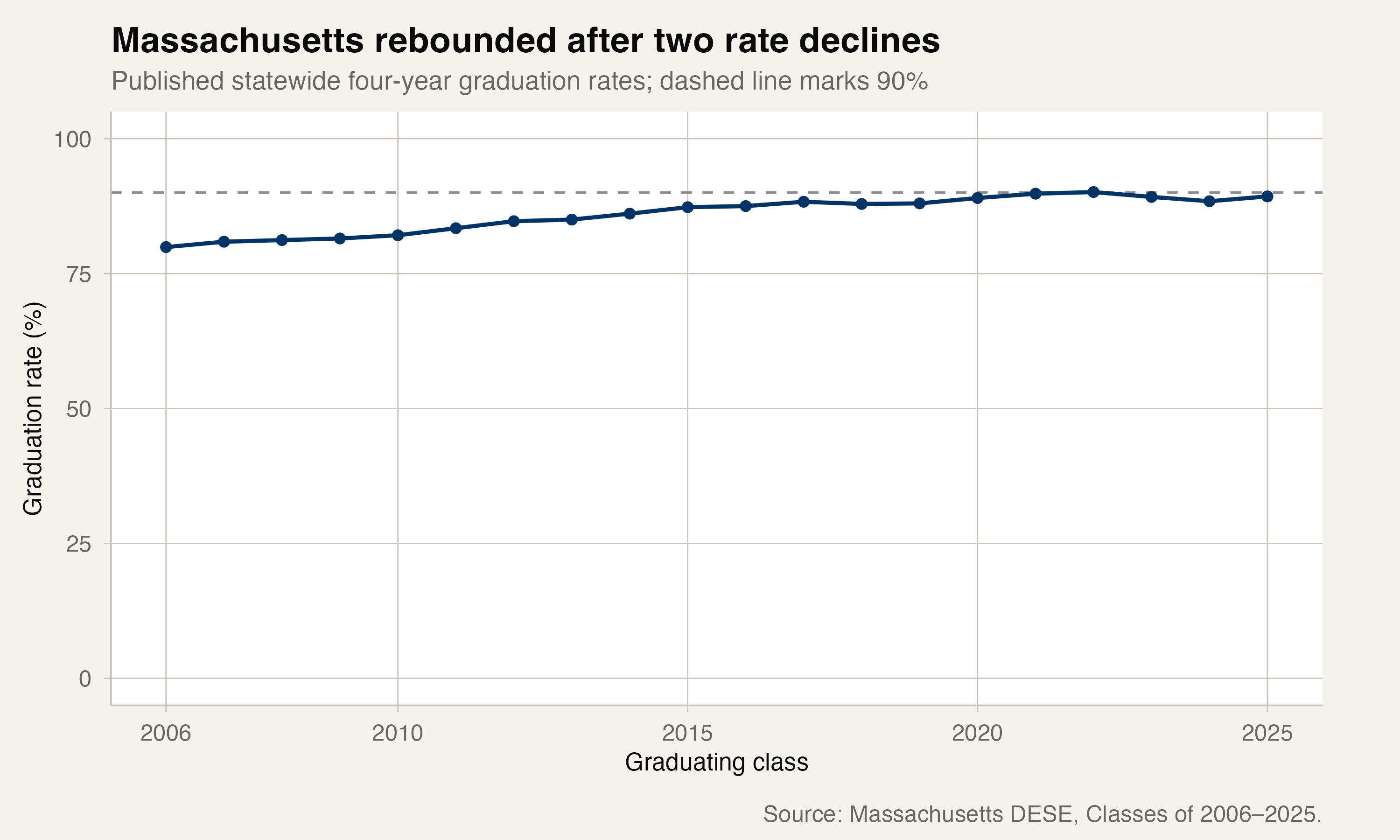
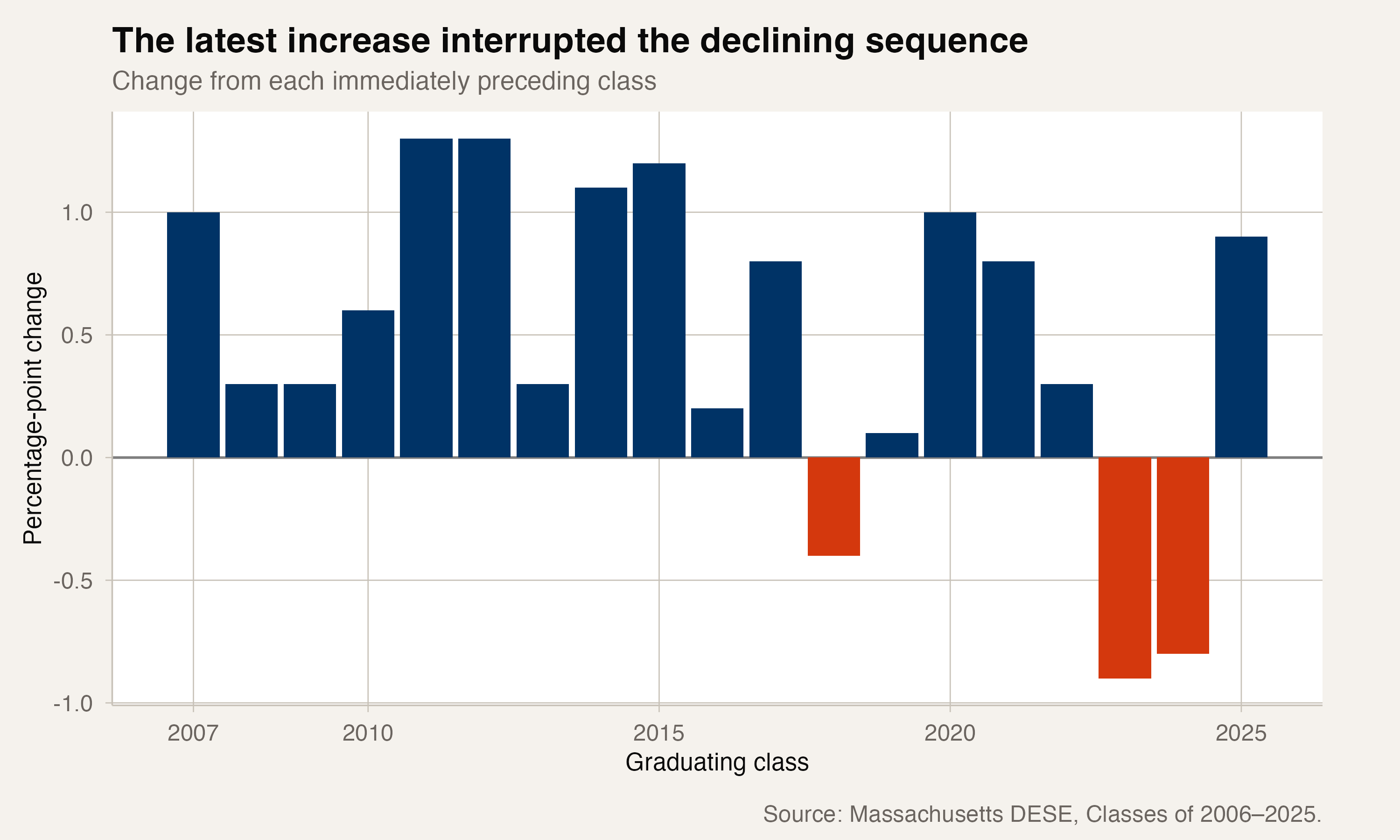
Massachusetts reported a four-year graduation rate of 89.3% for the Class of 2025, up from 88.4% for the Class of 2024. The increase of 0.9 percentage points interrupted two consecutive annual declines.
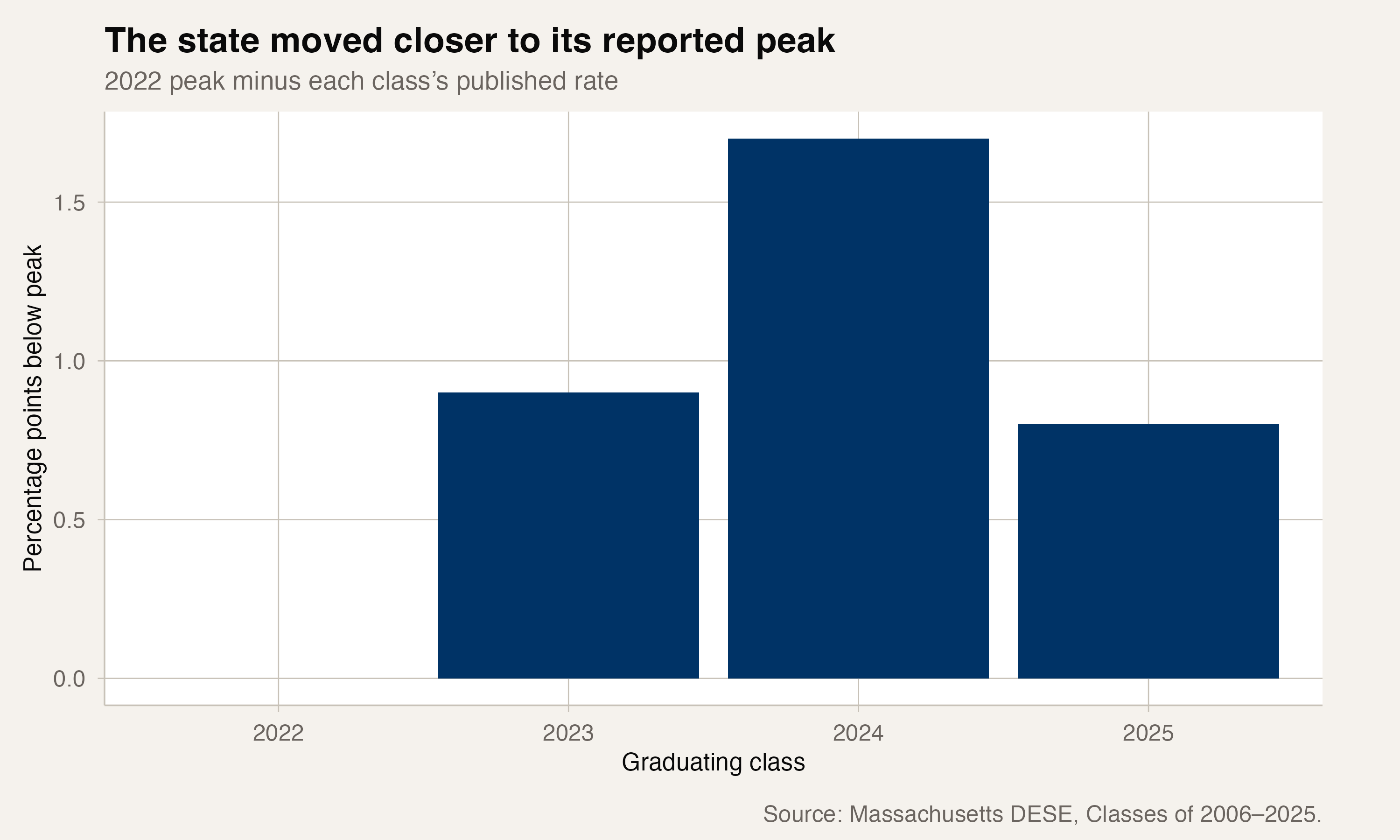
The statewide rate remained 0.8 points below its highest published observation in the available Classes of 2006–2025: 90.1% in 2022. The latest result shows a rebound after a retreat from that peak.
The latest class changed the direction
The state's rate went from 90.1% in 2022 to 89.2% in 2023 and 88.4% in 2024. The decline across those endpoints was 1.7 percentage points.
The Class of 2025 brought the rate back to 89.3%. A description based only on the preceding decline would miss the latest increase. Equally, the increase does not establish that the rate will return to its prior peak or keep rising in future classes.
Closer to the peak
The difference from the 2022 peak was 0.9 percentage points in 2023, widened to 1.7 in 2024 and narrowed to 0.8 in 2025.
The state first reached the 90% threshold in 2022 within this available reporting window. That is a bounded finding about the reported Classes of 2006–2025, rather than a claim about years outside the series.
A longer gain with setbacks
Massachusetts reported 79.9% in 2006. The gain from that first available class to 2025 was 9.4 percentage points.
That longer increase includes annual reversals. The state rate fell before the recent peak as well as afterward, so the complete record should not be described as an uninterrupted climb followed by a single turning point.
The rates measure outcomes for different graduating classes. They cannot establish which changes in policy, school practices or student composition caused the gains or setbacks. Nor does a change in a rounded rate by itself count how many additional students failed to graduate.
The state's graduation-rate guidance distinguishes four-year outcomes from longer-term graduation measures. Students outside the four-year graduate group are not automatically dropouts. The statewide rates alone also cannot identify which districts drove a change; that requires a separate district-level comparison.
Source: Massachusetts Department of Elementary and Secondary Education graduation reports, independently published statewide four-year all-student rates for Classes of 2006–2025. These are class outcomes, not live school-year counts or forecasts.
Detailed code that reproduces the analysis and figures in this article is available exclusively to EdTribune subscribers.
Discussion
Sign in to join the discussion.
Loading comments...