
Asked where he sees enrollment heading, Stephen Zadravec gave the kind of answer that is easy to skim past.
"Enrollment in Amesbury is stable and projected to increase a bit over the next few years," he wrote in response to questions from The MAEdTribune.
The projection is his. The recent headcounts can be checked. From 2014-15 through 2025-26, Amesbury↗ET lost a larger share of its enrollment than the typical district in the statewide comparison. Its most recent totals, though, fit inside a narrow band.
Zadravec became superintendent of Amesbury Public Schools on July 1, succeeding Elizabeth McAndrews. The Amesbury School Committee announced his appointment in March, describing him as a district leader with a doctorate in educational leadership who had most recently served as superintendent of School Administrative Unit 50 in Greenland, New Hampshire. He confirmed the July 1 start date in writing.
What brought him was not a turnaround assignment.
"What drew me to Amesbury was the pride in the schools and strong community relationships that exist here," he wrote.
A fifth of the district, then five flat years
Amesbury enrolled 1,813 students in 2025-26, last school year and the most recent published year verified here. That is 467 students fewer than the 2,280 it enrolled in 2014-15, a decline of 20.5% across twelve reporting years.
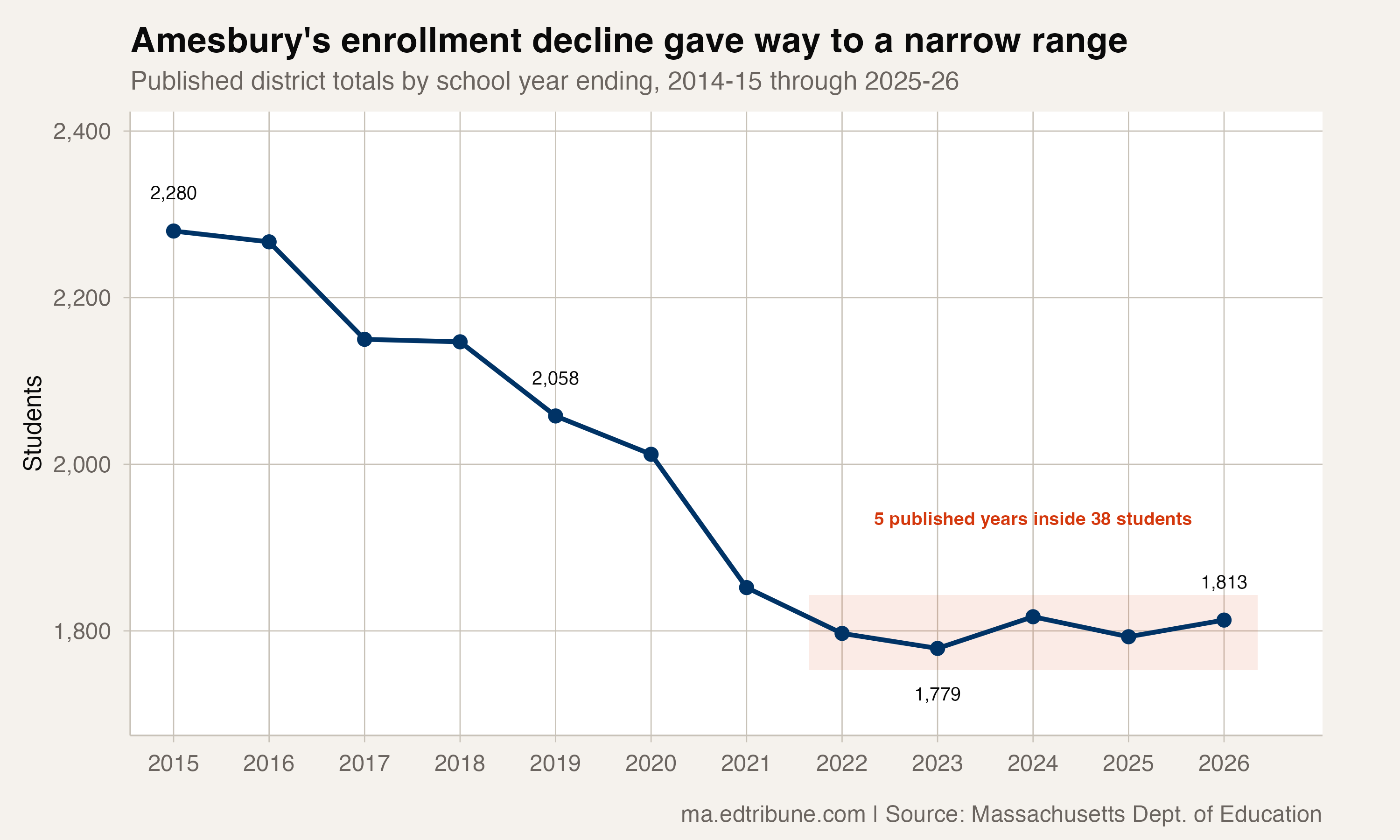
Those figures precede Zadravec's appointment. By the district's low point of 1,779 students in 2022-23, Amesbury had already given up 501 students, or 22.0% of its 2014-15 enrollment. The largest one-year move in this comparison came in 2020-21, when the count fell by 160 students.
The five most recent published years run 1,797, 1,779, 1,817, 1,793 and 1,813, a spread of 38 students from the lowest to the highest. That band is 2.1% of the district's low; extending the run back another year widens it. The count rose and fell within that range. The most recent published year moved up by 20 students, or 1.1%.
The state kept falling
The flat stretch reads differently once the rest of Massachusetts is on the same axis.
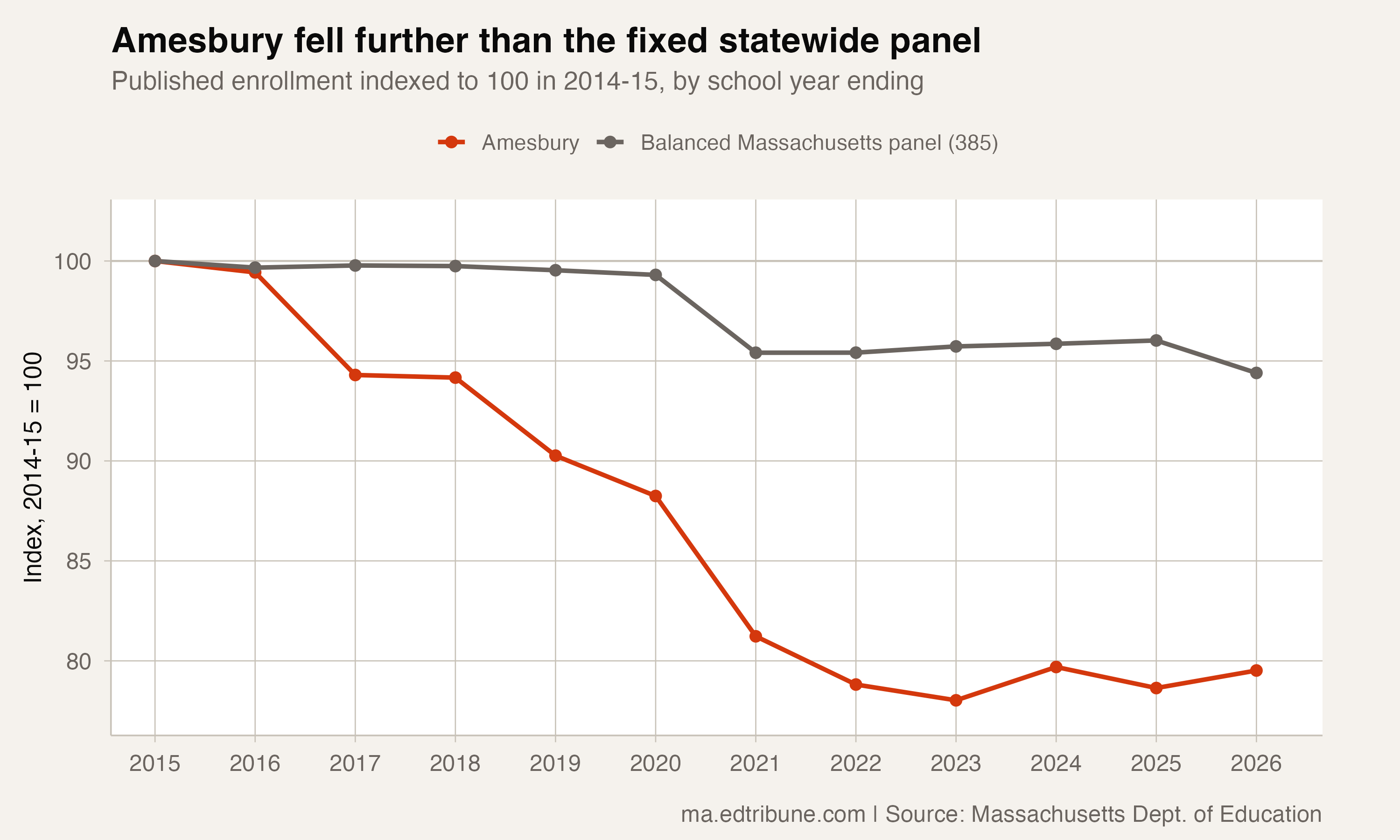
Across the 385 Massachusetts district organizations that reported a positive published total in every one of those twelve years, enrollment fell 5.6%. The median district in that group lost 5.8%, and 67% of them ended lower than they started. Amesbury's 20.5% decline is far steeper than the typical district's, and these files do not say why. They report how many students a district enrolled. They do not report housing, births, tuition, school choice, program changes, or who moved into town and who left.
What the two lines do show is different timing. Amesbury reached its low in 2022-23 and has not gone below it since. The statewide group reached its own lowest point in the most recent published year, falling 1.7% in the same year Amesbury added students.
What the summer was for
Zadravec spent his first months doing something other than restructuring.
"I've been on a listening tour all summer and what families and staff value most in Amesbury schools is the quality of the staff," he wrote.
His read on what the district wants next is a communications problem more than an academic one. "There is a strong desire to share the amazing work that goes on in our schools more broadly. I look forward to doing that," he wrote.
His answers identify communicating the schools' work as an early priority. The enrollment figures provide context for that work without explaining what families value or why they choose the district.
Kindergarten exceeded the senior class in the recent counts
One published series gives the stability a shape.
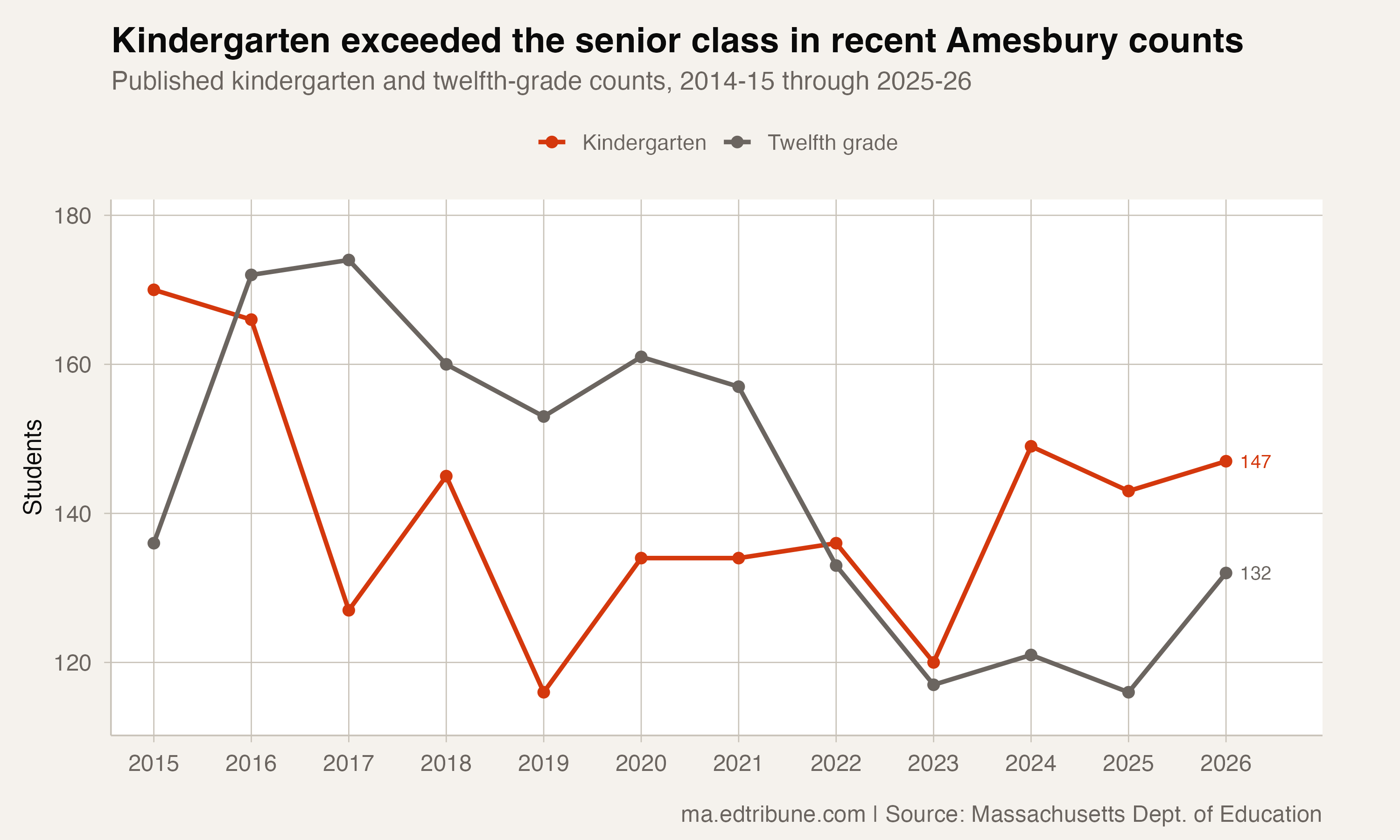
Amesbury's kindergarten class in 2025-26 was 147 students. Its senior class was 132. The kindergarten class has been the larger of the two in each of the last five published years, after being the smaller one in each of the six years before that. The kindergarten low in this record was 116, in 2018-19.
Those are twelve annual snapshots, not a forecast. They do not establish what enrollment will be in the current 2026-27 school year or how many of those kindergartners will remain through high school. Zadravec's expectation of modest growth and his assessment of the district's capacity are his own.
He says it has room.
"We have the facilities to handle that growth and will be discussing over the next year how that could impact growth of programs and opportunities in our schools," he wrote.
The groups within the total
The total does not show how many students the district reports in particular eligibility and service groups.
In 2025-26, Amesbury reported 594 low-income students, or 32.8% of the district. The number of reported English learners went from 35 students in 2014-15 to 100 in 2025-26, or 5.5% of enrollment. The district also reported 425 students receiving special education services, 23.4% of enrollment, in 2025-26. These groups overlap and should not be added together.
Massachusetts uses different eligibility rules for its current low-income measure and its earlier economically disadvantaged measure.
Those counts give another view of a district whose total stayed in a narrow range for five published years. They describe reported groups, without establishing why eligibility or service counts changed. Zadravec's proposed discussion of programs and opportunities will have to consider more than the district's overall size.
Whether the increase he expects arrives is not something these headcounts can answer yet. What they show is five reported years within a 38-student band, with annual rises and falls rather than uninterrupted growth.
Enrollment figures come from the Massachusetts Department of Elementary and Secondary Education. This comparison runs from 2014-15 through 2025-26, last school year. Amesbury's full published grade categories reconcile to its district total; shares above use the published district total. Stephen Zadravec responded in writing and supplied the professional headshot.
Detailed code that reproduces the analysis and figures in this article is available exclusively to EdTribune subscribers.
Discussion
Sign in to join the discussion.
Loading comments...