
Dr. Christine Pruitt did not need a map of Easton↗ET when she became its superintendent on July 1. She had been the district's assistant superintendent, and the Easton School Committee chose her for the top job by a unanimous vote after hearing her presentation at a February meeting, the district announced. She succeeded Dr. Lisha Cabral, who retired.
Asked in writing what drew her to the role now, Pruitt began with the district itself.
"Easton has been my professional home for many years, and I care deeply about this district, our students, our staff, and our community," she said in written responses to The MAEdTribune. "When the opportunity arose to serve as Superintendent, it felt like the right time to use what I had learned to help lead the district forward."
She named four early priorities. "My early priorities center on communication, culture and morale, instructional leadership, and strategic fiscal leadership," Pruitt said. "Most importantly, I want to spend this first year listening and learning, being present in our schools, hearing from our staff, students, families, and the community, and building on the many things that Easton already does well."
Her training runs through one institution. Boston College's Lynch School of Education and Human Development reported in May that she earned her bachelor's degree in elementary education and her master's degree there and was completing a doctorate in educational leadership at the same school, which makes her what the university calls a Triple Eagle. Pruitt told The MAEdTribune that she completed the doctorate in May 2026. The Boston College report also said the School Committee's approval of her appointment was unanimous.
An insider with a new lens
A leader promoted from inside a district starts with an advantage and a task: she already knows how things work, and she has to show families she will still look at the district fresh. Pruitt took that on directly when asked what she wants families to know about her.
"I hope families know that my history in Easton is something I value tremendously, but I also recognize that becoming Superintendent requires me to see the district through a new lens," she said. "I know our schools, our community, and many of the people who make Easton special, but I don't assume that means I know every perspective or have every answer."
She followed with a set of commitments. "I want families to know that I will listen, I will be visible, and I will make decisions with students at the center," Pruitt said. "I believe strongly that every child deserves to feel that they belong, that they are challenged, and that they have meaningful opportunities to grow."
She made a similar case to the School Committee before the vote. "My leadership is anchored in one belief: instruction first, people always," Pruitt told the committee, according to the district's announcement.
A smaller district, and a different one
Easton enrolled 3,297 students in 2025-26, the most recent school year in the state's published data. That is 498 students fewer than in 2014-15, a decline of 13.1 percent, more than twice the statewide drop of 5.8 percent over the same years. Counts for the current 2026-27 school year will differ once Massachusetts publishes them.
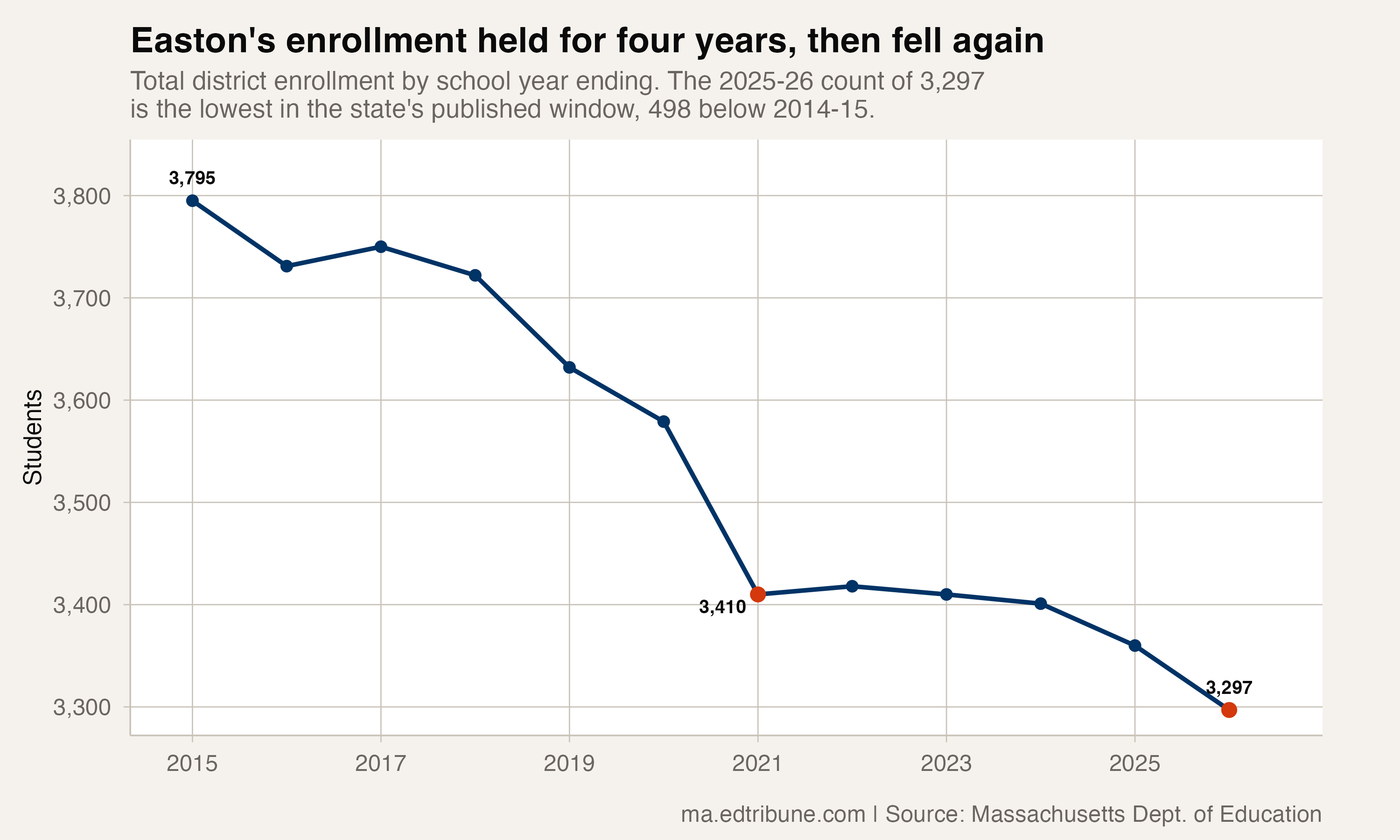
The decline did not arrive at a steady pace. The largest single-year loss in the state's files, 169 students, came between 2019-20 and 2020-21. Enrollment then held between 3,401 and 3,418 students for four straight reporting years, through 2023-24, before falling again: by 41 students in 2024-25 and by 63 in 2025-26. That most recent drop, 1.9 percent, was a little steeper than the 1.7 percent statewide decline the same year.
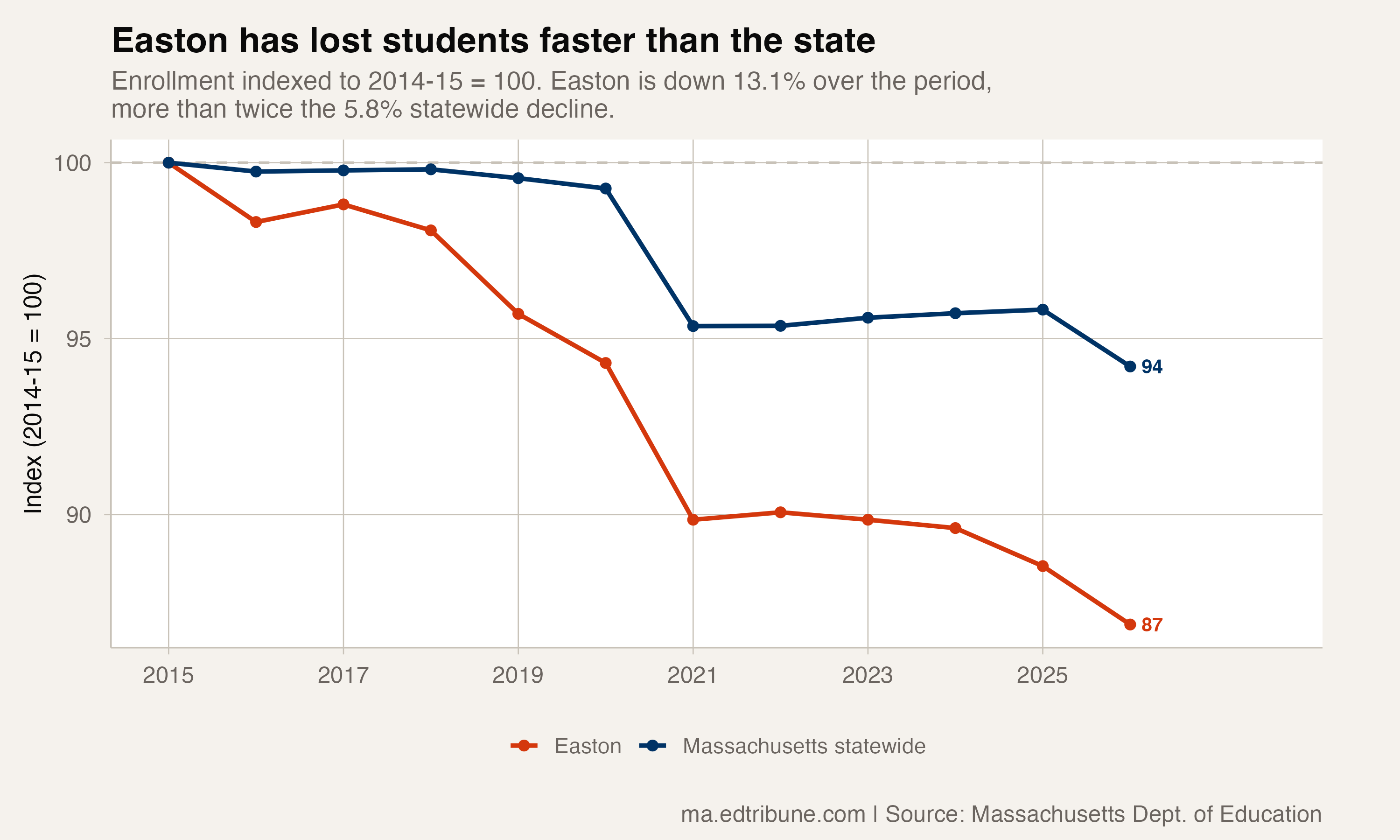
The district's footprint changed along the way. The state's school-level files list six Easton schools every year through 2021-22 and four from 2022-23 on.
Pruitt was asked how the enrollment trend shapes her planning, and her answer pushed back on reading the headcount alone.
"Enrollment is an important part of our long-term planning, and we look closely at both current enrollment and future projections," she said. "While our overall enrollment has shifted, the needs of the students we serve have also changed, so we cannot look at enrollment numbers in isolation."
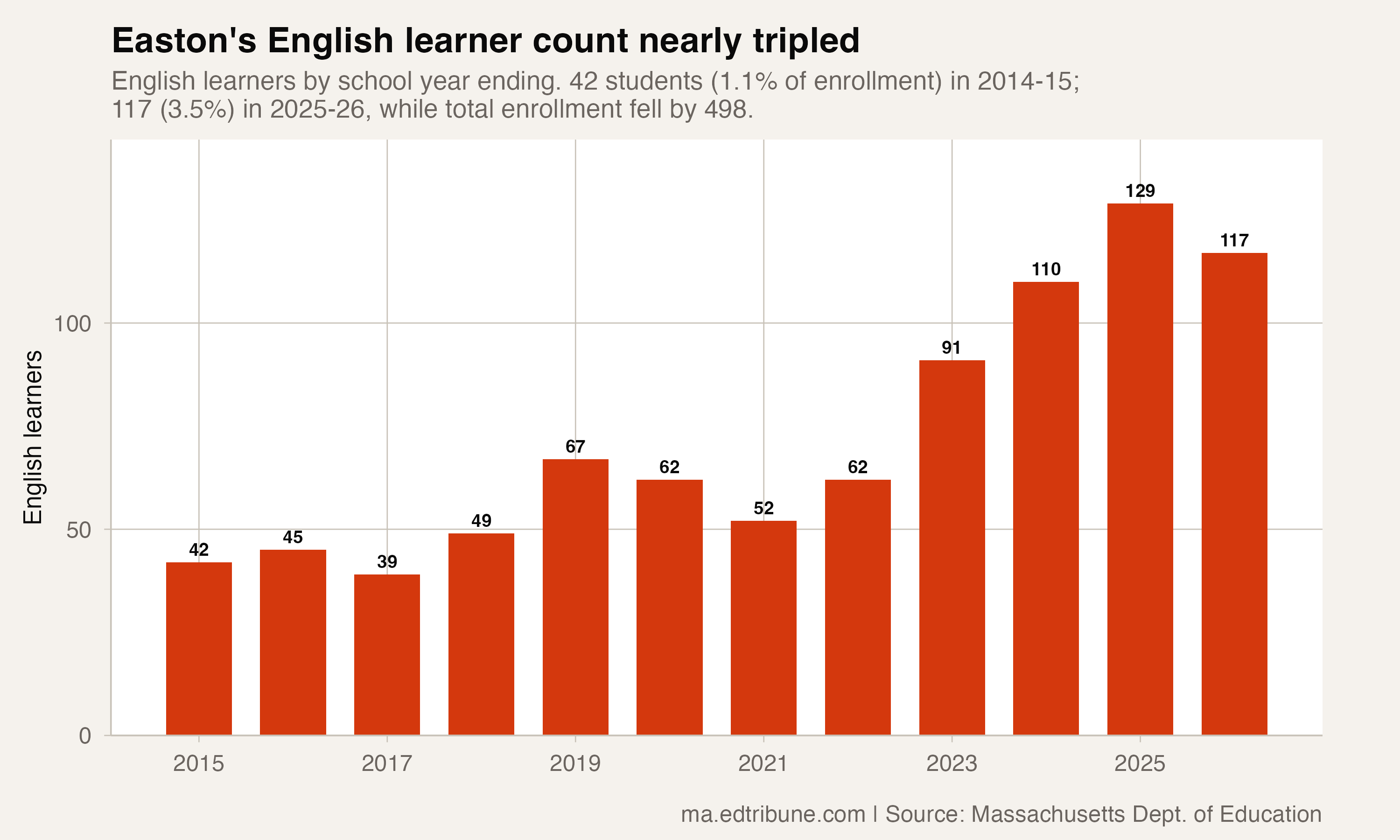
The state data bear out the second half of that sentence. Easton counted 42 English learners in 2014-15, 1.1 percent of its students. By 2025-26 it counted 117, or 3.5 percent, nearly triple the earlier number inside a district that had shrunk. The count peaked at 129 in 2024-25. Easton's share remains well below the statewide figure of 13.4 percent, but the change means more of the district's students are learning English while they learn everything else.
Special education moved the other way in raw numbers and the same way as a share. The district served 630 students with disabilities in 2014-15 and 596 in 2025-26, but because total enrollment fell faster, their share of enrollment rose from 16.6 percent to 18.1 percent. The statewide share in 2025-26 was 21.3 percent. English learners and students with disabilities are overlapping groups, so the two shares should not be added together. The state files record what changed; they do not say whether new families, identification practices, or program decisions drove either line.
Planning for what comes next
Pruitt's answer on planning named the pieces she says have to be weighed together.
"Our planning must consider class sizes, student needs, programming, facilities, and the resources needed to provide a strong educational experience across all four of our schools," she said. "My focus is on making thoughtful, sustainable decisions that allow us to respond to changing enrollment while continuing to invest in the opportunities and supports our students need to be successful."
She also mentioned the district's own enrollment projections. Those belong to the district and are not part of the state's published data, and no projection is reported here.
The year she has set out is one of listening before deciding. The state record gives that year a specific question to carry into the schools she visits: how to keep investing in programs and supports for a student body that is smaller than it was in 2014-15 and whose needs, on the evidence of the state's own files, have shifted.
Enrollment, school, English learner, and special education figures come from the Massachusetts Department of Elementary and Secondary Education data files covering the 2014-15 through 2025-26 school years. Quotations are from Christine Pruitt's written responses to The MAEdTribune, except her remarks to the School Committee, which are attributed to the linked district announcement. Appointment, predecessor, and education details are attributed to the linked Easton Public Schools and Boston College sources, except the completion date of her doctorate, which she provided. Pruitt supplied the headshot used with this profile.
Detailed code that reproduces the analysis and figures in this article is available exclusively to EdTribune subscribers.
Discussion
Sign in to join the discussion.
Loading comments...