Nancy Milligan did not arrive in Tewksbury↗ET needing an introduction. She had been the district's assistant superintendent since 2024, and on July 1 she moved up into the superintendency. The Tewksbury Public Schools superintendent's office page now lists Dr. Nancy Milligan as superintendent, and she confirmed her first day in writing to The MAEdTribune.
"Having served as Assistant Superintendent since 2024, I step into the superintendency with a deep, grounded understanding of our schools, operational structures, and community values," Milligan said in written responses. "That continuity eliminates a typical learning curve, allowing our administrative team to maintain momentum on district priorities without disruption."
The School Committee's May 27 minutes introduce Milligan as superintendent of schools among four incoming administrators, and record the committee approving Jason Stamp as assistant superintendent, on the superintendent's recommendation, by a unanimous vote. At the June 10 meeting, Milligan spoke at Brenda Theriault-Regan's retirement recognition and the committee voted to name the loop around the Ryan and Center schools in her predecessor's honor.
What Milligan says she plans to do first is listen.
"In my first year, I am leveraging this baseline through a structured Listening and Learning Tour to gather comprehensive stakeholder feedback in this new role to ensure my leadership represents our staff and community priorities," she said.
Asked what families and staff should understand about how she intends to lead, she named three things.
"I want our families and staff to know that my leadership is anchored in equity, transparency, and authentic relationships," Milligan said. "My foundational commitment is ensuring that every single student receives equitable access to high-quality education and robust support systems for success."
She described her own decision-making in similar terms. "My decision-making approach is direct, transparent, and grounded in data, balancing clear accountability with deep support so that educators feel valued and empowered to help students succeed," she said.
A record that moved in two directions
The enrollment record Milligan inherits reads differently depending on where the count starts. Tewksbury enrolled 3,271 students in 2025-26, last school year and the most recent published year verified here. That is 387 students fewer than in 2014-15, a drop of 10.6 percent, against a statewide decline of 5.8 percent over the same years. Counts for the current 2026-27 school year are outside this comparison.
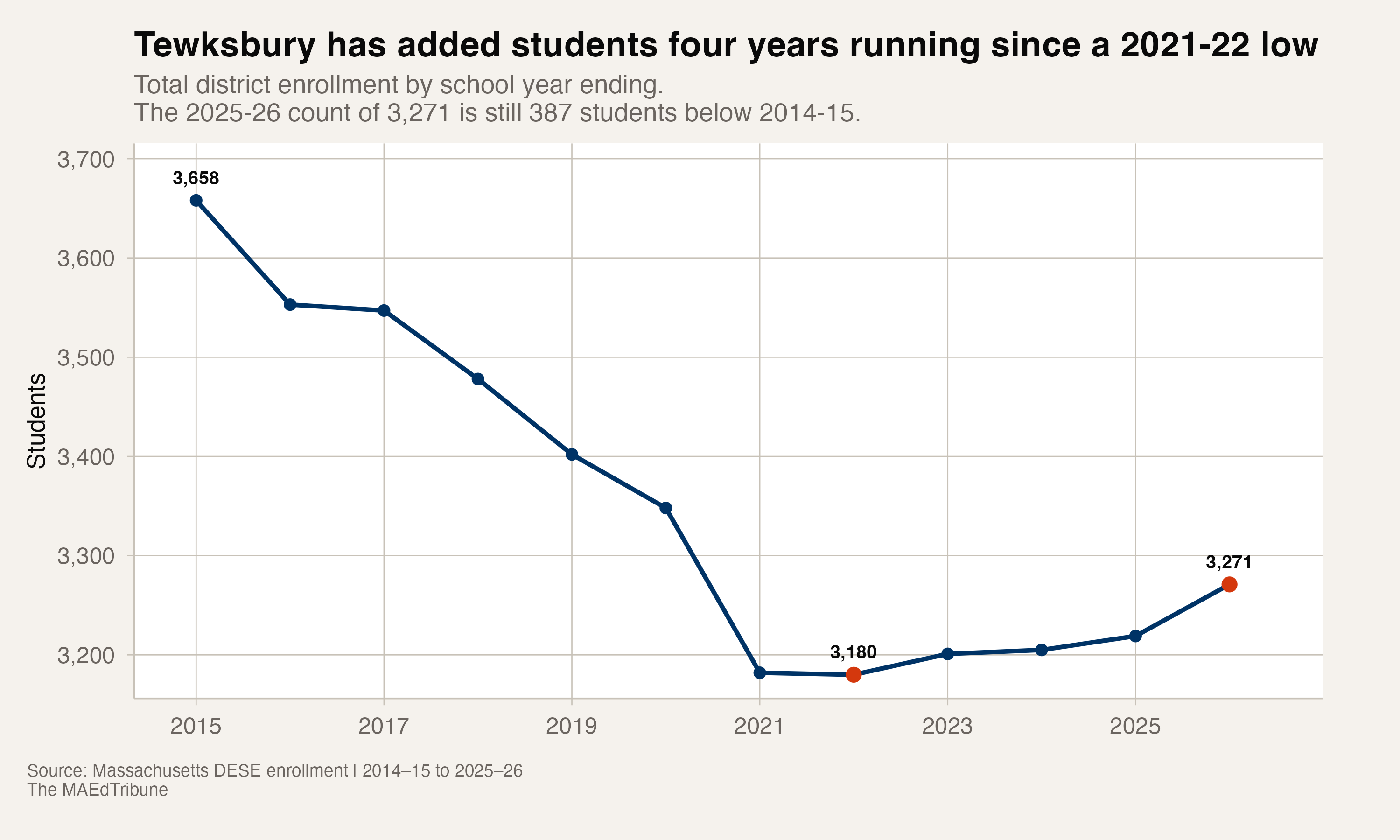
The low point, though, is four years behind the district. Enrollment bottomed at 3,180 students in 2021-22 and has risen in every year since, adding 91 students, or 2.9 percent. The most recent year produced the largest of those gains, 52 students or 1.6 percent, in a year when the statewide total fell 1.7 percent.
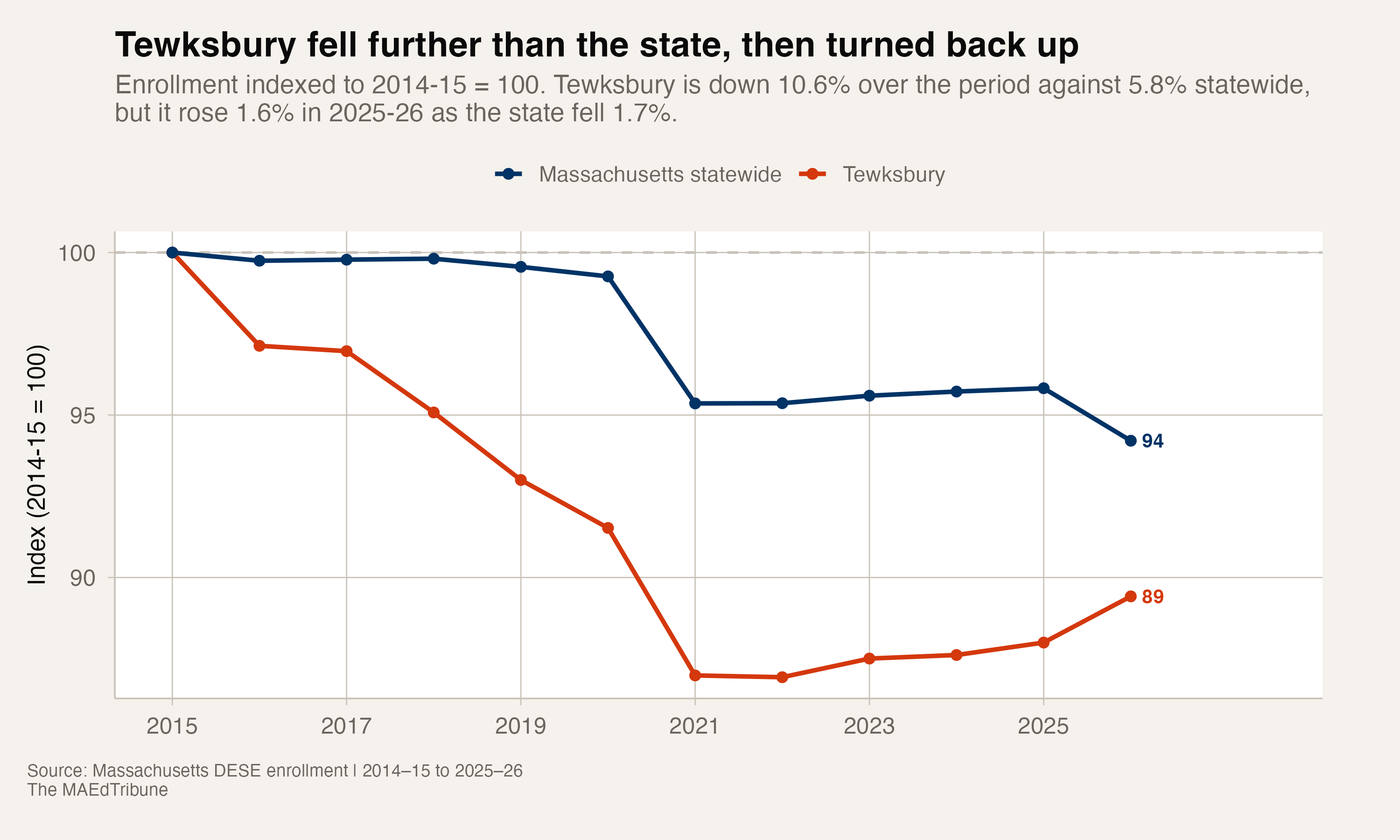
Milligan connects that turn to how families see the district. She described the recovery from the 2021-22 low as evidence of a strong school reputation, and said families are choosing to raise their children in Tewksbury. She pointed to one part of the enrollment record in particular.
"Our PK–6 grade totals have shown consistent strength, indicating that local families are actively choosing and staying in Tewksbury Public Schools," she said.
The grade-level files show an increase in PK-6 enrollment. Those grades held 2,027 students in 2025-26, the highest count in the twelve-year comparison from 2014-15 through 2025-26 and above the starting level of 1,998. Grades 7-12 moved the other way, from 1,652 students in 2014-15 down to 1,236, a loss of 416 students or 25.2 percent. The district's entire net decline across the period sits in the upper grades. Its kindergarten class was larger than its senior class in 2025-26: 273 kindergartners against 189 seniors.
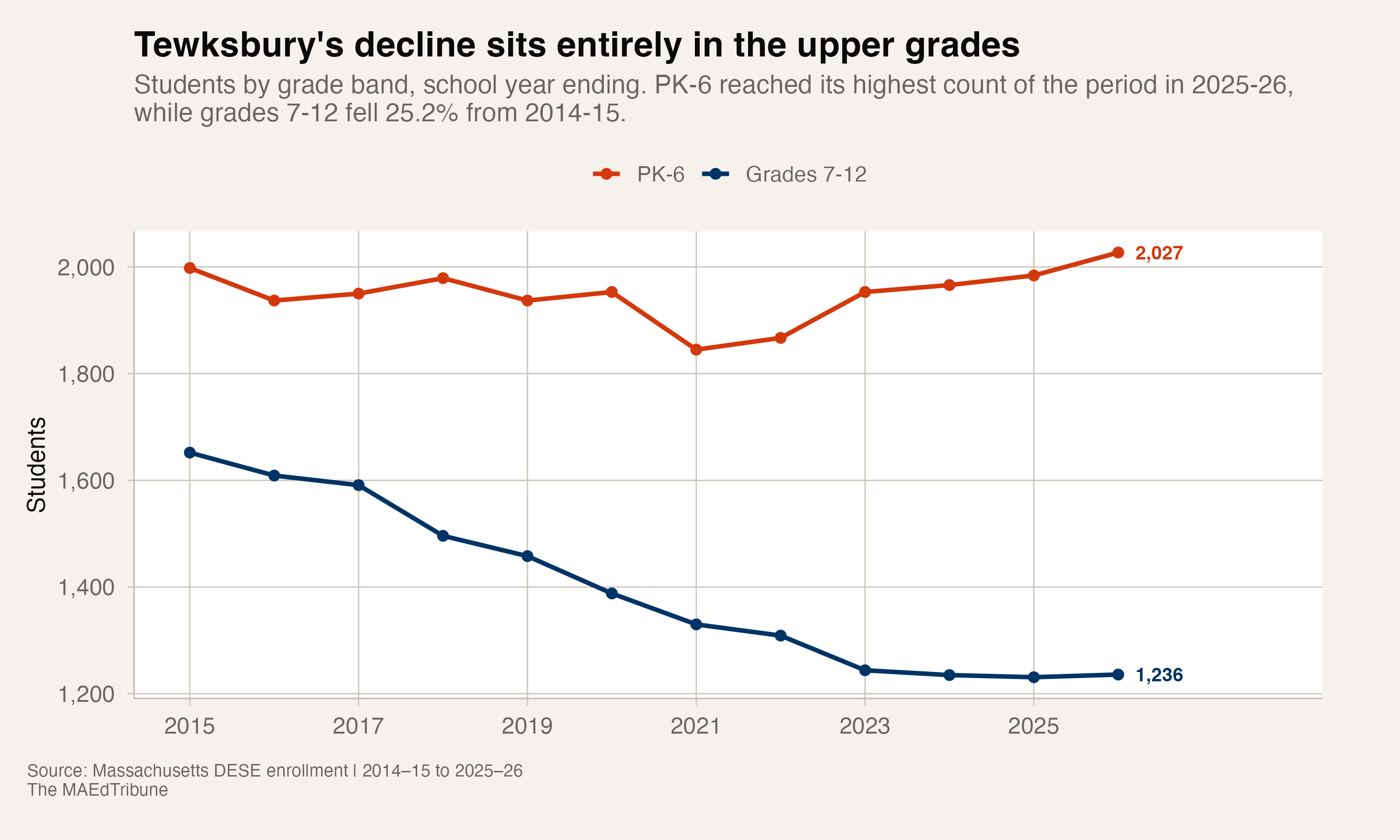
What the state files cannot do is say why. They show a higher PK-6 count in 2025-26 than in any other year of this comparison. Earlier published years had higher counts, so this is not an all-time high. The files do not show whether a family moved to town for the schools, stayed because of them, or arrived for reasons that have nothing to do with the district. Milligan's reading of the cause is her own, and the enrollment data neither confirms nor contradicts it.
She also pointed to projections that sit outside the state record. "According to our multi-year NESDEC demographic projections, we expect this positive trend to hold," she said. "The data forecasts steady, manageable enrollment growth over the coming decade as these larger elementary cohorts progress through middle and high school." Those projections belong to the district and are not part of the state's published data.
The service mix underneath
Another part of the record concerns special education. Tewksbury counted 678 students receiving special education services in 2025-26, or 20.7 percent of enrollment, up from 17.7 percent in 2014-15 and just under the statewide share of 21.3 percent. As with the headcounts, the files record what changed without explaining whether student needs, identification practice, placement decisions, or in-district programming drove it. They do give a size to the support systems Milligan says every student should have.
Her first year, as she describes it, is built to take information in before it commits to a direction. The enrollment record hands that tour one specific question to carry. Tewksbury's elementary grades reached their high for this twelve-year comparison, while its secondary grades were a quarter smaller than in 2014-15. How the larger elementary cohorts change secondary enrollment is a question for later headcounts.
Enrollment, grade-level, and special education figures come from the Massachusetts Department of Elementary and Secondary Education data files. The comparison covers 2014-15 through 2025-26; earlier published years are excluded from its high-point claim. Quotations are from Nancy Milligan's written responses to The MAEdTribune. Appointment, governance, and retirement details are attributed to the linked district and School Committee sources.
Detailed code that reproduces the analysis and figures in this article is available exclusively to EdTribune subscribers.
Discussion
Sign in to join the discussion.
Loading comments...