
Christopher Bowen started July 1 as principal of Chelsea Opportunity Academy, bringing a career shaped by alternative education, student support systems and personalized pathways to a high school in Chelsea↗ET that reported 115 students last school year, 2025-26.
Chelsea Opportunity Academy's staff page lists Bowen as principal. In an email to The MAEdTribune, Bowen described the move as a return to the work that first pulled him toward school leadership.
A Return to the Work That Started It
"What drew me to Chelsea Opportunity Academy is that it sits at the intersection of many of the things I have cared most about throughout my career," Bowen said. He pointed to students who have experienced academic failure, disconnection, interrupted schooling, trauma or responsibilities outside school, and said COA's belief that "every day is a new day" fits his own philosophy.
Bowen comes to Chelsea after leading Revere High School. In his written reply, he connected his work in Revere to competency-based and restorative practice and described the move to Chelsea Opportunity Academy as a return to the kind of work that first inspired him to become a school leader.
His path to the principalship has followed that same thread. When Revere named him principal in 2022, the Revere Journal reported that Bowen began as a high school mathematics teacher, mostly at Framingham High School, and had experience designing and leading programs for students who needed additional support. The same report said he had served as assistant principal of Revere High School's Freshman Academy and held degrees in mathematics, sociology and educational leadership from Boston College.
Bowen said he loved leading a large comprehensive high school, but that a smaller school gives leaders a different kind of connection to daily student life.
"There is something powerful about working in a smaller school community where relationships can be deeper, systems can be more responsive, and leaders can remain closely connected to the daily experiences of students and staff," Bowen said.
The Scale of the School
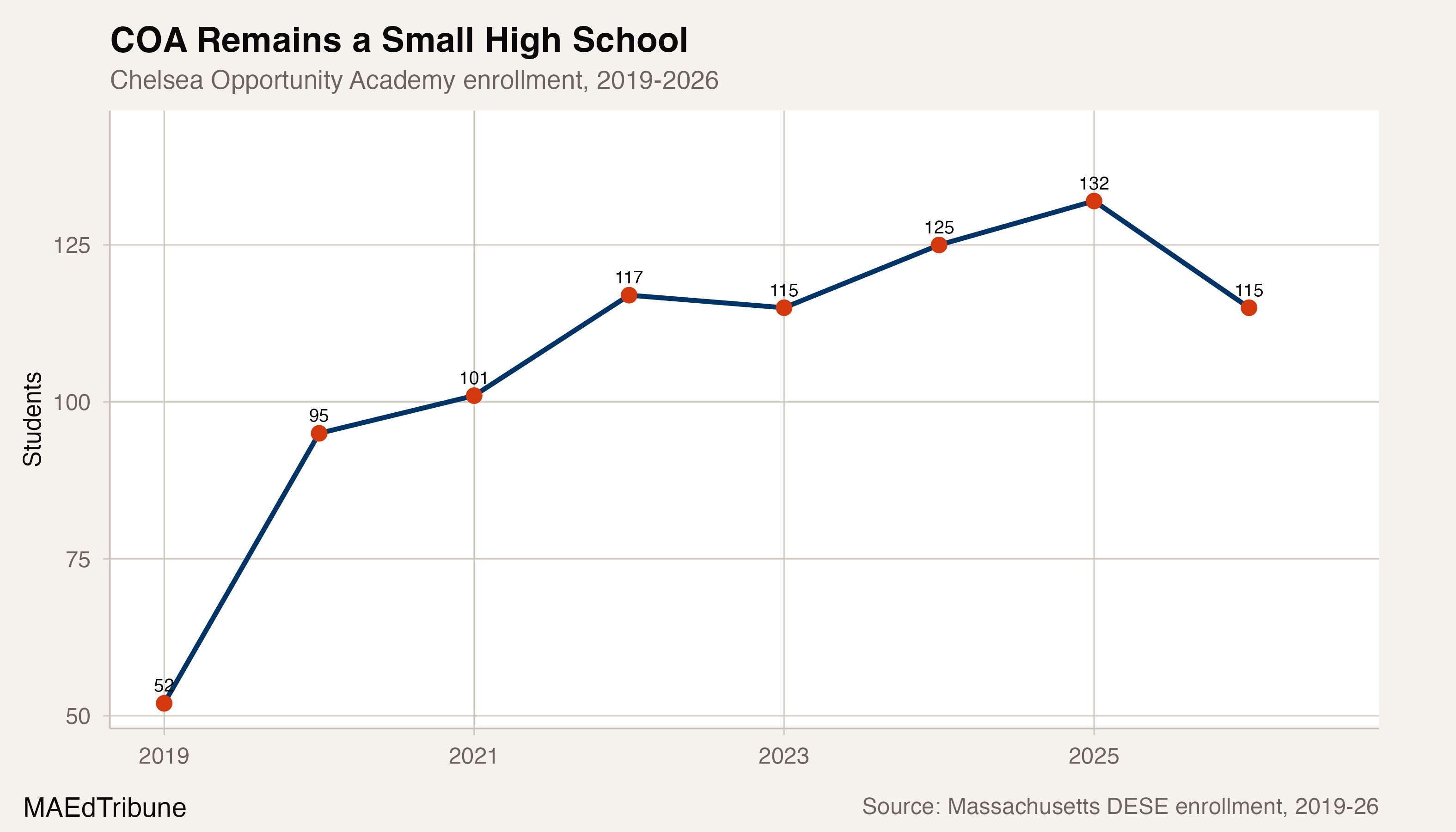
State enrollment data show Chelsea Opportunity Academy grew from 52 students in 2018-19 to 132 in 2024-25, then fell to 115 last school year, 2025-26, the most recent year in the published record.
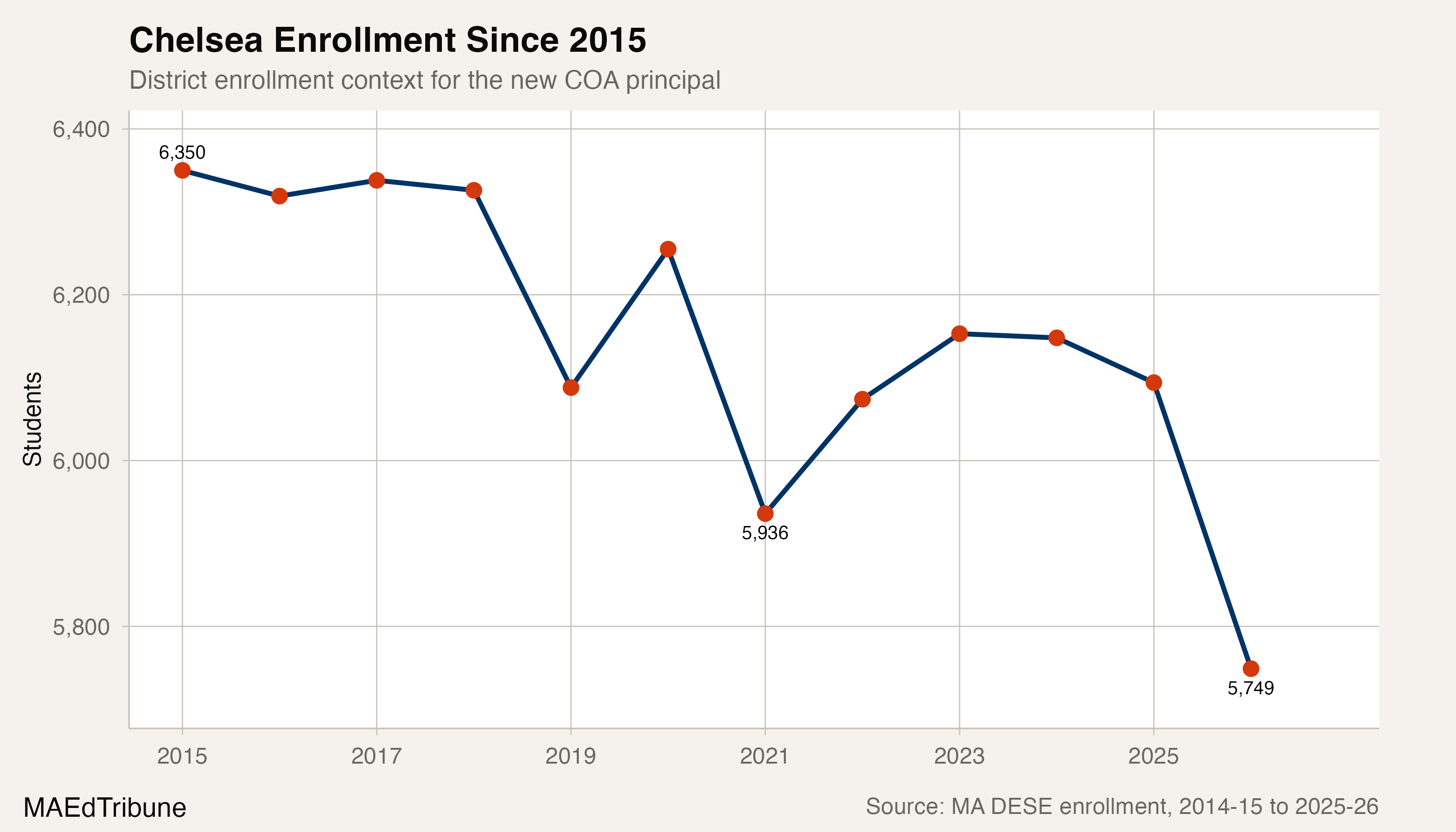
The broader district is also navigating enrollment pressure. Chelsea reported 5,749 students last school year, 2025-26, down 601 students, or 9.5%, since 2014-15. Statewide enrollment fell 5.8% over the same period. Chelsea's latest published year-over-year decline was 345 students, a 5.7% drop.
Those numbers are not the story Bowen told about the school. They are the operating context for the work he described: a small setting where each student's attendance, credit progress and sense of belonging can materially change the school's trajectory.
Belonging as an Academic Strategy
Bowen's reply kept returning to relationships. "The first thing I hope students and families feel under my leadership is that they are known, valued, and believed in," he said. "Strong relationships are not separate from academic success; they are the foundation that makes it possible."
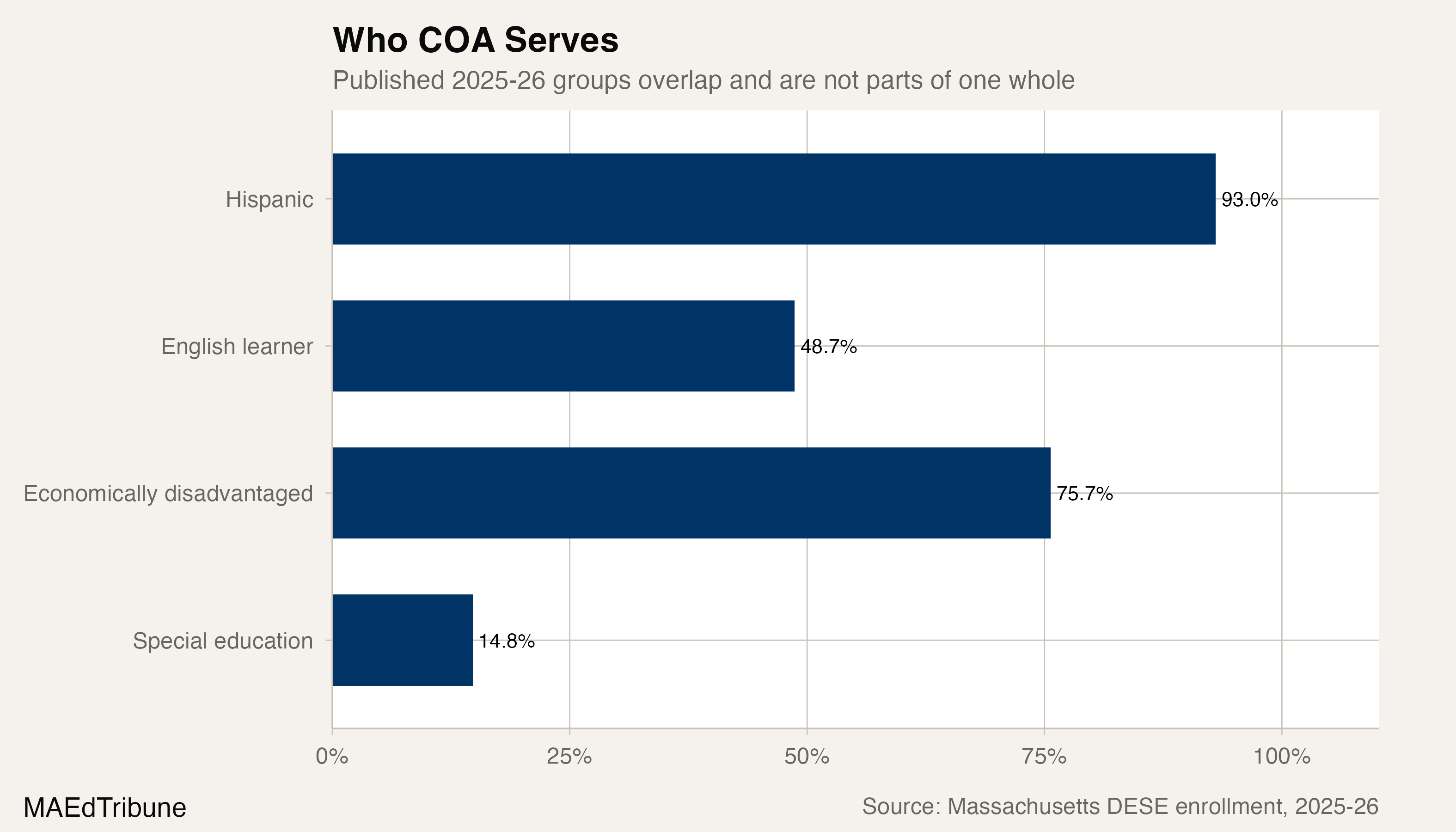
Last school year, 2025-26, Chelsea Opportunity Academy reported a student population that was 93.0% Hispanic; 48.7% received English learner services, 75.7% were economically disadvantaged and 14.8% received special education services in the state's most recent published data. Those categories overlap, so they should not be added together. They describe different dimensions of the school's student population and service needs.
Bowen said families should feel they have "a true partner in the school," and that students should be seen for their strengths and potential rather than for past challenges. State attendance data show the scale of the challenge he is inheriting.
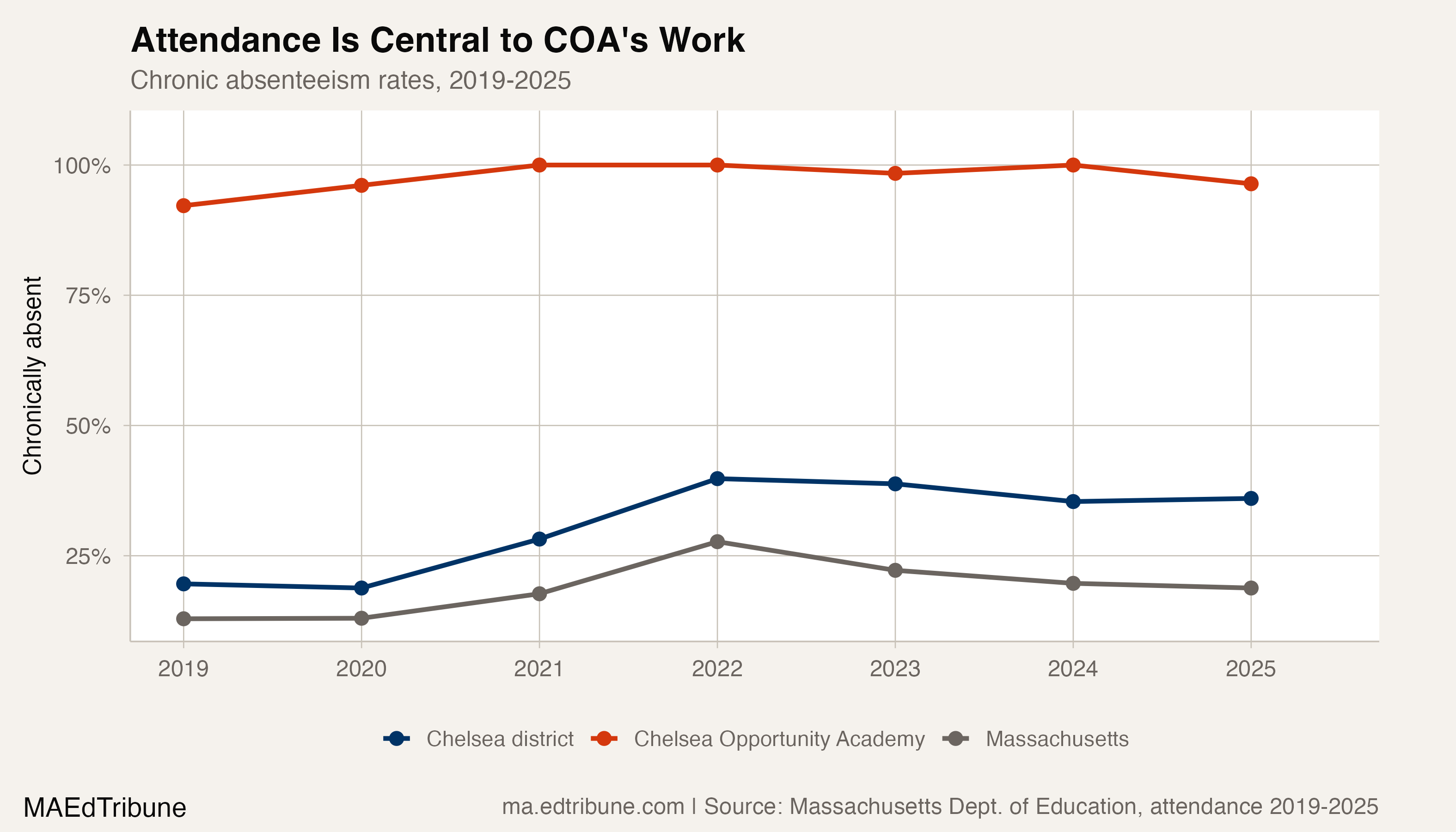
In 2024-25, 96.4% of Chelsea Opportunity Academy students were chronically absent, down from 100.0% the year before. The districtwide rate was 36.0%, while the Massachusetts rate was 18.8%. The school's average student missed 77.8 days in 2024-25.
Bowen did not frame attendance, credits and belonging as separate problems. He described them as one system.
"In a school the size of COA, attendance, credits, and belonging are deeply interconnected," Bowen said. "Students are more likely to attend when they feel connected to the adults and peers around them, when they see progress toward graduation, and when they can envision a future that makes the effort feel worthwhile."
What Comes Next
The appointment moves Bowen from a comprehensive high school to a smaller setting. The school reported 115 students in 2025-26, and its latest attendance data predate his tenure. Bowen's career has included math teaching, alternative programming, ninth-grade transition work and competency-based learning before his move to a school organized around students who need a different route.
His stated goal is to build on the foundation already in place at COA while strengthening adult relationships, graduation pathways and relevant learning experiences.
"When students experience a sense of belonging and purpose, improvements in attendance and credit attainment often follow," Bowen said. "My goal is to build on the strong foundation already in place at COA while continuing to create the conditions that help every student engage, persist, and thrive."
Detailed code that reproduces the analysis and figures in this article is available exclusively to EdTribune subscribers.
Discussion
Sign in to join the discussion.
Loading comments...