In this series: Massachusetts Chronic Absenteeism.
In Framingham↗ET, a MetroWest suburb where Hispanic students now make up roughly half the district, 40.9% of those students were chronically absent in the 2024-25 school year. The rate for white students in the same district: 17.0%. That 23.9-point chasm is not an outlier. It is the local expression of a statewide pattern that COVID made worse and three years of recovery have failed to fix.
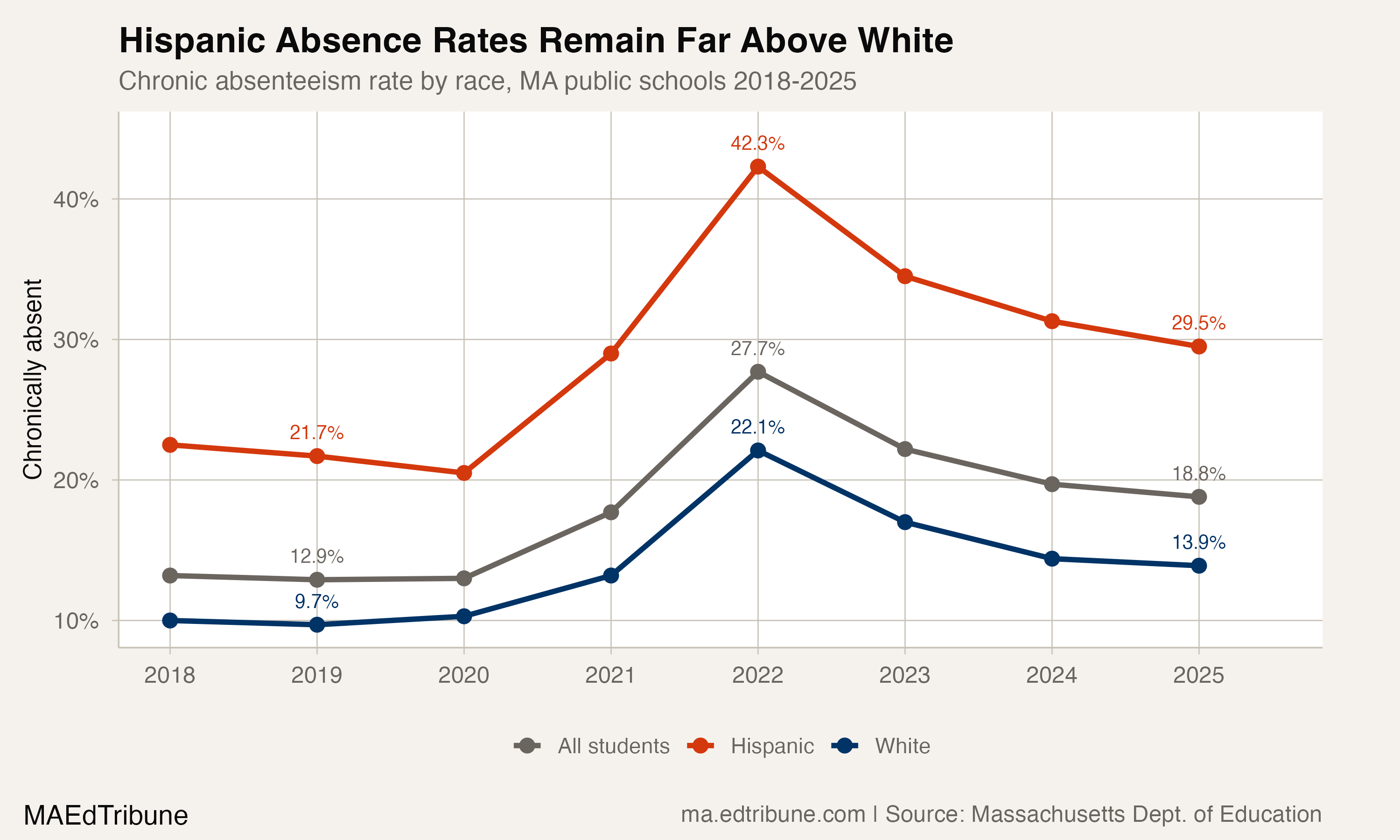
Across Massachusetts, 29.5% of Hispanic students are chronically absent, the highest rate of any racial group. The gap between Hispanic and white students stood at 12.0 percentage points before the pandemic. It exploded to 20.2 points at the 2022 peak. It has since narrowed, but only to 15.6 points, still 3.6 points wider than the pre-COVID baseline. For a state that prides itself on leading the nation in educational outcomes, that widening represents a structural failure that no amount of statewide improvement can paper over.
Inside the 15.6-point gap
Before COVID, one in five Hispanic students was chronically absent. Now it is closer to one in three.
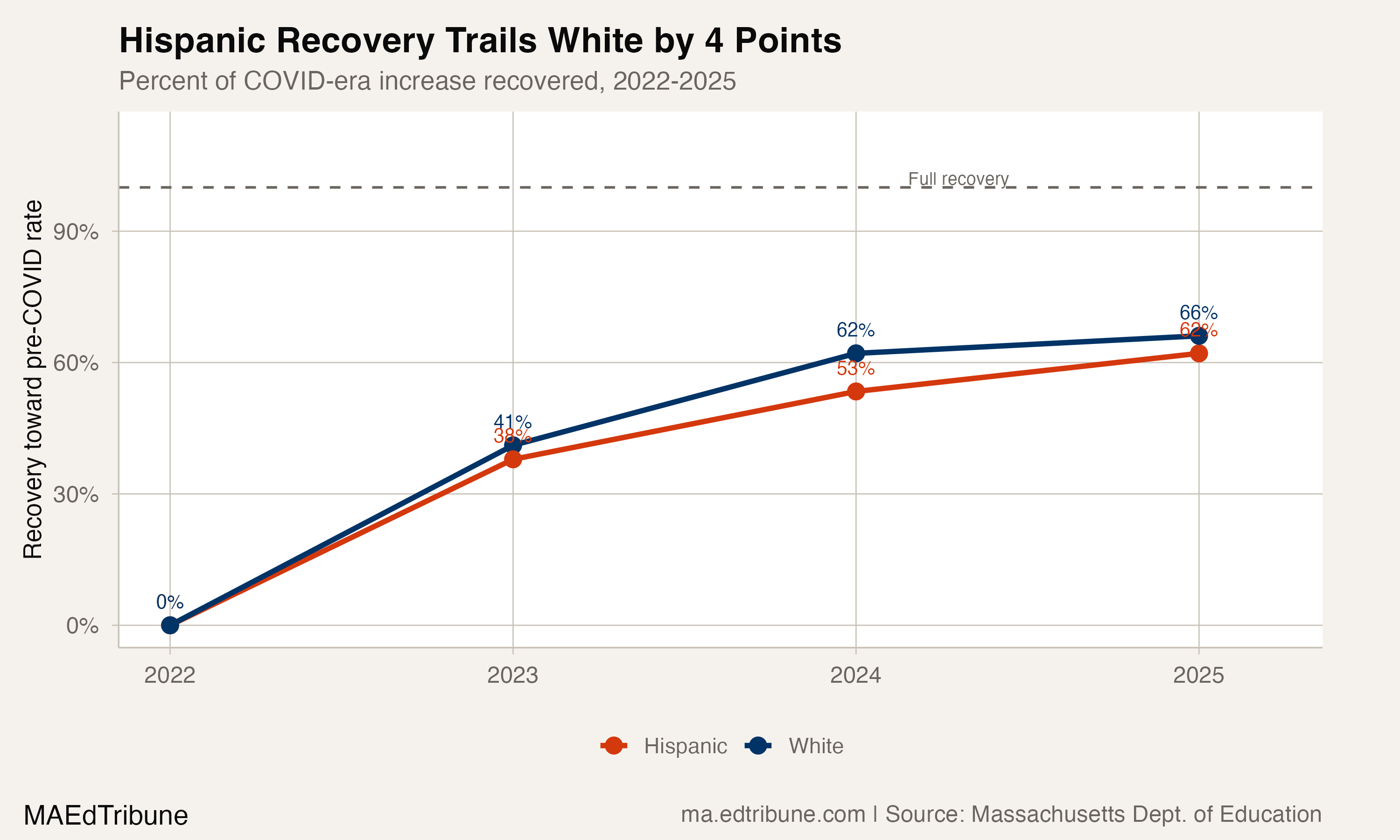
The trajectory tells the story of unequal impact and unequal recovery. Hispanic chronic absenteeism climbed from 21.7% in 2019 to 42.3% in 2022, a near-doubling. White rates rose too, from 9.7% to 22.1%, but the proportional surge was smaller. Both groups have recovered ground since, but not at the same pace: white students have clawed back 66.1% of their COVID-era increase, while Hispanic students have recovered only 62.1%. The result is a gap that remains stubbornly wider than it was before the pandemic reshaped school attendance nationwide.
That 3.6-point widening is the second-largest of any racial group. Native American students saw the widest expansion, with their gap over white students growing by 4.2 points since 2019. The Black-white gap, by contrast, widened by just 0.3 points, to 6.8. Every non-white group's gap widened except Asian students, whose already-favorable gap actually grew slightly in their favor.
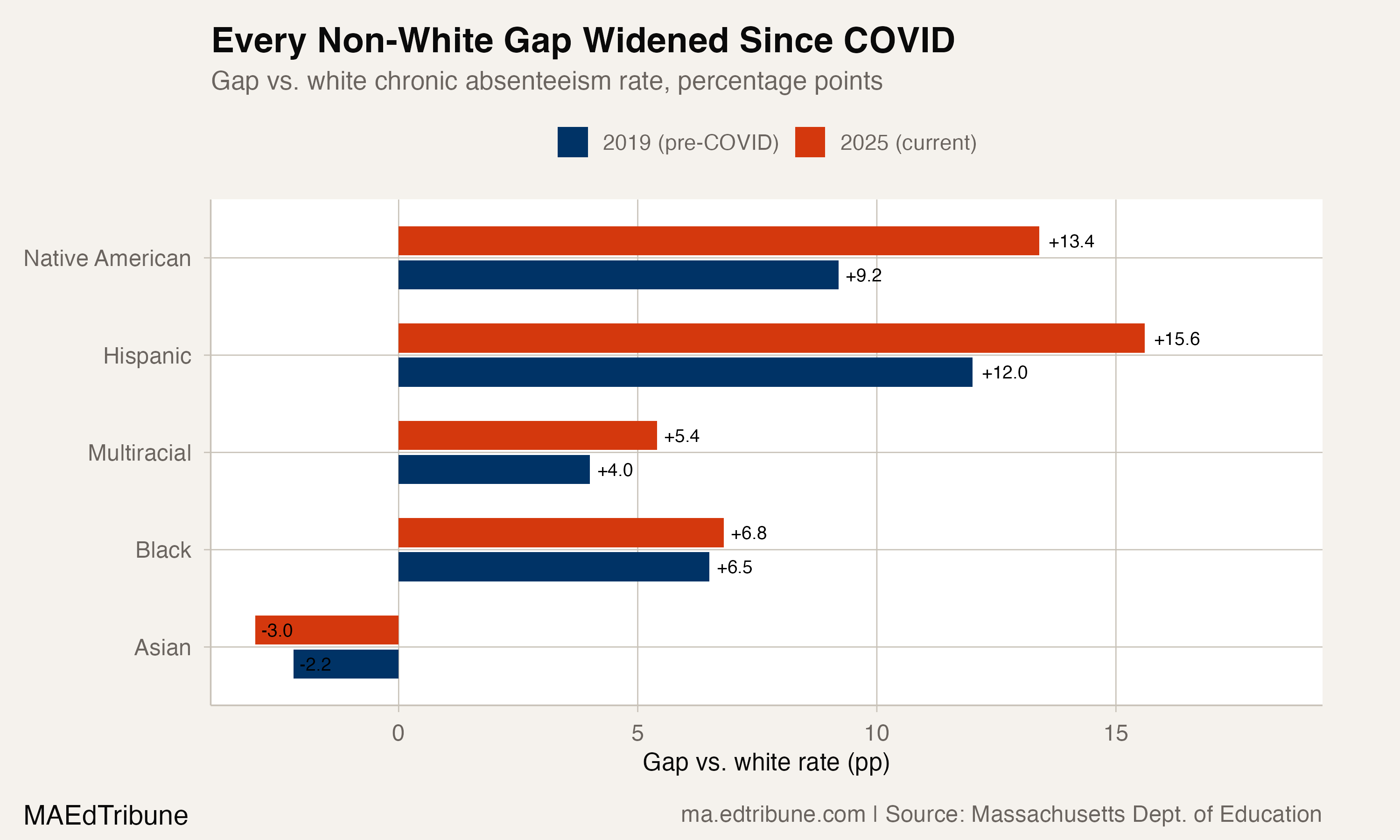
Hispanic students carry the largest absolute gap of any group: 15.6 points over white students, compared to 6.8 for Black students and 5.4 for multiracial students. The scale of the Hispanic disparity is distinct.
Where the gap lives: Gateway Cities and beyond
The statewide number masks enormous variation at the district level. In 102 of 382 districts reporting Hispanic absence data, more than 30% of Hispanic students are chronically absent. In 30 districts, the rate exceeds 40%.
Boston↗ET has the widest Hispanic-white gap among Gateway Cities at 23.1 percentage points. Hispanic chronic absence there stands at 40.7%, compared to 17.6% for white students. That gap has actually widened since 2019, when it was 15.1 points. The district's overall chronic absence rate, 33.0%, receives most of the public attention. The within-district racial gap receives less.
Holyoke↗ET, where 44.7% of Hispanic students are chronically absent, has the highest Hispanic rate of any Gateway City. Springfield↗ET follows at 36.5%, and Chelsea↗ET at 36.4%.
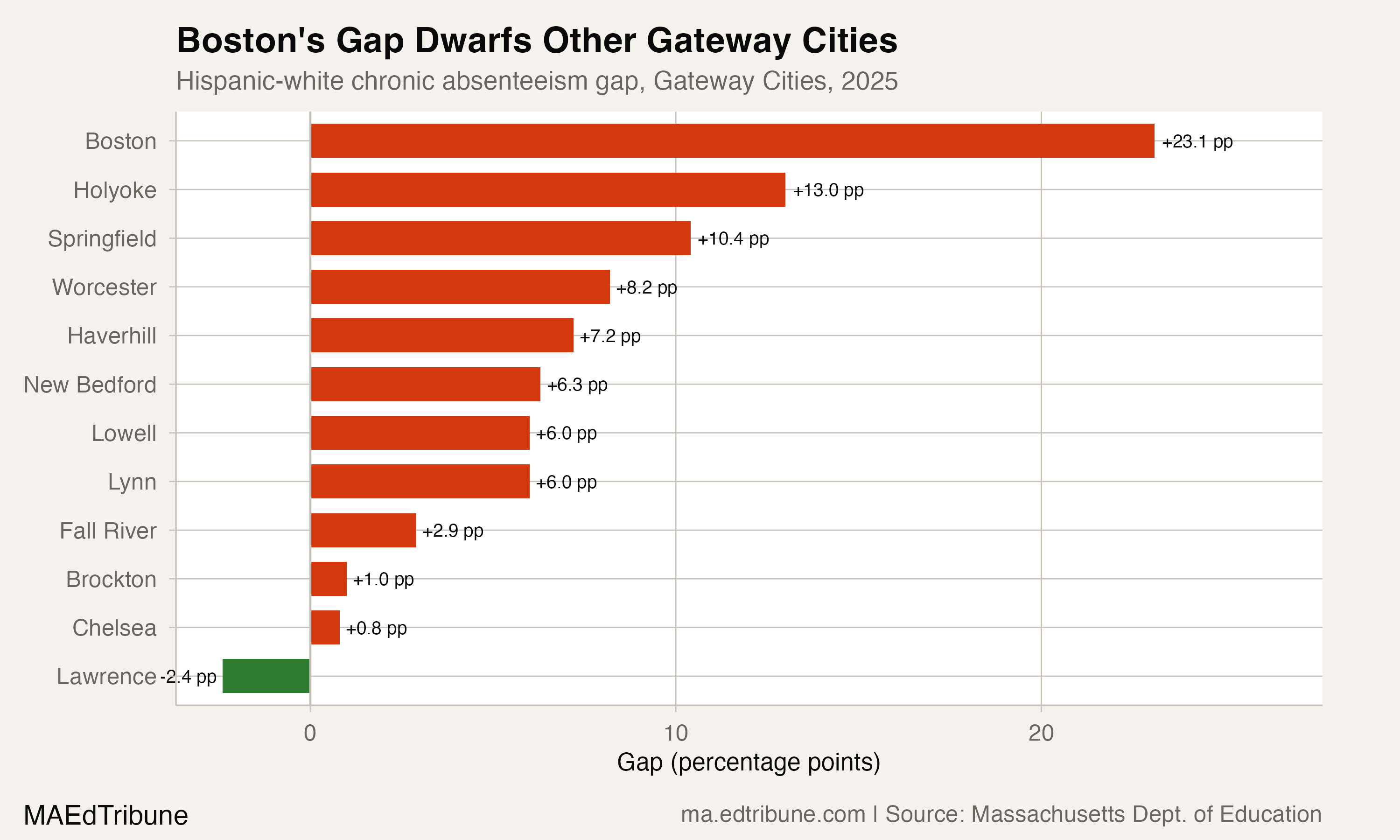
Then there is Lawrence↗ET. The city under state receivership since 2012 is the only Gateway City where the gap runs in reverse: white students (25.9%) are chronically absent at higher rates than Hispanic students (23.5%). Lawrence's overall rate of 23.3% is the lowest of any Gateway City, and its superintendent, Ralph Carrero, has credited a coalition of more than a dozen social service agencies and nonprofits holding monthly meetings about every student who is currently homeless and every student newly arrived in the country. Whatever Lawrence is doing, it is producing the only Gateway City attendance profile where Hispanic students are not disproportionately missing school.
Across all districts with data, 68.5% saw their Hispanic-white gap widen between 2019 and 2025. Only 31.5% saw it narrow.
The compounding forces behind the disparity
The gap did not widen because of a single cause. Multiple forces, some structural and some pandemic-specific, pushed Hispanic absence rates higher and held them there longer.
The most direct evidence points to economic instability. Hispanic households in Massachusetts face a poverty rate of 25%, more than four times the 6% rate for white households, according to a 2022 Boston Foundation report. More than half of Hispanic renters spend over a third of their income on housing. That housing instability translates directly into school disruption: students who move mid-year, who lack stable transportation, or whose parents work multiple shift jobs without flexibility to manage morning routines are less likely to attend consistently.
Transportation is a particular pressure point. Research by Latinos for Education documented that low-income Latino families in cities like Lynn, Springfield, and Worcester face compounding transit barriers: fare costs, unreliable schedules, and routes that do not connect homes to schools. One respondent described pulling her daughter out of school because she could no longer afford the commute after changing jobs.
Immigration enforcement adds another layer. As CommonWealth Beacon reported, Massachusetts lost more than 15,000 students between fall 2024 and fall 2025, with a large share of the decline concentrated among English learners, a group that overlaps heavily with Hispanic enrollment. The Chelsea superintendent has sought emergency state funding to offset the enrollment and budget hit. Whether enforcement actions directly reduce attendance or create a climate of fear that keeps families home, the effects fall disproportionately on Hispanic communities in Gateway Cities.
A 2025 Ed Trust survey of Massachusetts parents found that 37% of Latino parents reported their child had experienced unfair treatment due to race or ethnicity, compared to 21% of white parents. Latino parents also reported the lowest sense of safety from bullying, violence, and racism of any racial group. Whether these climate factors directly cause absence is hard to measure, but they shape how welcome students and families feel in school buildings.
Recovery stalled, not just delayed
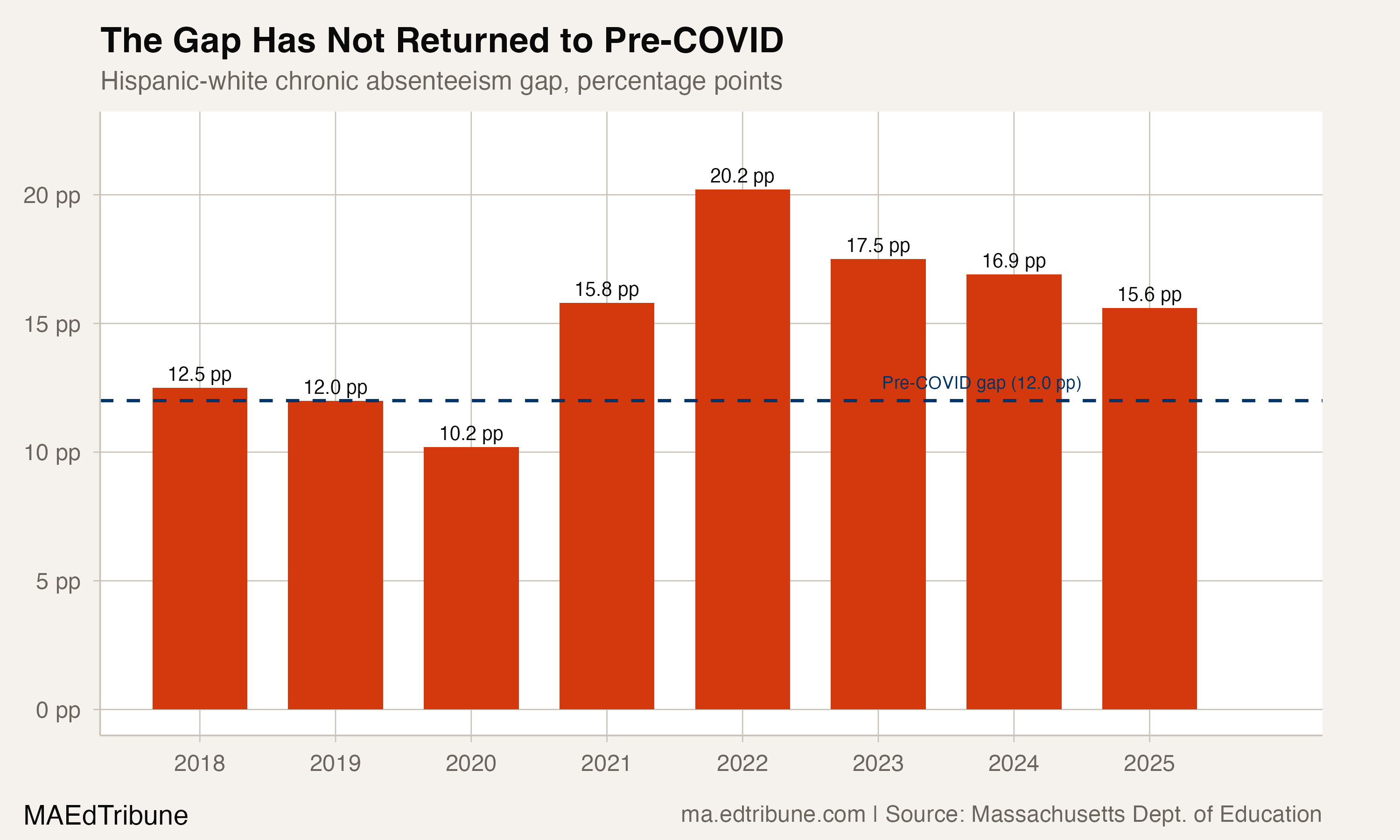
The gap briefly narrowed from its 2022 peak of 20.2 points, falling to 17.5 in 2023 and 16.9 in 2024. But in 2025 it dropped only to 15.6, a deceleration that mirrors the statewide recovery stall. The Boston Globe reported in July 2025 that at the statewide rate of improvement, Massachusetts would need another 21 years to return to pre-pandemic attendance levels. For Hispanic students, who remain 7.8 points above their pre-COVID rate compared to 4.2 for white students, that timeline is even longer.
The state's "Your Presence is Powerful" awareness campaign and universal free school meals represent system-wide interventions. But system-wide interventions produce system-wide results, and the gap is a story about differential impact. The forces holding Hispanic absence rates elevated, including poverty, housing instability, language barriers, and immigration enforcement, are not addressed by a poster campaign.
Former state education commissioner Jeff Riley called the absenteeism levels "something we've never seen before." The statewide numbers are staggering. The gap within them is worse.
What the state average hides
Massachusetts funds schools through Chapter 70, an enrollment-based formula that does not penalize districts for absence the way average daily attendance states do. Hispanic students who are chronically absent still generate full per-pupil funding for their districts. The fiscal signal that might force targeted intervention in an ADA state does not exist here. The consequence falls entirely on the students: lost instructional time, lower MCAS scores, higher dropout risk.
That instructional cost is not hypothetical. The 2025 MCAS results showed just 31% of Hispanic students passing 10th-grade English, a 5-point drop from 2024. Students who miss 18 or more days a year are not getting the same educational product as those who show up. The attendance gap and the achievement gap are not separate problems.
The question is whether the statewide recovery, now approaching a plateau at 18.8% overall, will close the racial gap or simply freeze it in place. Three years of data suggest the latter: the gap narrowed rapidly in 2023, slowed in 2024, and barely moved in 2025. If that deceleration holds, Massachusetts will settle into a new equilibrium where nearly one in three Hispanic students is chronically absent, and the system treats that as normal.
Detailed code that reproduces the analysis and figures in this article is available exclusively to EdTribune subscribers.
Discussion
Sign in to join the discussion.
Loading comments...