In this series: Massachusetts Chronic Absenteeism.
In Dover-Sherborn↗ET, girls were chronically absent at a rate of 6.8% in 2024-25. Boys: 3.8%. The gap, 3.0 percentage points, is more than four times the statewide female-higher gap. And it is not new. Girls in Dover-Sherborn were already missing more school than boys before the pandemic. COVID just widened the distance.
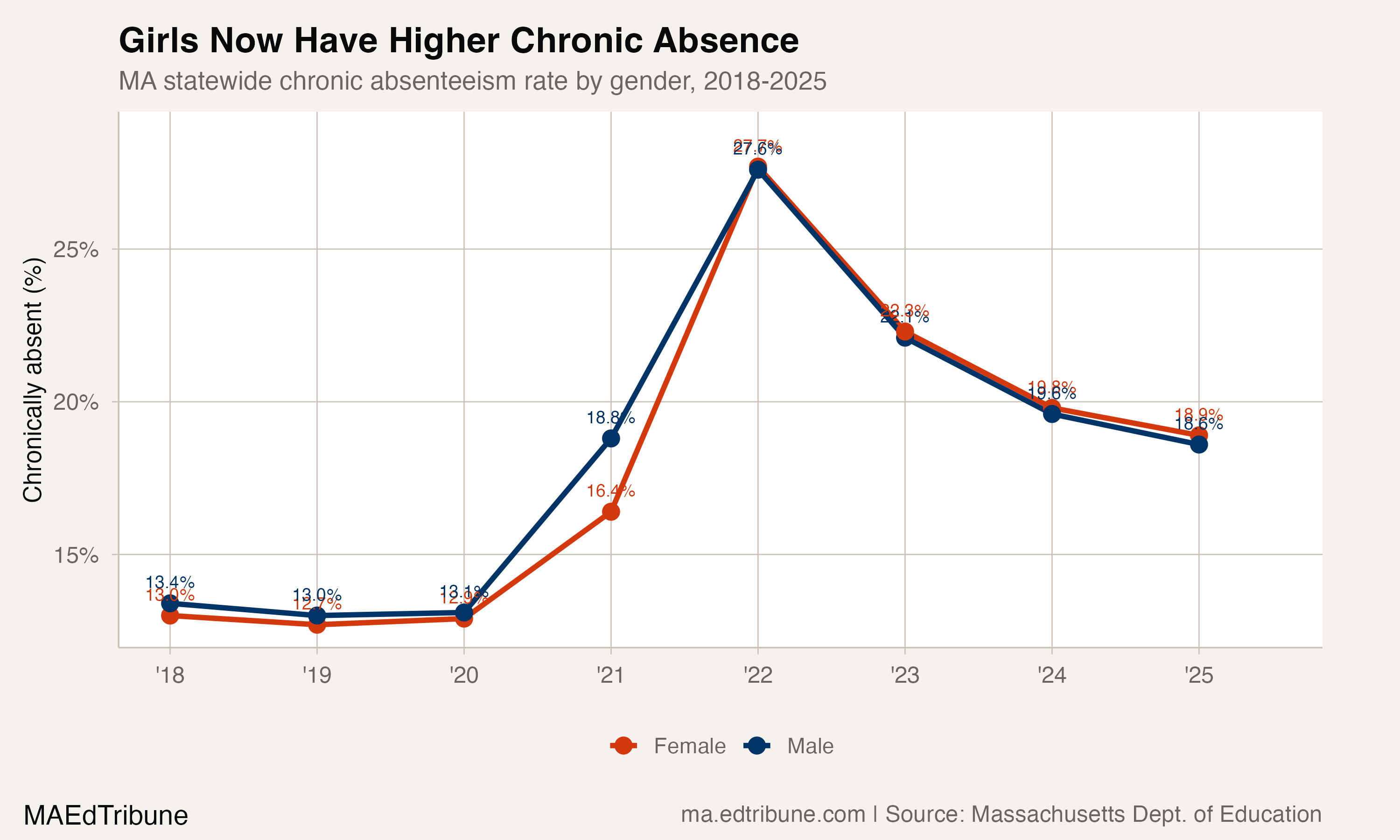
That pattern, where female students carry higher chronic absence rates than their male peers, used to be the exception in Massachusetts. It is becoming the rule. Before the pandemic, boys had slightly higher statewide chronic absenteeism than girls: 13.0% versus 12.7% in 2019. The gap was modest, about 0.3 percentage points, but it was consistent in the Massachusetts package data from 2018 through 2020.
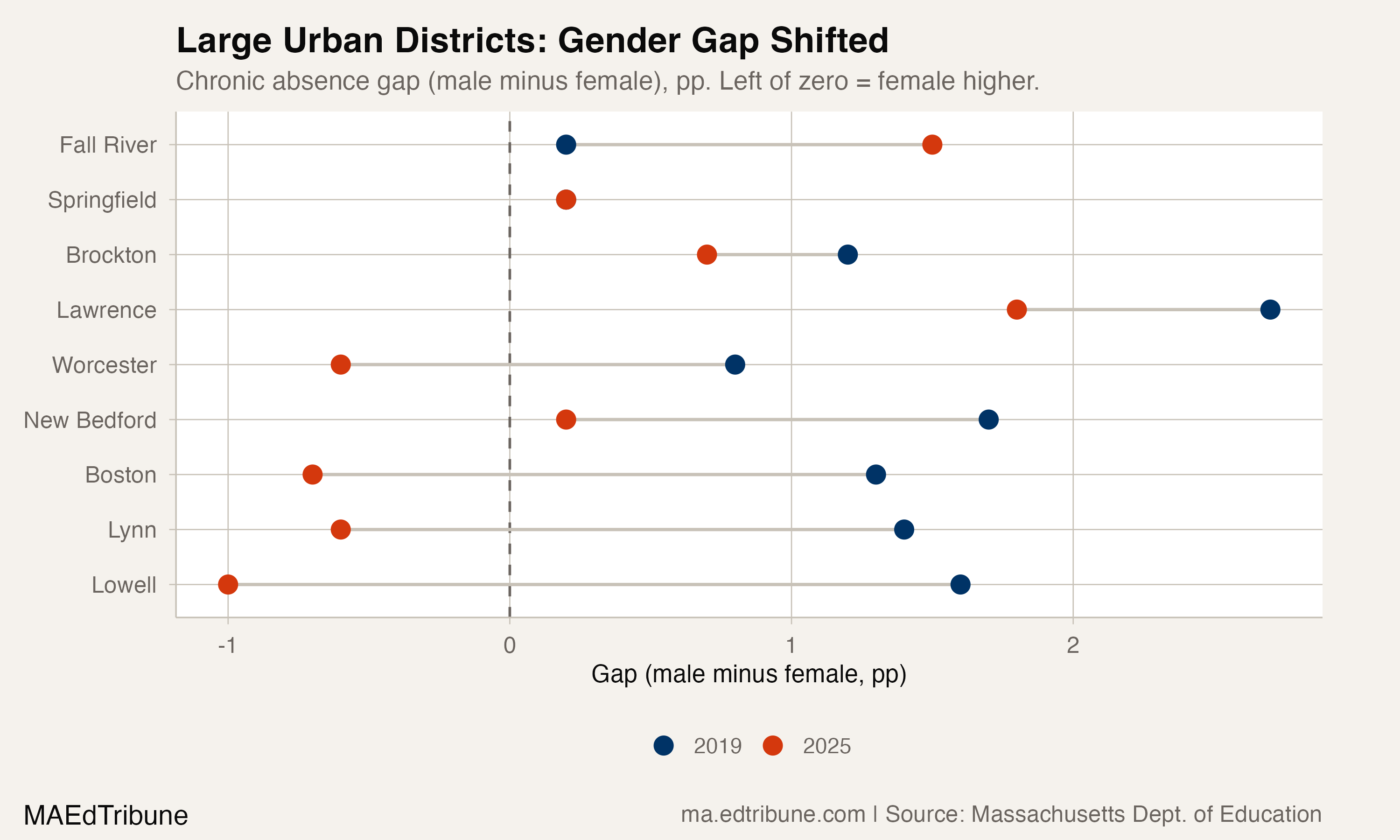
Starting in 2022, the lines crossed. Girls hit 27.7% chronic absence that year, edging past boys at 27.6%. By 2025, the reversal had not corrected: girls were at 18.9%, boys at 18.6%. The female-higher gap grew from 0.1 points in 2022 to 0.3 points in 2025, the widest female-higher margin in the post-2021 data.
A small gap, a large shift
A 0.3-point statewide gap does not sound like much. But the reversal is not a statistical blip in one year's data. It has persisted for four consecutive years, it is getting incrementally wider each year, and it is visible at the district level in a way that makes it hard to dismiss as noise.
In 2019, 206 of 405 districts (50.9%) had higher chronic absence among girls than boys, essentially a coin flip. By 2025, that figure was 232 of 395 districts (58.7%). Nearly three in five Massachusetts districts reported higher female chronic absence.
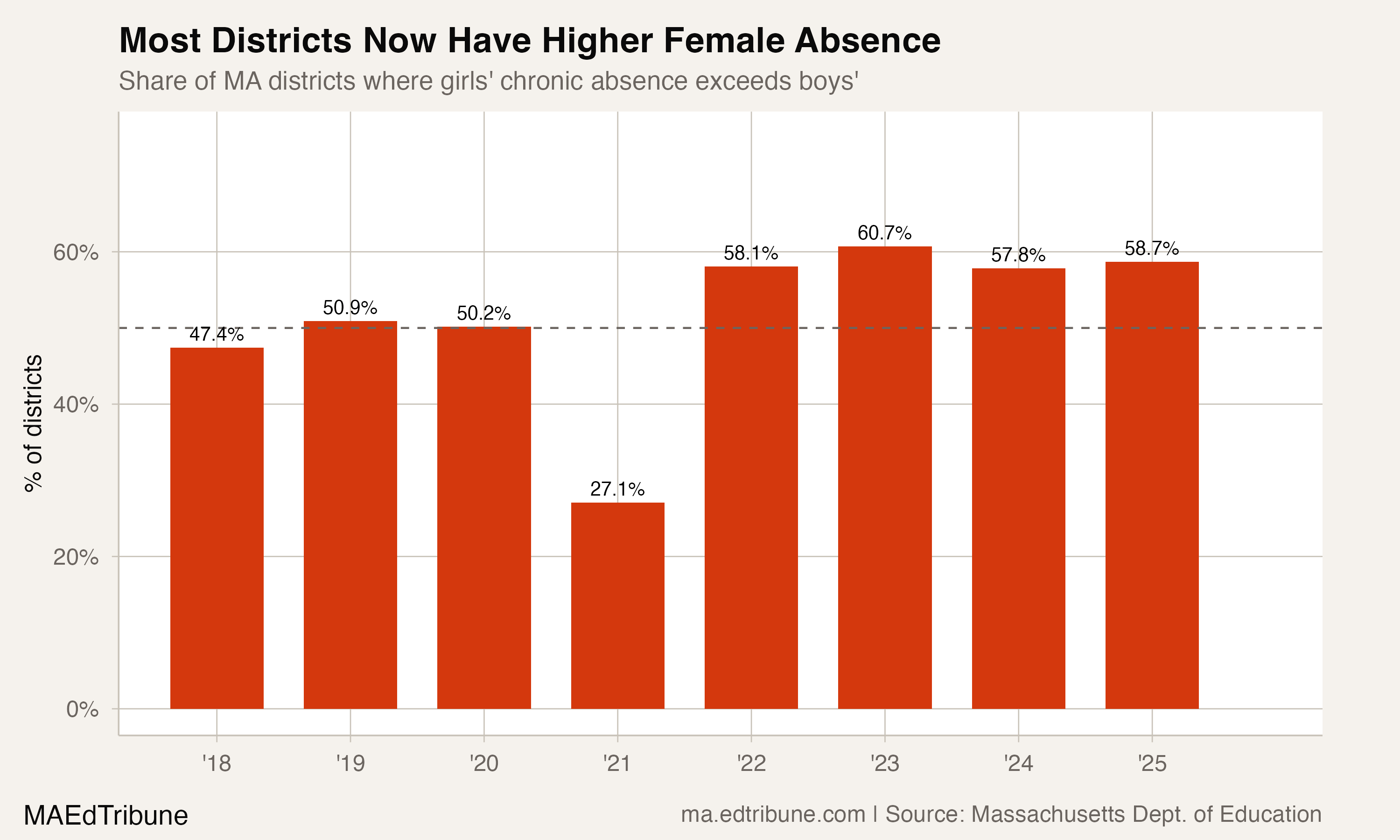
Of the 188 districts where boys had clearly higher absence rates in 2019, 92 flipped by 2025, with girls leading. That is 48.9% of previously male-skewing districts reversing in six years.
The pandemic-disrupted 2021 school year, when Massachusetts districts operated across remote, hybrid, and in-person models, pushed the gender gap in the opposite direction: boys' chronic absence surged to 18.8% while girls held at 16.4%, a 2.4-point male-higher gap, the widest in the dataset. The package data do not explain that anomaly. They do show that the dynamic inverted in 2022 and stayed inverted through 2025.
Two different Massachusetts
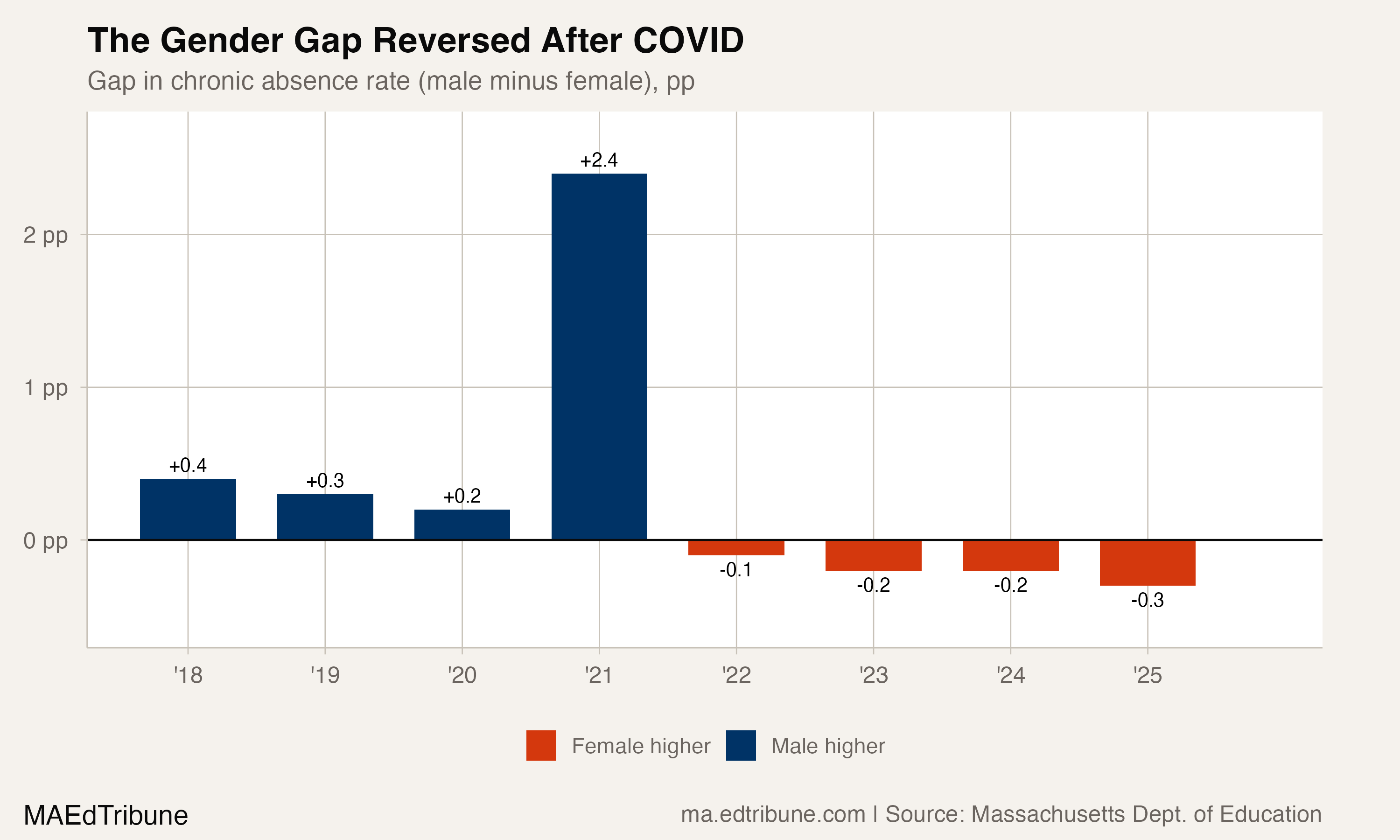
The flip did not happen uniformly. Among nine large urban districts tracked here, including Boston and eight Gateway Cities, four flipped from male-higher in 2019 to female-higher in 2025: Boston↗ET (+1.3 to -0.7), Worcester↗ET (+0.8 to -0.6), Lowell↗ET (+1.6 to -1.0), and Lynn↗ET (+1.4 to -0.6). In Boston, one in three girls was chronically absent in 2024-25 (33.4%), compared with 32.7% of boys.
Five of the large urban districts still showed higher male absence: Springfield, Lawrence, Brockton, Fall River, and New Bedford. Lawrence, the district in state receivership since 2011, maintained the widest male-higher gap in the group at +1.8 points, though even that was narrower than its +2.7 in 2019.
In selected suburbs, the story is different again. Several districts already had female-higher absence before COVID. In Wellesley↗ET, the gap was -1.8 points in 2019 and remained -1.7 in 2025. In Weston↗ET, it was -1.7 and was -1.9 in 2025. Concord-Carlisle went from -1.9 to -2.2. These communities did not experience a reversal because the pattern was already established. The newer change is that the same female-higher pattern also appears in Boston and several large Gateway Cities by 2025.
What could explain the shift
The data cannot tell us why girls missed more school in the latest package year. But two bodies of evidence offer competing explanations.
Suggestive context: one hypothesis involves the intersection of mental health and attendance. The CDC's Youth Risk Behavior Survey documented that 53% of female high school students nationally reported persistent feelings of sadness or hopelessness in 2023, down from 57% in 2021 but still roughly double the rate for male students. In Boston, the trend was steeper: persistent sadness among BPS high school students jumped 9 percentage points between 2019 and 2021, compared with 5 points nationally. Female and LGB students reported the highest rates, with female students attempting suicide at roughly double the rate of males.
"Females and LGB youth are experiencing statistically significant higher rates of sadness and hopelessness than their male and straight counterparts." -- Boston Indicators, March 2023
Suggestive context: researchers studying what the United Kingdom terms "emotionally based school avoidance" have documented a surge in anxiety-driven absences since the pandemic. The condition disproportionately affects girls: 38.0% of female adolescents have a lifetime anxiety disorder diagnosis, compared with 26.1% of males. That mechanism is distinct from older truancy frameworks: rather than defiance or disengagement, the linked literature describes avoidance driven by anxiety, social stress, or depressive episodes.
Competing explanation: the gender gap in chronic absence was already narrowing before COVID, shrinking from +0.4 in 2018 to +0.2 in 2020. The pandemic may have accelerated a pre-existing trend rather than creating a new one. The selected-suburb data support this reading, since districts like Wellesley and Weston already had female-higher absence before the pandemic disrupted anything.
Unresourced: the package data cannot determine whether one explanation dominates, or whether mental health pressures compounded a pre-existing trend in the same direction.
The average-days signal
Average days absent tells a slightly different version of the story. In 2019, girls averaged 9.5 days absent and boys 9.6, a negligible difference. By 2025, girls averaged 12.0 days and boys 11.9. The averages are nearly identical, so the chronic-rate gap is not mirrored by a large gap in mean days missed. A student averaging 12.0 days in a 180-day year is at the 6.7% mark, below Massachusetts' 10% chronic-absence threshold. The distribution around that threshold matters more than the statewide mean can show.
Whether interventions reach the right students
Suggestive context: Boston alone added $21 million in federal pandemic aid for school-based mental health services. Whether investments like that affect attendance depends on whether mental-health supports reach students whose absences accumulate without matching older truancy patterns.
The statewide gap is 0.3 percentage points. The question is whether the 2022-25 reversal represents a durable structural shift in who misses school, or a temporary post-pandemic pattern that future attendance work can bend back.
Detailed code that reproduces the analysis and figures in this article is available exclusively to EdTribune subscribers.
Discussion
Sign in to join the discussion.
Loading comments...