In this series: Massachusetts 2025-26 Enrollment.
Four years of slow, grinding recovery from the pandemic's enrollment shock. Four years of districts clawing back a few hundred students at a time. Then, in a single school year, all of it gone.
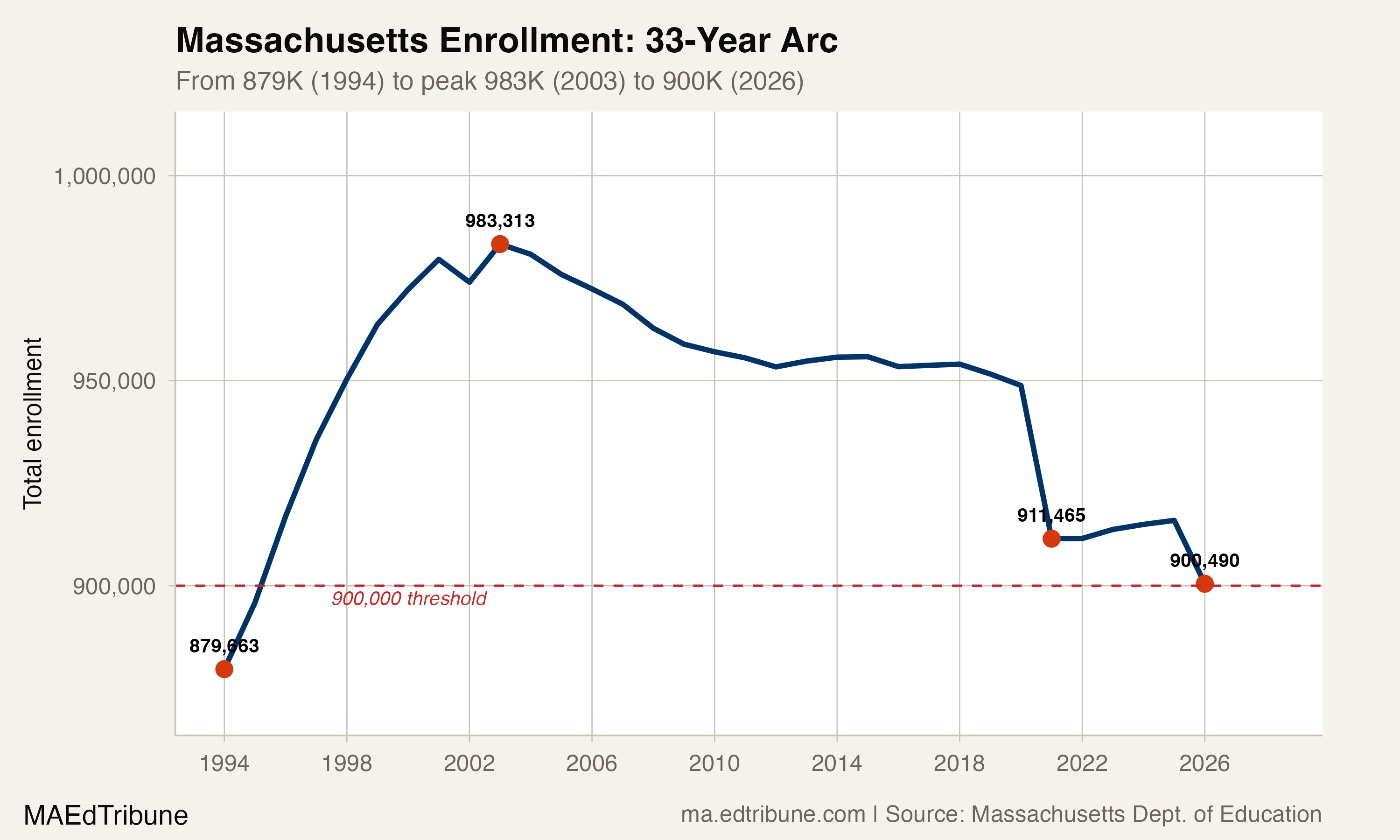
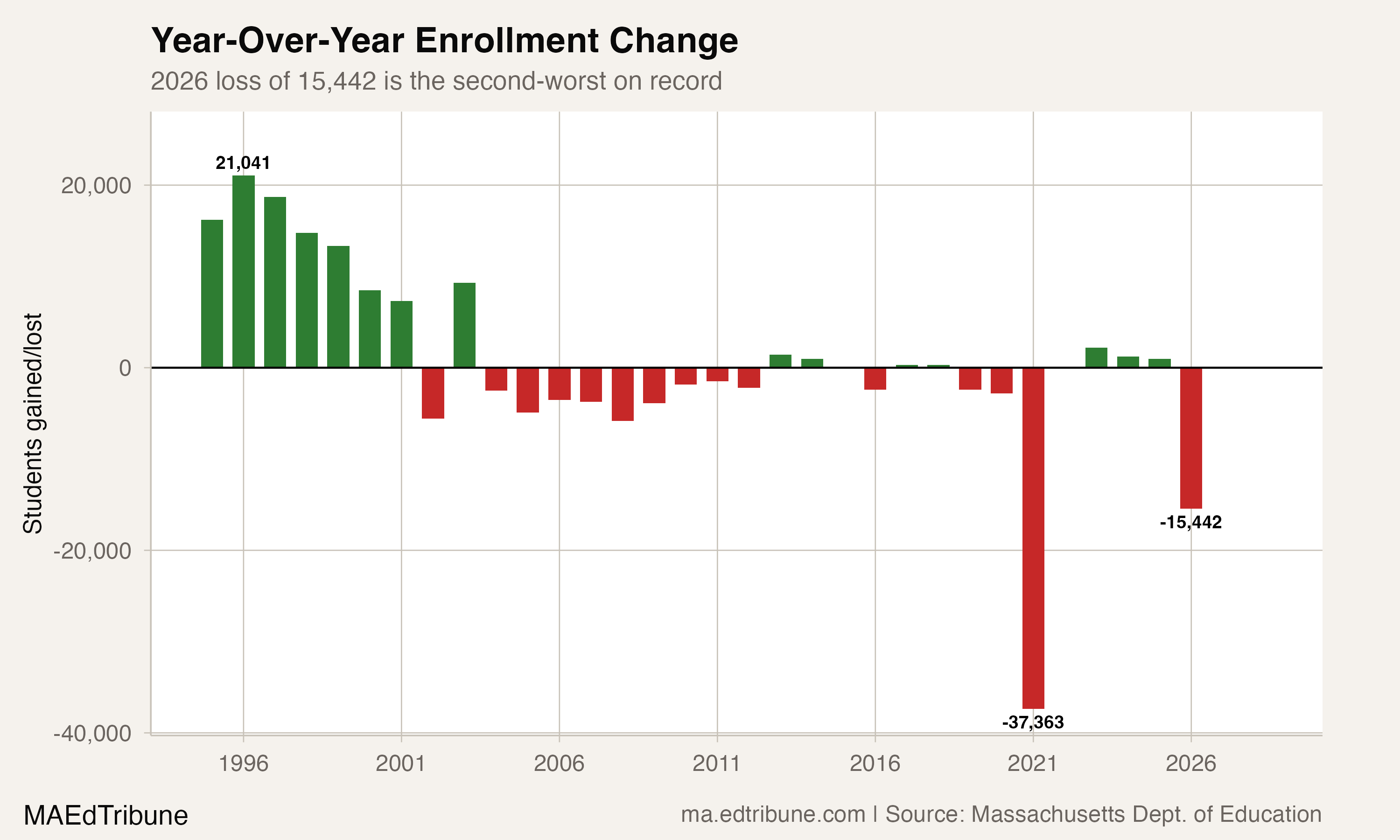
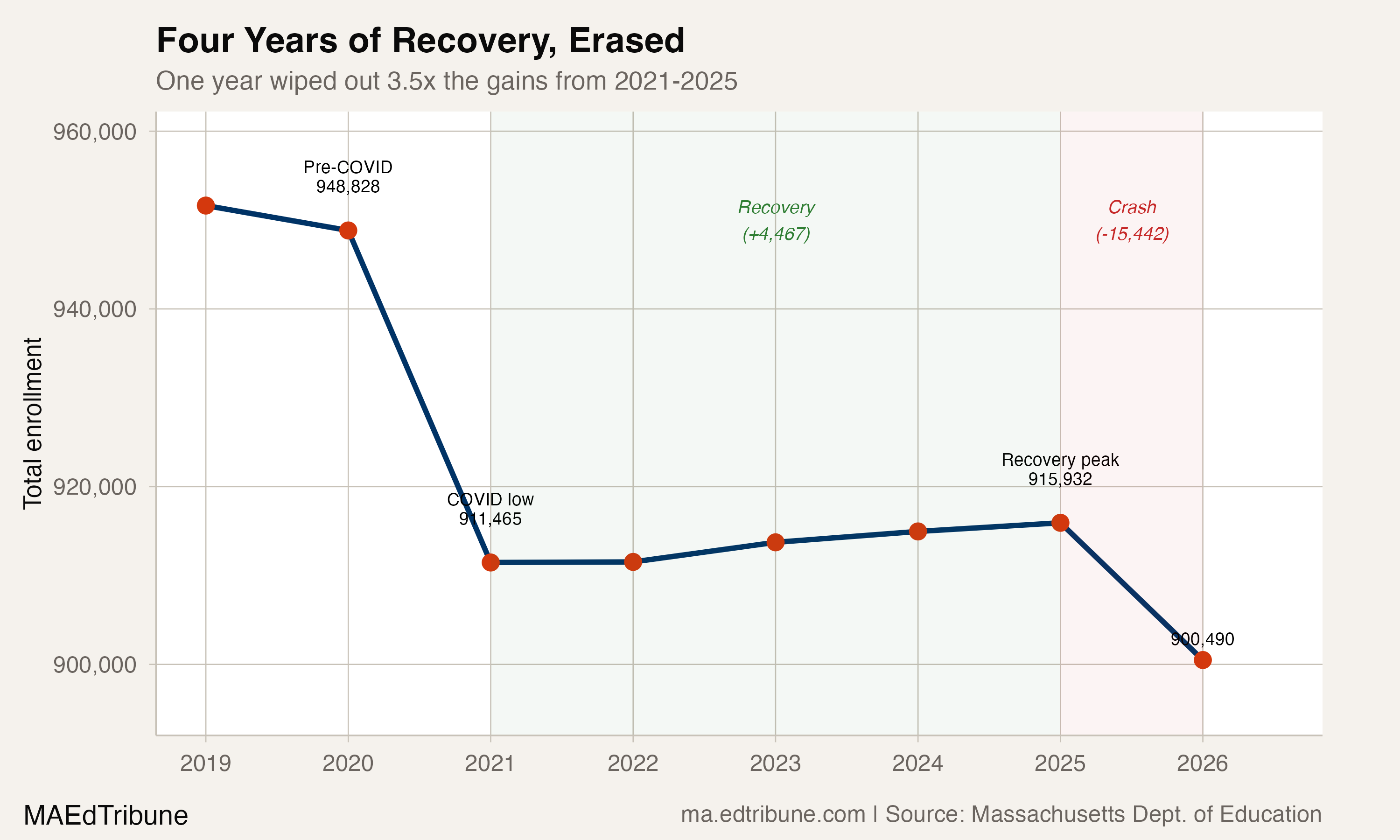
Massachusetts public schools enrolled 900,490 students in 2025-26, a loss of 15,442 from the prior year and the second-worst single-year decline in the state's recorded history. Only the pandemic year of 2020-21, which erased 37,363 students, was worse. The state now sits 490 students above 900,000, a threshold it last crossed in 1995. The total is 82,823 below the 2003 peak of 983,313, an 8.4% decline over 23 years.
The recovery that wasn't
Between 2021 and 2025, Massachusetts recovered just 4,467 students, or 12% of its pandemic losses. That tepid recovery placed the state among the weakest post-COVID rebounds in the northeast. Then 2026 erased 3.5 times those gains in a single year, dropping enrollment 10,975 below the COVID-era low.
The pattern is visible in the year-over-year data: the state gained 64 students in 2022, then 2,206 in 2023, 1,224 in 2024, and 973 in 2025. Each year's recovery was smaller than the last. The 2026 collapse did not interrupt a rebound. It ended a stall.
Two shocks in one number
The 15,442-student drop has two distinct components, and conflating them obscures what happened.
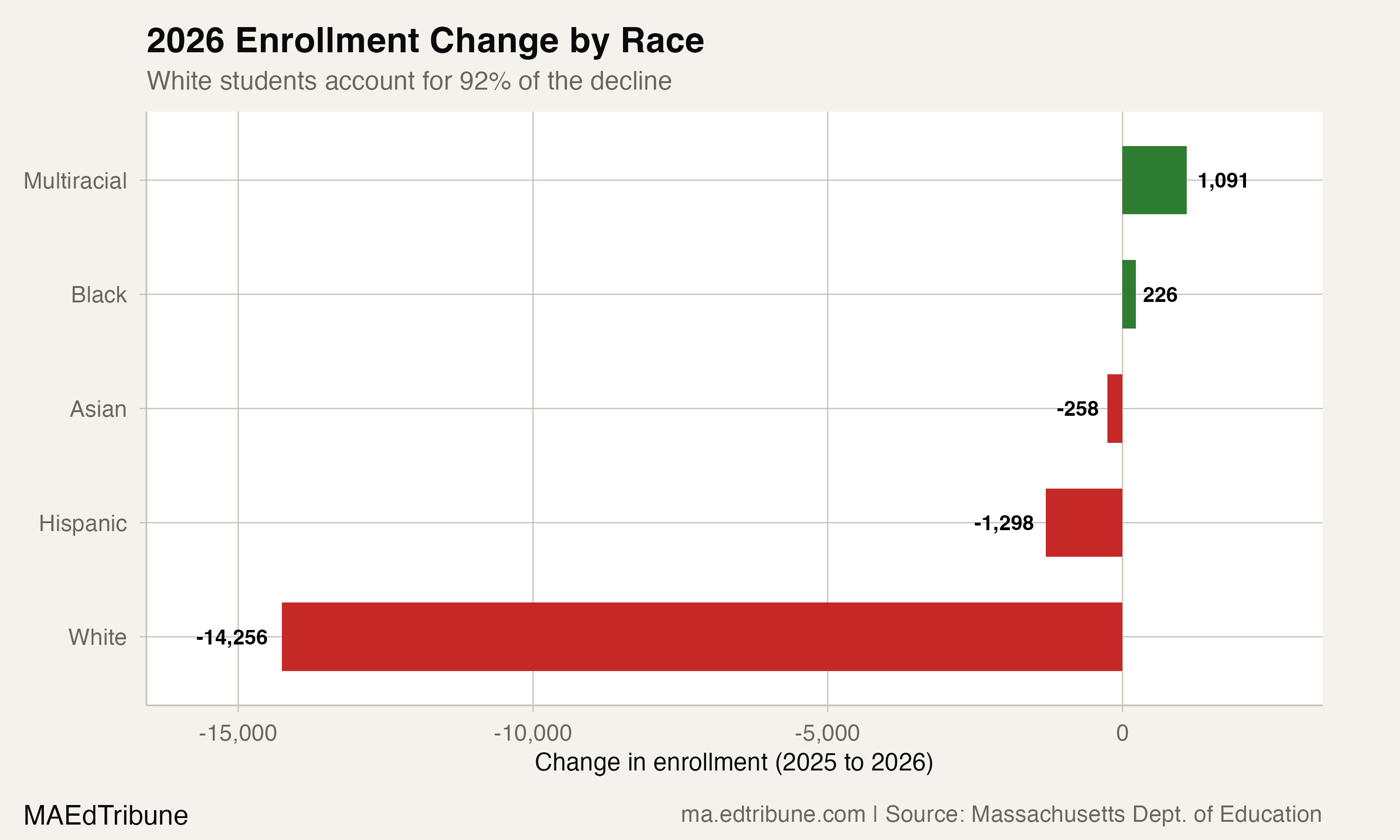
The first is structural. White enrollment fell by 14,256 students, accounting for 92.3% of the total decline. This is not new. White enrollment has declined every year since 2003, losing an average of roughly 12,000 students annually over the past decade outside of the pandemic year. The 2026 loss is larger than the recent average but within the range of a long-running demographic transition. White students now make up 50.8% of total enrollment, down from 79.3% in 1994.
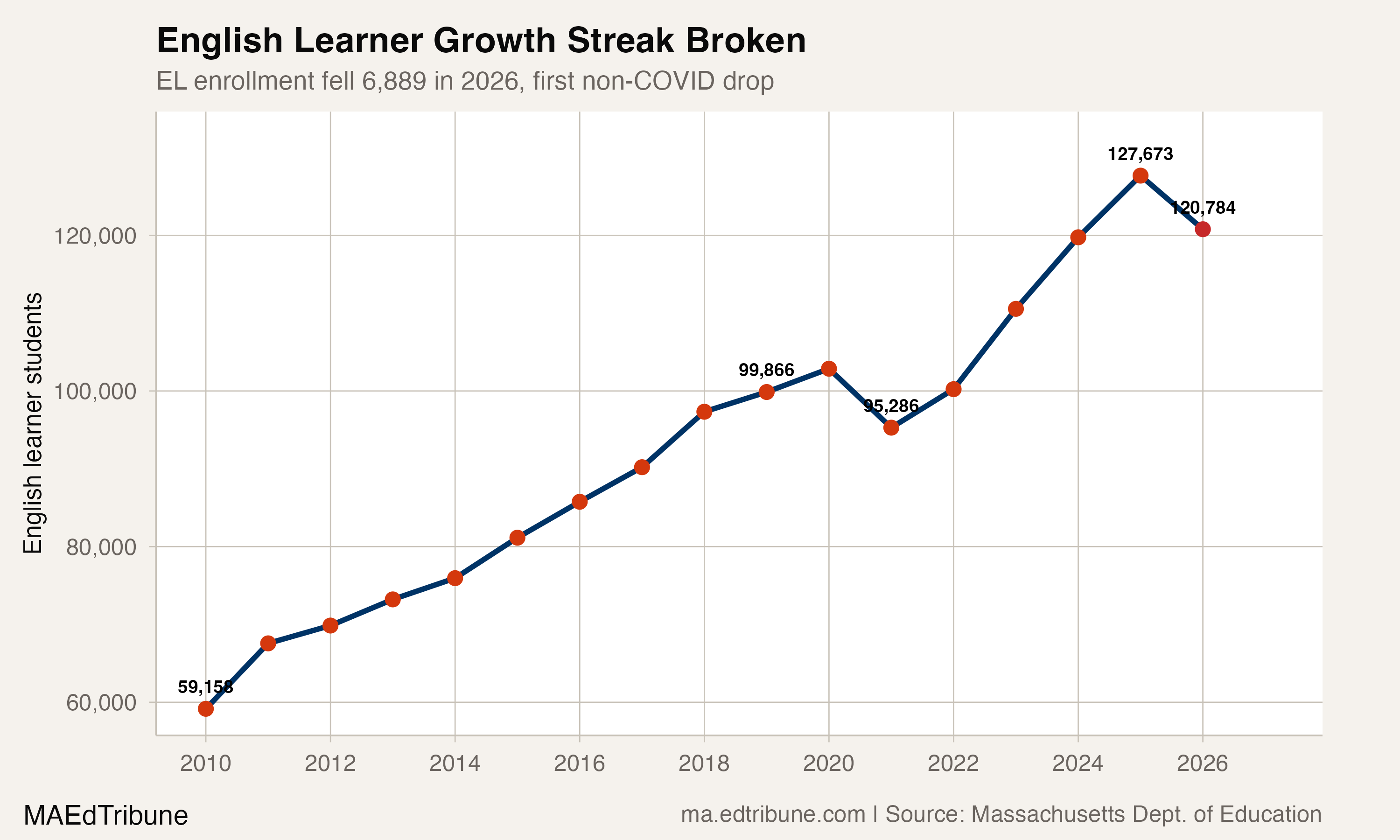
The second component is new and acute. English learner enrollment fell by 6,889 students, a 5.4% drop that broke a growth streak dating to 2010. Outside of the pandemic year, EL enrollment had risen every year for 16 years, more than doubling from 59,158 in 2010 to 127,673 in 2025. The 2026 reversal is the first non-COVID decline in that entire period.
Hispanic enrollment, which overlaps heavily with the EL population, also declined for only the second time on record, losing 1,298 students after gaining an average of 8,500 per year from 2022 to 2025.
Where the fear landed
The districts that lost the most students in 2026 are not randomly distributed. Boston↗ET lost 1,678 students, or 3.6% of its enrollment. Framingham↗ET lost 642 (7.0%), Brockton↗ET lost 638 (4.2%), Lynn↗ET lost 487 (3.0%), Everett↗ET lost 399 (5.5%), and Chelsea↗ET lost 345 (5.7%). Every one of these cities is a center of immigrant settlement in the Greater Boston area. Every one has an English learner population well above the state average.
The geographic concentration is consistent with reporting from school leaders who attribute the losses to federal immigration enforcement that intensified in early 2025. Chelsea Superintendent Almi Abeyta told WBUR that families cited "cost of living and U.S. Immigration and Customs Enforcement agent sightings" as reasons for leaving. Framingham Superintendent Bob Tremblay described the dynamic to WBUR in starker terms:
"You have the fear of Immigration and Customs Enforcement, ICE, in the community...families that have left the country, left the city to go and seek refuge elsewhere."
Lynn Superintendent Molly Cohen told GBH the consequences are budgetary as well as human: "We are seeing fear. We are seeing instability. And we are seeing the financial consequences of that instability land squarely on the districts serving our most vulnerable students."
The enrollment data cannot distinguish between families who were deported, families who left voluntarily, and families who never enrolled children they otherwise would have. What the data shows is a sudden, geographically concentrated reversal in a student population that had been growing without interruption for a decade and a half.
The structural floor keeps dropping
Even without the immigration-driven EL decline, Massachusetts would have posted a significant enrollment loss. Traditional public school districts lost 15,800 students in 2026 while charter schools gained 358, a divergence that has widened every year since 2016. Charter enrollment has grown from 35,688 (3.7% of total) to 48,472 (5.4%) over that span, but charter growth is not large enough to explain more than a fraction of the traditional sector's losses.
The deeper structural driver is demographic. The kindergarten class of 2026, at 60,871 students, is 7.8% smaller than the kindergarten class of 2016. The 12th-grade class, at 70,385, is larger. The kindergarten-to-12th-grade ratio has fallen to 86.5, meaning the state is replacing every 100 graduating seniors with only 87 incoming kindergartners. Each year's incoming class is smaller than the one graduating out.
Across all 395 districts reporting data for both years, 271 (68.6%) declined in 2026, up from roughly half in each of the four prior years. The losses are concentrated at the top: the 79 largest districts account for 72.1% of the total decline, with 89.9% of them losing students. Eighty-seven districts, including Boston, sit at all-time enrollment lows.
Boston's long contraction
Boston Public Schools, the state's largest district, enrolled 44,416 students in 2026. That is 19,322 fewer than its 1994 peak of 63,738, a 30.3% decline over three decades. The district lost 8,847 students in just the past nine years.
The district's response is already in motion. In December 2025, the Boston School Committee voted to close three schools by the end of the 2026-27 school year: Lee Academy Pilot School, Another Course to College, and Community Academy of Science and Health. Superintendent Mary Skipper estimated savings of roughly $20 million.
The closures are part of a broader plan to reduce the district's footprint from its current number of buildings to approximately 95 by 2030. "These are hard decisions. They never, ever get easier," Skipper said.
What the next kindergarten class signals
If immigration-driven enrollment continues to decline at the rate observed in 2025-26 while the structural white enrollment decline continues at its recent pace, the 900,000 threshold will not hold through 2027. At the 2026 rate of loss, the state would fall below 885,000 by 2028.
The fiscal arithmetic is straightforward. Massachusetts distributes Chapter 70 state education aid based in part on enrollment. Every student who leaves takes funding with them. Framingham has already eliminated 84 staff positions for 2026-27, including 12 ESL teachers, as a direct consequence of its 7.0% enrollment drop. Chelsea faces the potential loss of 70 educators next year.
The 490-student margin above 900,000 is not a policy threshold. No funding formula kicks in at that number, and no law changes when it is crossed. But when Framingham eliminates 12 ESL teachers and Chelsea budgets for 70 fewer educators, the number has already done its work. A system that peaked at 983,313 students a generation ago has lost the only growth engine it had. The kindergarten pipeline feeds in 60,871 students. The graduation pipeline sends out 70,385. The arithmetic does not require a forecast.
Detailed code that reproduces the analysis and figures in this article is available exclusively to EdTribune subscribers.
Discussion
Sign in to join the discussion.
Loading comments...