In this series: Massachusetts 2025-26 Enrollment.
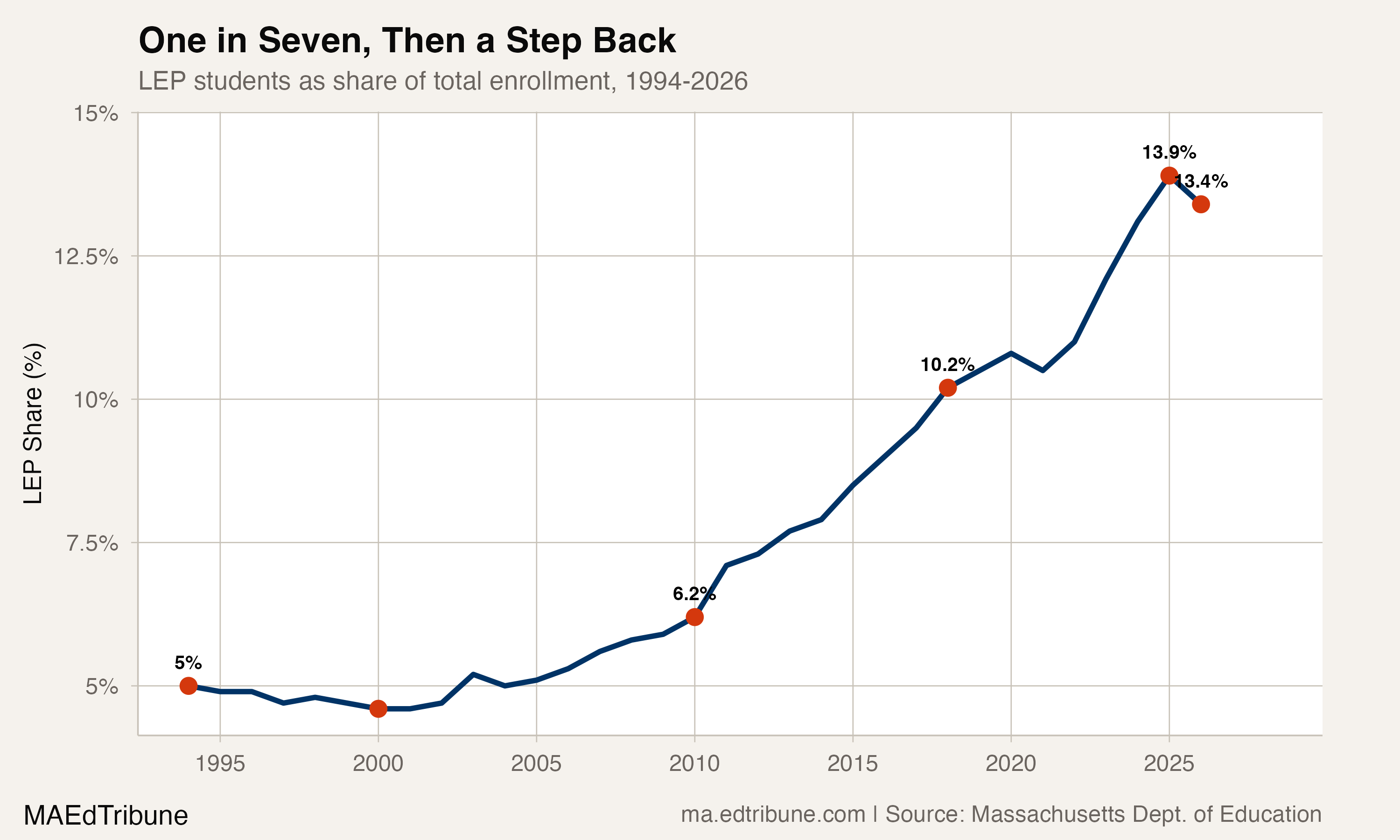
For 30 years, the trajectory pointed in one direction. Massachusetts public schools enrolled 43,690 students classified as limited English proficient in 1994. By 2025, that number had nearly tripled to 127,673, a climb so steady that annual gains of 5,000 to 10,000 LEP students had become the new normal. Three consecutive years of surges from 2023 to 2025 added 27,442 students to the LEP rolls.
Then the line broke. In 2026, LEP enrollment fell by 6,889 students to 120,784, a 5.4% decline that erased nearly a quarter of those three years of gains in a single fall count. It is the second-largest single-year drop in the program's history, exceeded only by the 7,575-student COVID-era loss in 2021. The LEP decline accounts for 44.6% of the state's total enrollment loss of 15,442 students, even though LEP students represent just 13.4% of the student body.
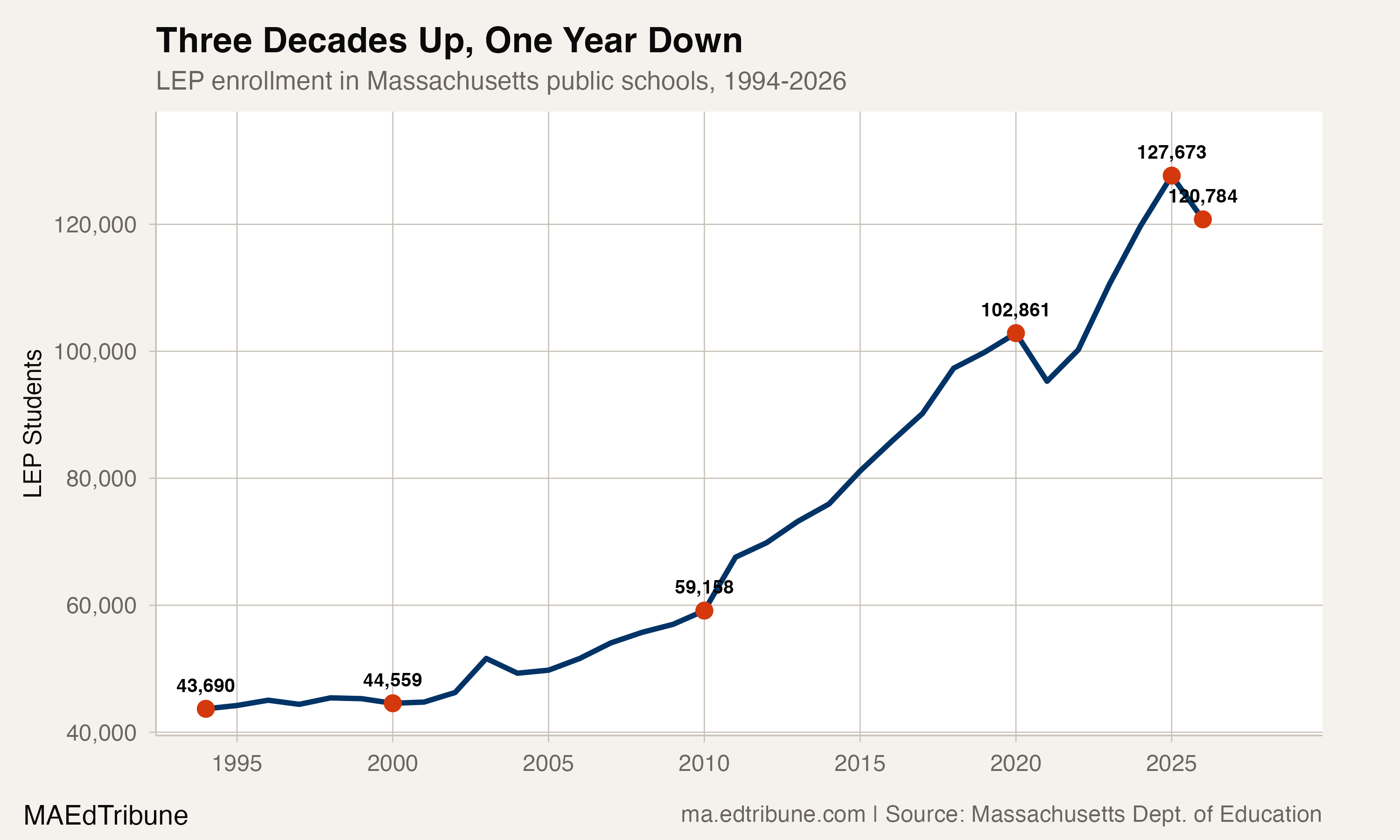
The acceleration, then the cliff
The speed of the reversal is what makes 2026 unusual. From 2023 to 2025, Massachusetts was adding LEP students at a pace unseen since the early 2010s: 10,323 in 2023, 9,195 in 2024, 7,924 in 2025. Those gains pushed LEP students from 12.1% of total enrollment to 13.9%, crossing the one-in-seven threshold for the first time. The share had been one in 20 as recently as 2000.
The 2026 reversal dropped LEP share back to 13.4%. But the underlying pattern is more severe than the statewide number suggests. The losses are concentrated in the districts that had been absorbing the most growth.
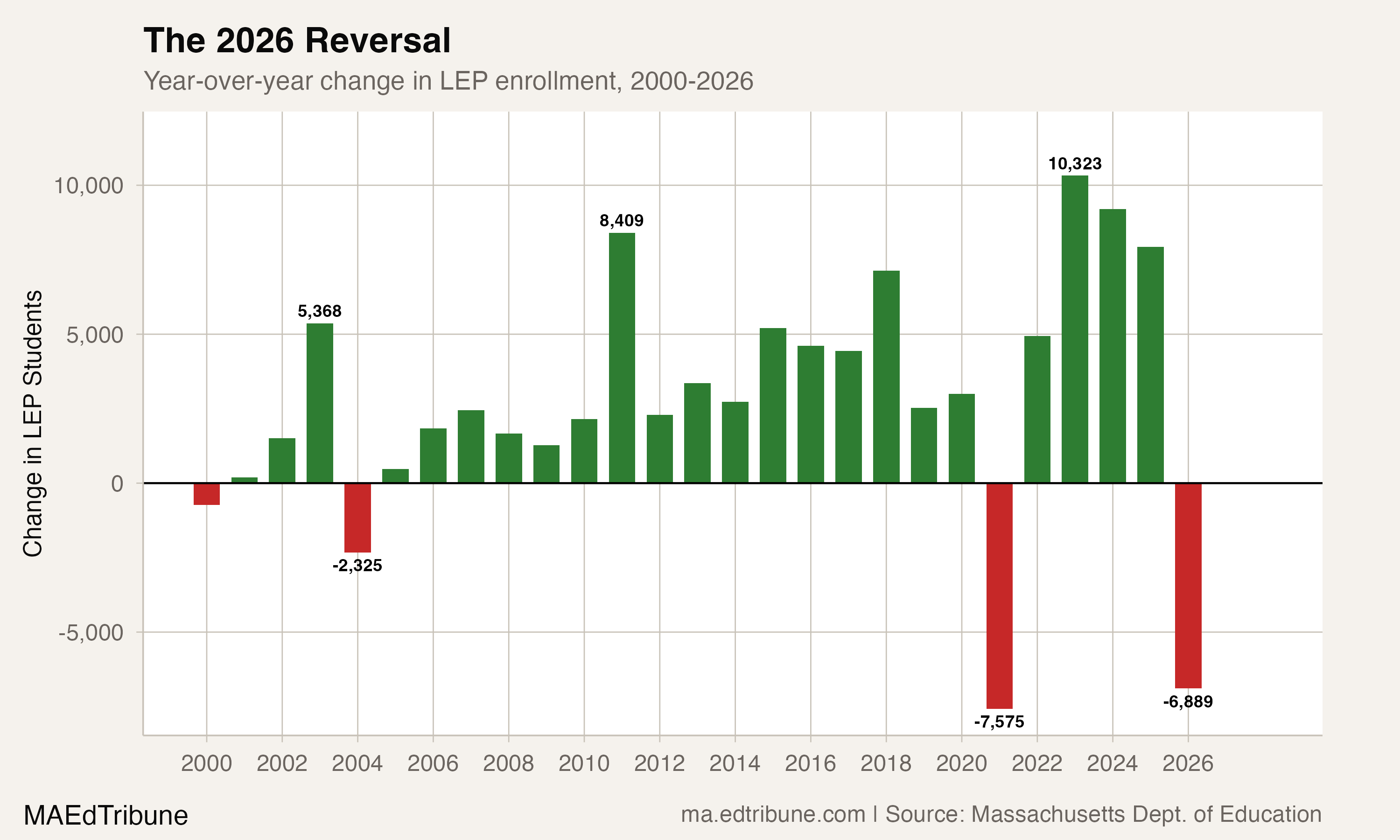
Immigrant gateway cities bore the losses
Boston↗ET lost 1,059 LEP students, a 6.6% decline from a base of 15,972. Framingham↗ET lost 380 (-10.9%). Lawrence↗ET lost 309 (-5.2%). Brockton↗ET lost 304 (-5.7%). Revere↗ET lost 293 (-11.2%). Lynn↗ET lost 287 (-3.8%). Marlborough↗ET lost 274 (-17.1%). Everett↗ET lost 263 (-8.1%). Worcester↗ET lost 243 (-3.0%). Milford↗ET lost 240 (-15.1%). Chelsea↗ET lost 223 (-7.8%).
These 11 districts account for the vast majority of the statewide loss. The pattern is uniform: every major immigrant-receiving city in the state saw its LEP enrollment contract.
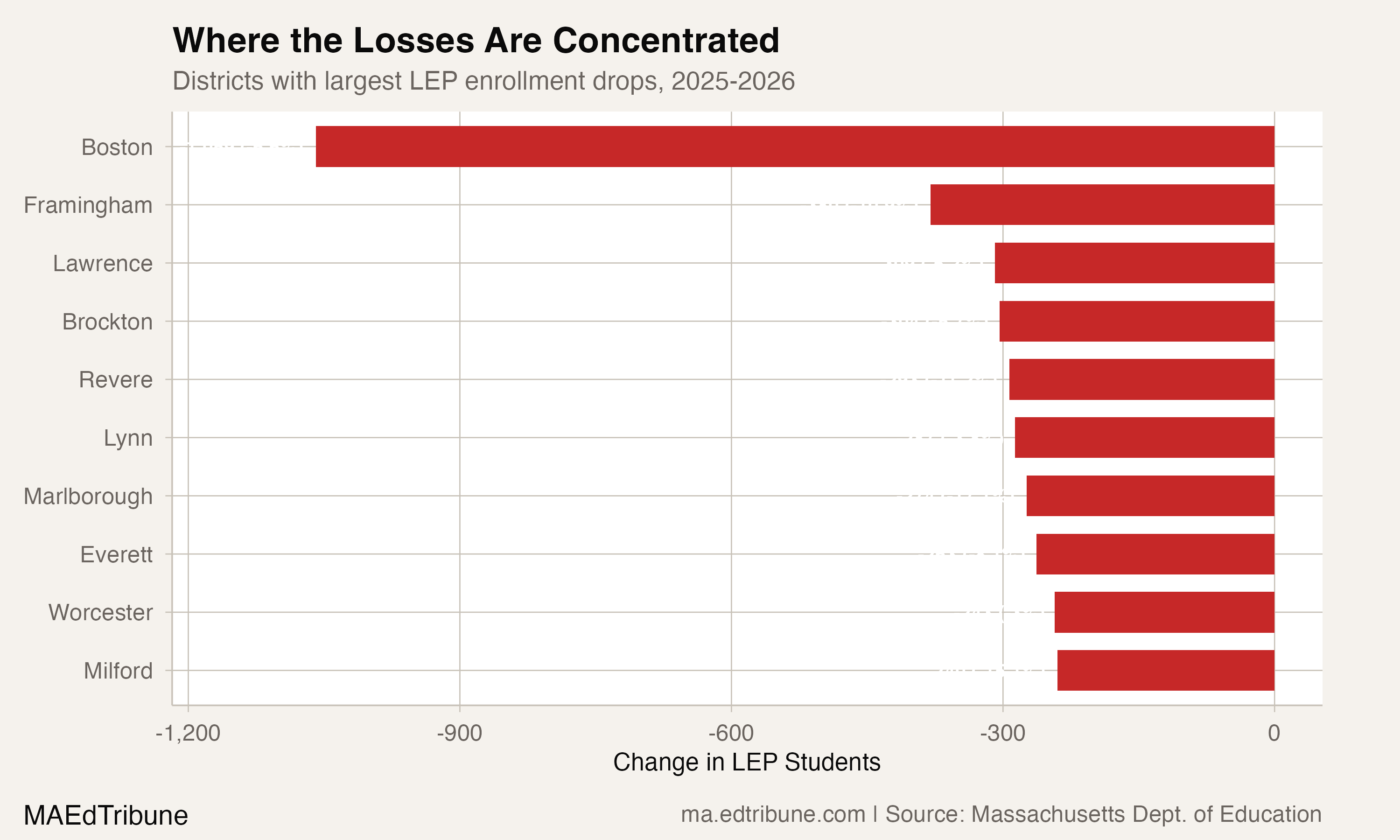
The percentage declines in smaller gateway cities are steeper. Cambridge↗ET lost 20.8% of its LEP students. Marlborough lost 17.1%. Milford lost 15.1%. In these districts, LEP students still make up roughly a third of total enrollment: Chelsea at 46.1%, Lynn at 45.4%, Everett and Lawrence at 43.4%, Framingham at 36.6%, Boston at 33.6%.
The immigration enforcement mechanism
School districts do not collect immigration status data. They cannot directly measure how many families left because of federal enforcement activity. But school leaders across the state have pointed to a single factor with unusual unanimity.
"We know what we are seeing. We are seeing fear. We are seeing instability. And we are seeing the financial consequences of that instability land squarely on the districts serving our most vulnerable students." -- Lynn Superintendent Molly Cohen, GBH, March 2026
Chelsea, where 45% of residents were born abroad, became the early indicator. By September 2025, roughly 990 students had transferred out of Chelsea schools since the previous October. According to Daniel Mojica, who runs the district's Parent Information Center, about a quarter enrolled in other Massachusetts districts, a quarter left the country for Honduras, Guatemala, and Colombia, and the largest portion, about half, relocated to other U.S. states. The destinations were striking: Florida, Arkansas, Alabama, Ohio, and South Carolina, all states with less visible federal enforcement presence.
"Parents are saying, 'Well, we're leaving ... we don't want to live where there's ICE on the streets, so we're leaving Chelsea.'" -- Chelsea Superintendent Almi Abeyta, WBUR, September 2025
The most likely driver of the LEP decline is families with limited-English-proficient children leaving the state or keeping children home to avoid visibility. This aligns with both the geographic concentration of losses (gateway cities with high immigrant populations) and the timing (following the January 2025 revocation of the federal sensitive locations policy that had previously shielded schools from ICE activity). Governor Healey filed legislation in January 2026 to restrict ICE access to schools, hospitals, and courthouses at the state level.
Cost of living is also at work. Superintendent Abeyta noted families cited both housing costs and enforcement sightings as reasons for departure. Massachusetts has among the highest housing costs in the nation, and immigrant-heavy communities like Chelsea and Everett sit in a metro area where rents have risen sharply. The enrollment counts alone cannot separate the two forces.
Could reclassification criteria have shifted? Massachusetts uses WIDA ACCESS scores for reclassification, and there is no evidence the state changed its criteria or thresholds between 2025 and 2026. The drop is in headcount, not reclassification rates.
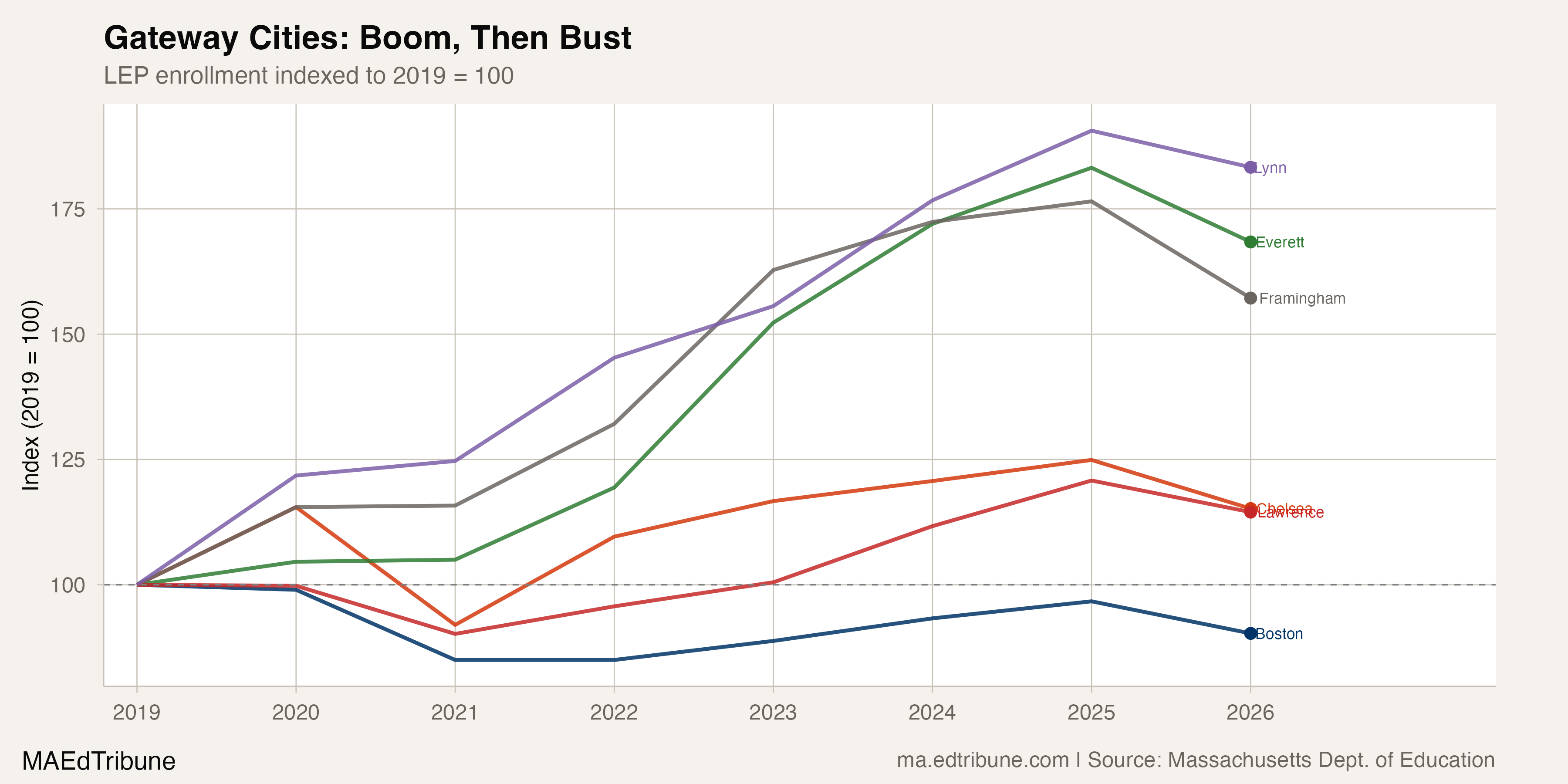
The indexed view of gateway city LEP trends reveals the boom-bust pattern most starkly. Lynn's LEP enrollment nearly doubled from 2019 to 2025 (from 3,934 to 7,499) before dropping to 7,212. Everett tripled its LEP rolls from 1,779 to 3,259 in the same span, then fell to 2,996. Framingham went from 1,976 to 3,487 to 3,107. In each case, the 2026 downturn bends the curve but does not come close to reversing the seven-year accumulation.
The fiscal bind
The financial consequences are immediate and asymmetric. Districts that enrolled large numbers of LEP students built staffing and programming around that growth: bilingual teachers, ESL coordinators, family liaisons, translation services. When 380 LEP students leave Framingham, the district loses per-pupil state aid, but the cost of maintaining those specialized programs does not fall proportionally.
"We might have fewer students, but we still have the same amount of school buildings and we still have the same electrical bills. All that overhead stays the same." -- Chelsea School Committee member Sarah Neville, WBUR, September 2025
The state's Chapter 70 funding formula includes a hold-harmless provision that prevents districts from receiving less state aid than the prior year. But for districts that had been receiving annual increases tied to enrollment growth, the hold-harmless floor is a ceiling: it locks in last year's allocation while costs continue to rise. Chelsea faces a projected $5.7 million budget shortfall. Framingham is looking at a $9 million reduction. Lynn anticipates a $7 million gap for fiscal year 2027.
Statewide, 222 districts lost LEP students in 2026 while 131 gained, a sign of how broadly the decline is distributed. Even districts not typically thought of as immigrant destinations, places like Danvers (-45.8%), Stoughton (-23.8%), and Lexington (-23.5%), recorded double-digit percentage drops.
Departure or non-arrival
Hispanic enrollment in Massachusetts also declined for the first time in the dataset: 237,226 in 2025 to 235,928 in 2026, a drop of 1,298 students. LEP and Hispanic are overlapping categories, but the Hispanic drop is modest at 0.5% while the LEP drop is 5.4%. That gap suggests many families with school-age children are staying while their LEP-classified children are either leaving, being kept home, or being reclassified at normal rates while new arrivals have slowed.
The distinction matters for planning. If families already here are pulling children from school, those children may return when conditions change. If new immigrant families are choosing not to settle in Massachusetts, the pipeline effect will compound across future years. Net international migration to the U.S. is projected to fall to about 321,000 between July 2025 and June 2026, down from 2.7 million two years earlier.
The COVID-era drop of 7,575 LEP students in 2021 was fully recovered within two years. Recovery this time depends on variables that lie outside school district control. Marlborough lost 17.1% of its English learners in a single year. The 12 ESL positions Framingham planned to cut in 2026 took a decade to hire.
Detailed code that reproduces the analysis and figures in this article is available exclusively to EdTribune subscribers.
Discussion
Sign in to join the discussion.
Loading comments...