In this series: Massachusetts 2025-26 Enrollment.
Correction (July 23, 2026): An earlier version described 900,490 students as the lowest total since 1994. Enrollment in 1995 was 895,886, below the 2025-26 figure, so the correct reference is the lowest since 1995.
North Adams↗ET peaked at 2,368 students in 1997. In fall 2025, it enrolled 1,064. Hull↗ET has lost 55.5% of its students from peak. Sandwich↗ET has crossed below half its former size. These are not anomalies. In 2026, 85 of Massachusetts' 323 traditional school districts recorded their lowest enrollment in 33 years of state data. One in four traditional districts is now at an all-time low.
The losses span the state's geography, from Berkshire County mill towns to Cape Cod tourist communities to South Shore suburbs. But the concentration in Western Massachusetts is unmistakable: 23 of the 85 districts at record lows sit west of the Connecticut River. On Cape Cod, six districts are at all-time lows in a region where the share of the population under 18 has been declining steadily and median home prices have priced out young families.
The 2026 cliff
Massachusetts public schools enrolled 900,490 students in fall 2025, the lowest total since 1995 and 82,823 below the state's 2003 peak of 983,313. The year-over-year loss of 15,442 students, a 1.7% decline, shattered four years of post-COVID stability during which enrollment had been essentially flat.
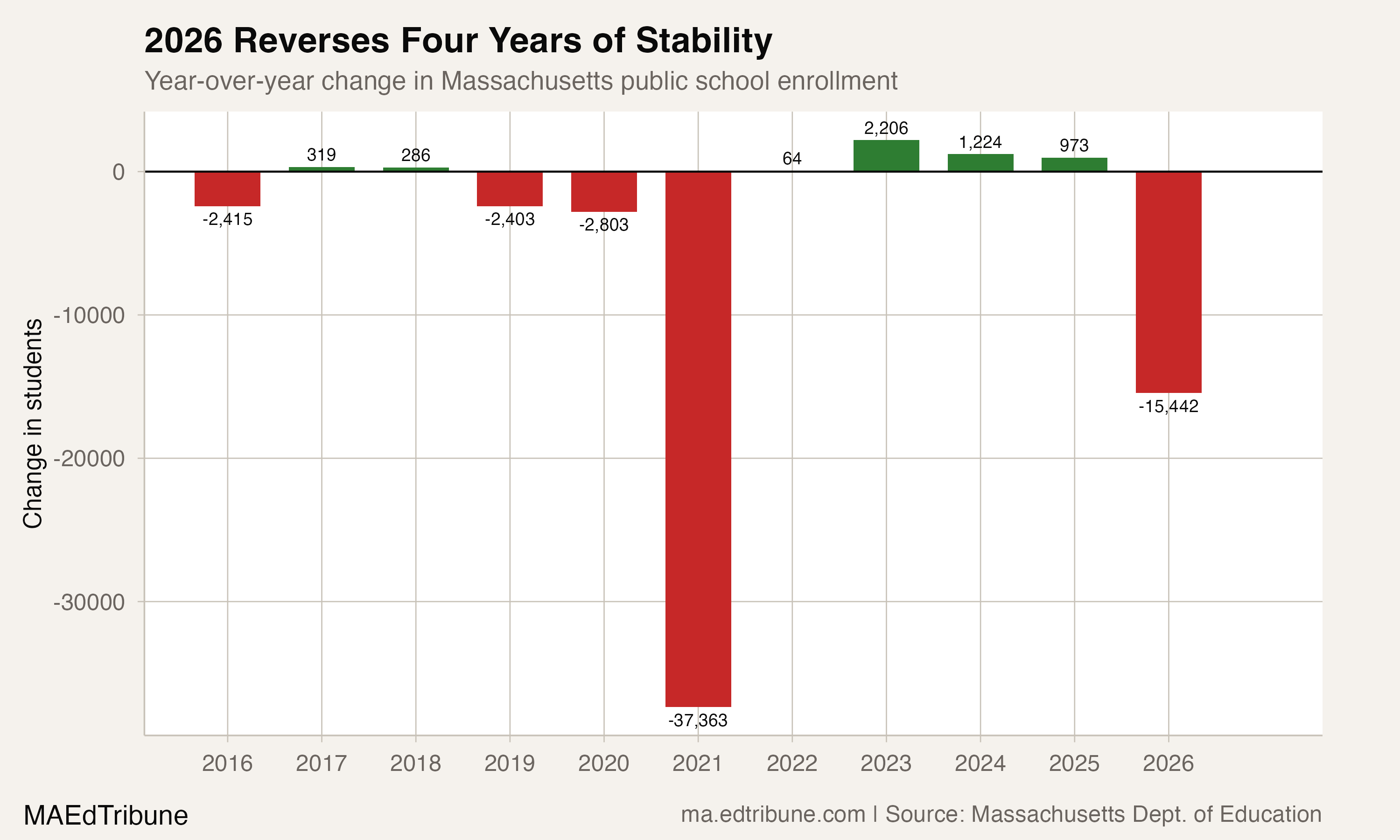
The scale of the 2026 drop is exceeded in the data only by the 37,363-student COVID plunge in 2021. But the 2021 loss had a clear cause and a partial recovery. The 2026 decline arrived after four consecutive years of modest recovery, during which the state regained barely 4,500 of the 37,000 students lost to COVID, and landed on districts that had no cushion left.
Of 395 districts reporting data, 271 lost students in 2025-26. Only 109 grew. Boston alone shed 1,678 students, a 3.6% drop. Framingham lost 642 (7.0%), Brockton lost 638 (4.2%), and Chelsea lost 345 (5.7%).
Where the records cluster
The 85 districts at all-time lows hold a combined 227,045 students, 25.2% of the state total. They have collectively lost 89,798 students from their peaks. The median district at an all-time low peaked 24 years ago. For 66 of the 85, peak enrollment was more than two decades ago.
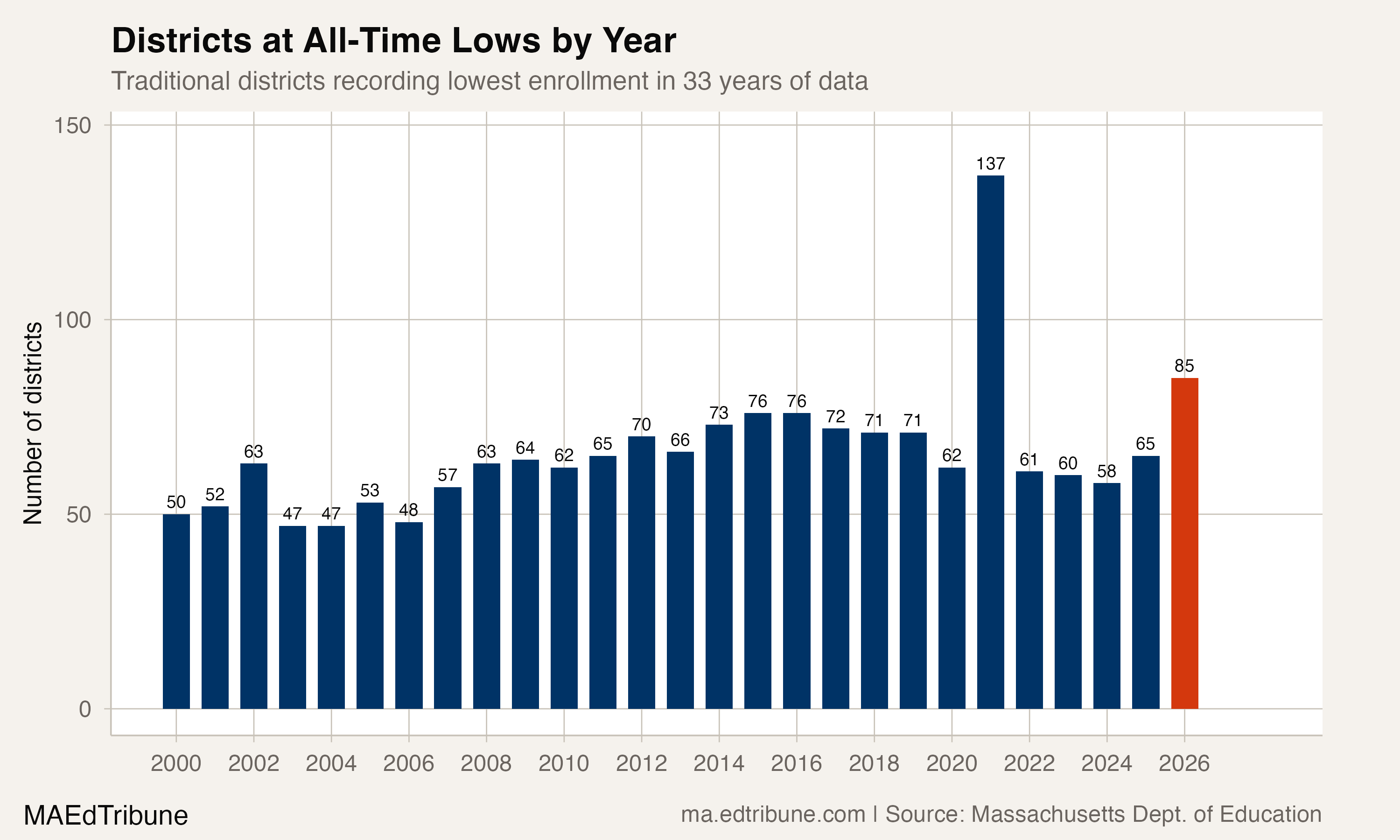
The count of 85 is the highest outside the pandemic year of 2021, when 137 districts bottomed out simultaneously before many partially recovered. Before the pandemic, the typical year saw 60 to 77 districts at record lows. In 2026 that number spiked to 85, and unlike 2021, there is no obvious catalyst that might reverse itself.
The half-their-former-size club
The deepest losses are staggering. Greenfield↗ET enrolled 2,616 students in 1994 and 1,285 in fall 2025, a 50.9% decline. Palmer↗ET dropped from 2,251 to 1,068, down 52.6%. Falmouth↗ET, once a 5,218-student district, now enrolls 2,783.
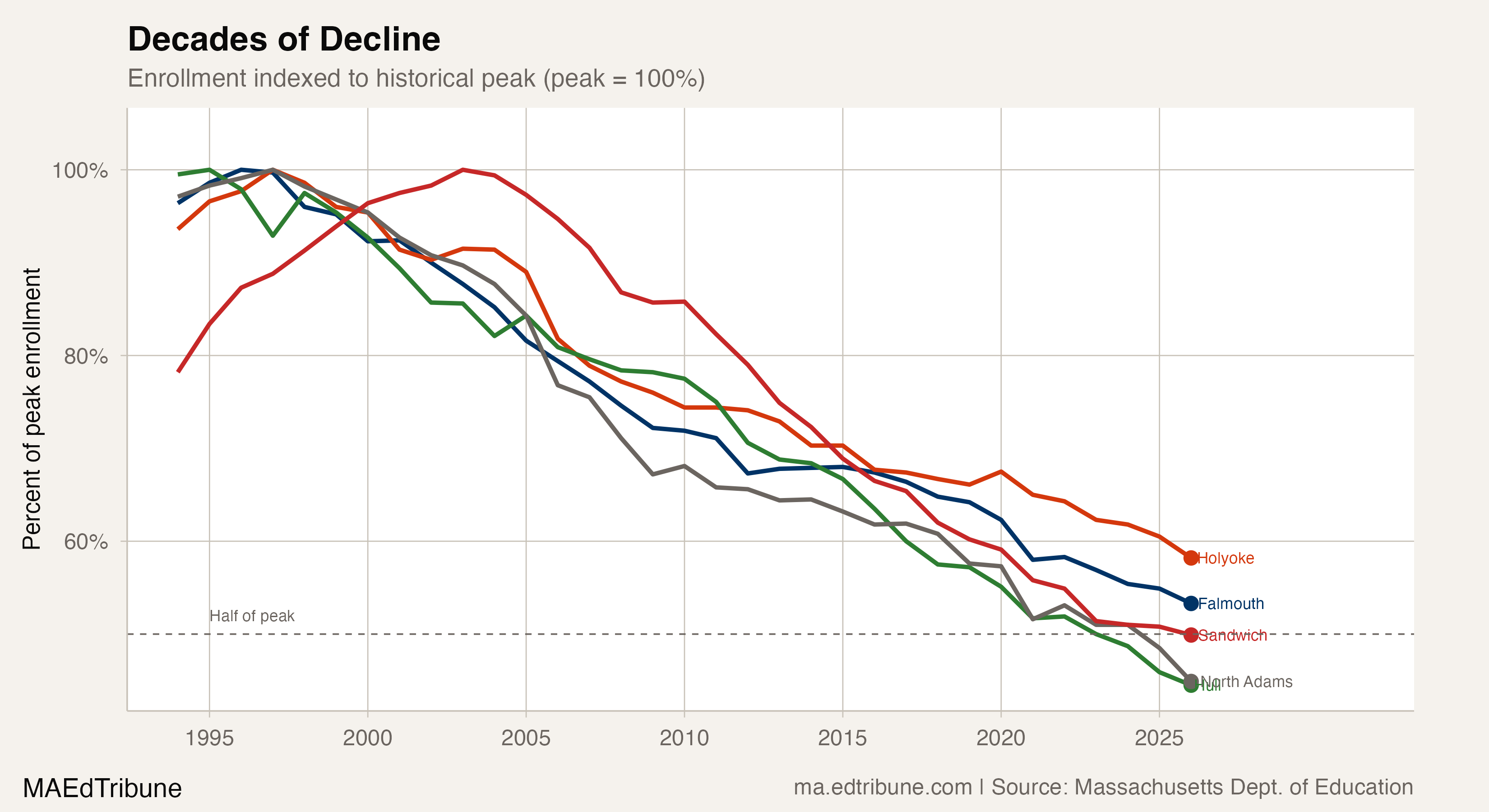
What these districts share is not just declining enrollment but the duration of the decline. Sandwich has fallen for 16 consecutive years. Pittsfield↗ET has declined for 13 straight years. Springfield↗ET has fallen for nine. For these communities, enrollment decline is not a recent disruption. It is the defining condition of their school systems.
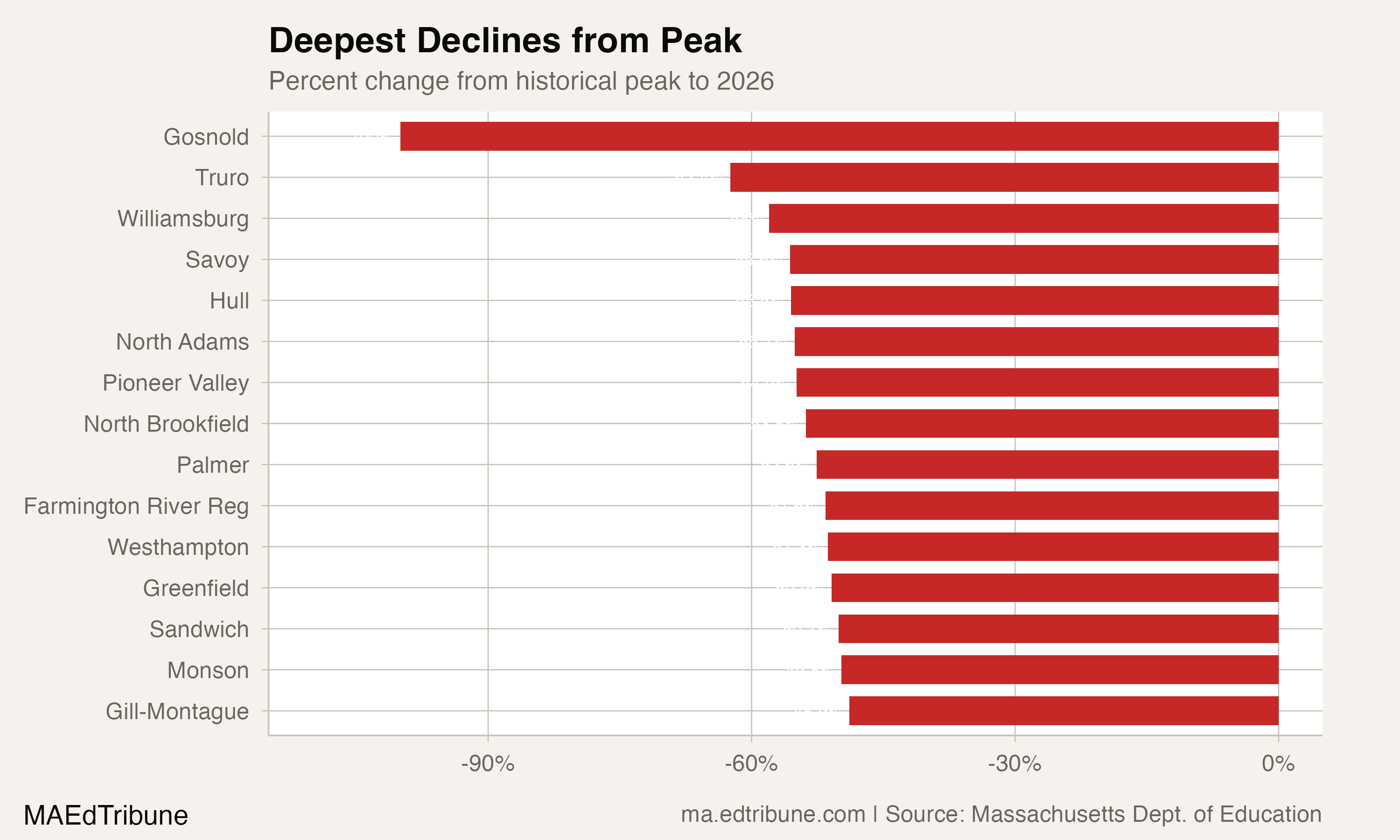
The list also includes large districts. Boston↗ET is at its all-time low of 44,416 students, down 30.3% from its 1998 peak of 63,762. Springfield, at 23,574, is 11.4% below its 2003 peak. New Bedford↗ET, Plymouth↗ET, Chicopee↗ET, and Peabody↗ET are all at record lows and all above 5,000 students.
Two forces, one result
The 2026 collapse has two distinct drivers operating on different timelines.
The long-term force is demographic. Massachusetts' birth rate has been falling for years. Boston's births declined nearly 15% between 2017 and 2021, and the state's births fell substantially during the pandemic and have not recovered.
On Cape Cod, the demographic squeeze is compounded by housing costs that have pushed young families off the peninsula entirely. Median single-family home prices in Mashpee reached $750,000 in 2022, up more than $300,000 since 2018. Cape Cod school enrollment declined roughly 14% between 2012 and 2023, even before the 2026 drop.
The acute force is immigration enforcement. WBUR reported that the fall 2025 data showed 7,000 fewer English learners enrolled statewide, reversing a trend of roughly 8,500 new English learners arriving each year. Chelsea Superintendent Almi Abeyta told WBUR she lost 344 students and attributed the departure to ICE activity:
"They want to be in states where there's less attention, in terms of less presence of ICE." -- WBUR, January 2026
The districts hardest hit by immigration departures, Chelsea, Framingham, Brockton, and Everett, are largely distinct from the Western Massachusetts districts that have been declining for decades. But both sets landed at record lows in the same year, inflating the total to 85.
Not just a small-district problem
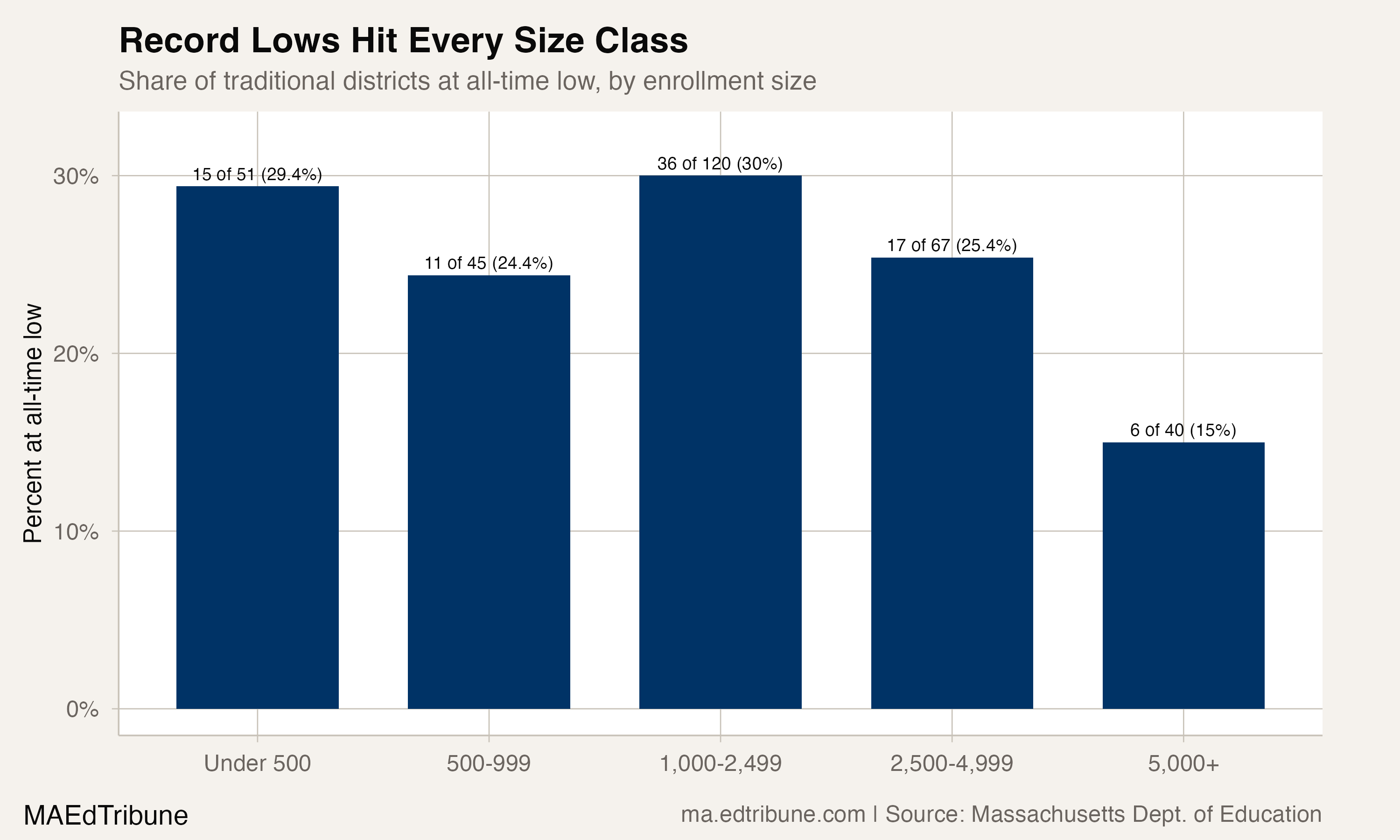
Record lows hit every size class. Among districts enrolling 1,000 to 2,499 students, 30% are at their all-time low. Among districts with 2,500 to 4,999 students, 25.4% are. Even among the 40 largest traditional districts (5,000+ students), six are at record lows, including Boston and Springfield.
The one modest bright spot: 37 districts reached all-time highs in 2026, though 19 of those are charter schools. Among traditional districts, the few at record highs are either vocational-technical schools, which have seen surging demand statewide, or affluent suburbs like Hopkinton and Ashland.
The 'death spiral' in rural schools
In Western Massachusetts, enrollment decline has progressed from a problem into an existential question. The Mohawk Trail↗ET Regional School District has lost 57.6% of its students since 1997, falling from 1,791 to 759. The district and neighboring Hawlemont are now exploring a merger that would consolidate all students from eight towns onto a single campus.
Martha Thurber, chair of the Mohawk Trail Regional School Committee, described the dynamics to WAMC:
"Once you start to lose staff and lose programming, you lose students. That's what we call the 'death spiral.'"
The fiscal math in these communities is stark. Charlemont, one of the towns in the Mohawk Trail district, allocates 56% of its $4.6 million town budget to education. State Senator Jo Comerford has noted that Western Massachusetts districts are "cutting educators two or three dozen at a time."
A state commission recommended $60 million for rural school aid. The legislature appropriated $12 million.
The merger that almost wasn't
In Western Massachusetts, Mohawk Trail and Hawlemont are exploring a consolidation that would put all students from eight towns on a single campus. Warwick's school committee voted 4-1 against joining. Charlemont allocates 56% of its $4.6 million town budget to education. The state commission recommended $60 million for rural school aid. The legislature appropriated $12 million.
Holyoke↗ET has fallen 41.8% from its 1997 peak. Falmouth is down 46.7% from 1996. The 2027 kindergarten cohort, born during the pandemic's deepest birth-rate trough, arrives in fall 2026. For communities that have already lost half their students, the buildings are still standing. The boilers still run.
Detailed code that reproduces the analysis and figures in this article is available exclusively to EdTribune subscribers.
Discussion
Sign in to join the discussion.
Loading comments...