In this series: Massachusetts 2025-26 Enrollment.
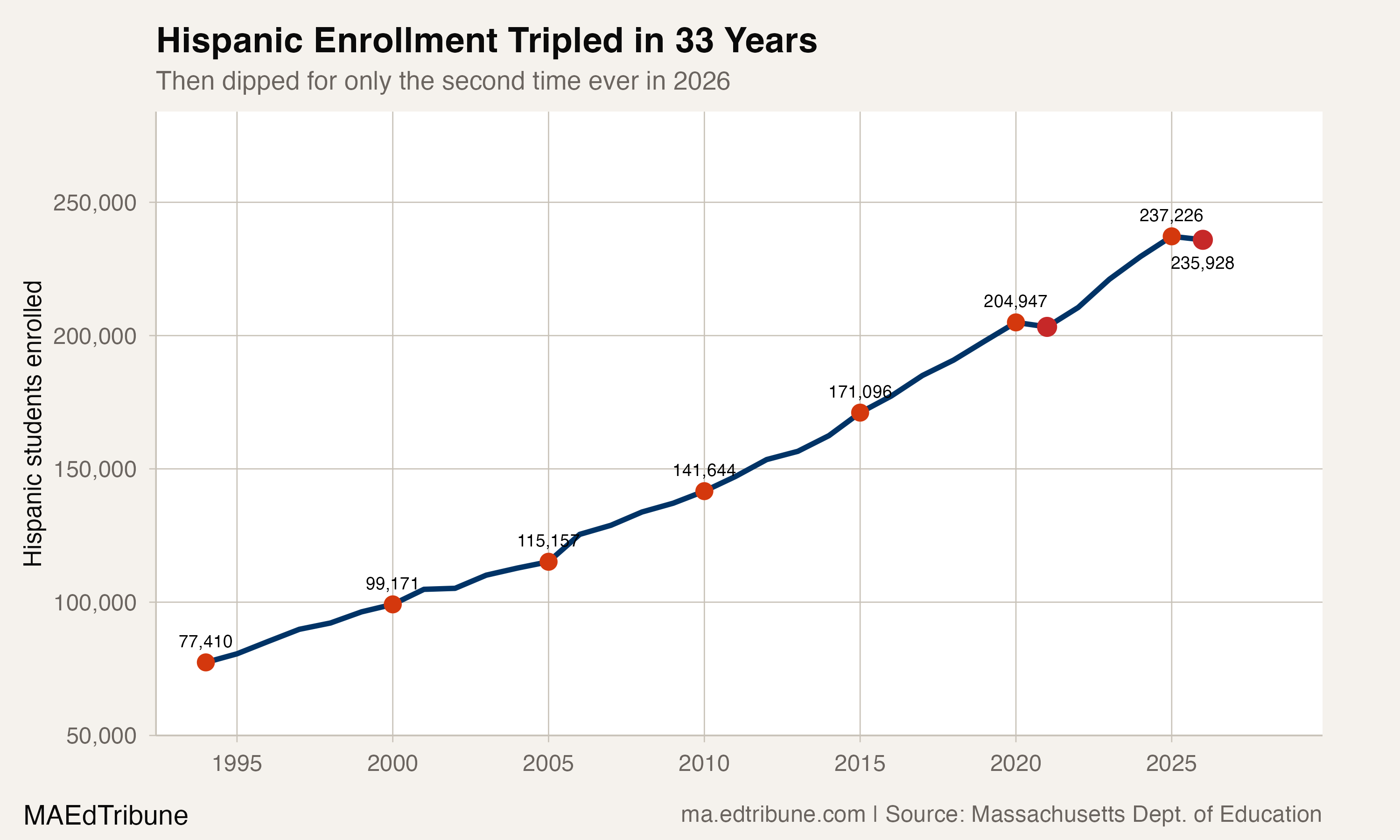
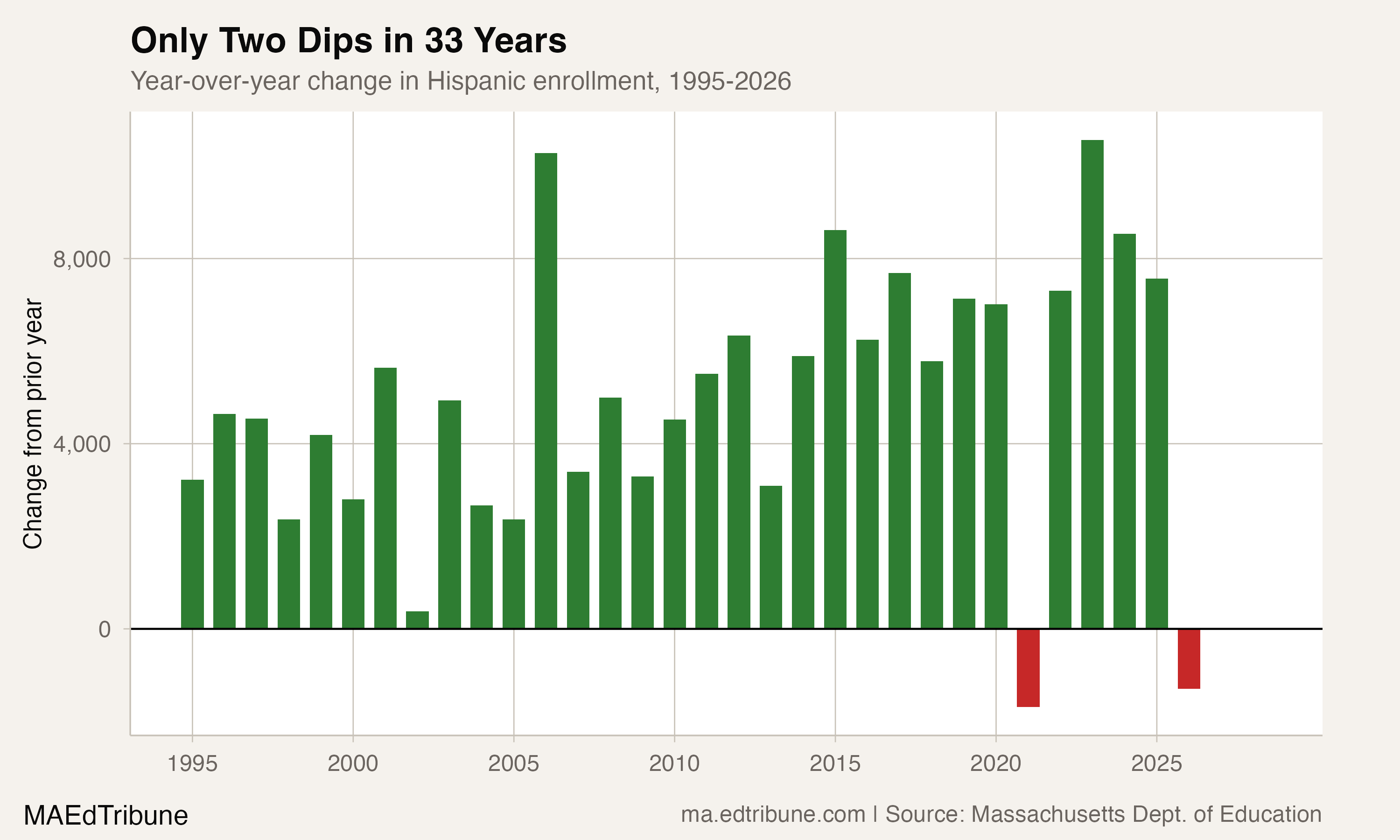
For 30 of the past 32 years, Hispanic enrollment in Massachusetts grew. It grew through recessions and recoveries, through three governors and two presidents, through the post-9/11 years and the Great Recession. It grew so reliably that before 2025-26, the only interruption was a COVID-era dip in 2020-21 that lasted exactly one year before the trajectory resumed.
In 2025-26, Hispanic enrollment fell by 1,298 students, to 235,928. It is the second decline in 33 years of data, and the first that cannot be attributed to a pandemic.
From One in 11 to One in Four
The scale of the transformation that preceded this dip is difficult to overstate. In 1993-94, Massachusetts enrolled 77,410 Hispanic students, 8.8% of its student body. By 2024-25, that number had reached 237,226, a peak of 25.9%. Hispanic enrollment more than tripled, adding 159,816 students even as total statewide enrollment barely moved.
The growth came in waves. From 1994 to 2000, Hispanic enrollment rose 28.1%, adding about 3,600 students per year. The pace accelerated through the 2000s and 2010s, peaking at 10,561 new Hispanic students in a single year (2022-23), a period that coincided with a national surge in immigration from Central and South America. By 2025-26, Hispanic students comprised 26.2% of Massachusetts enrollment, up from 8.8% three decades earlier.
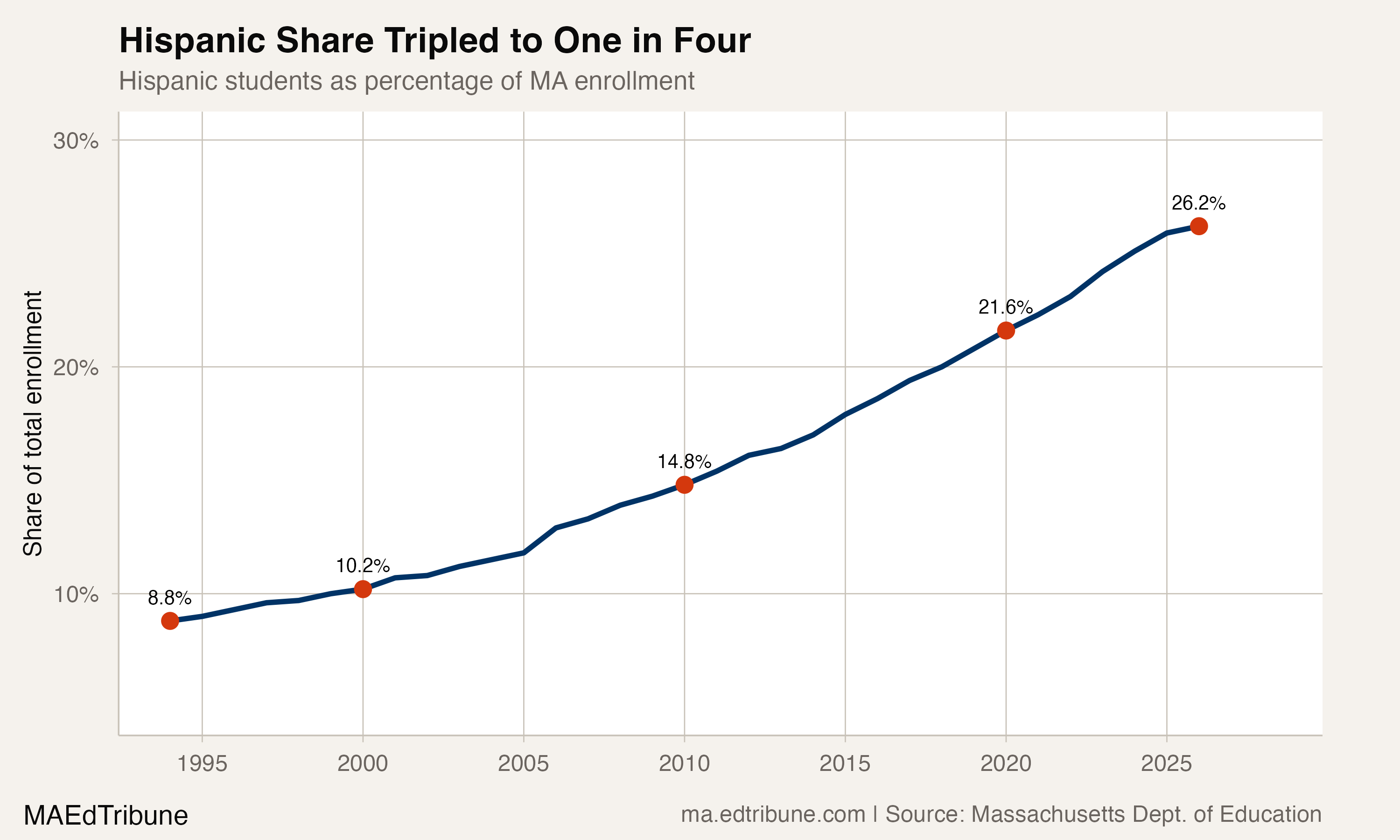
That growth rate made the 2026 reversal conspicuous. The state lost 1,298 Hispanic students, a 0.5% decline. Small in percentage terms, and because total enrollment fell faster (down 15,442), the Hispanic share actually ticked up to 26.2%. But in a series that had declined exactly once before, the signal matters more than the magnitude.
Gateway Cities Carried the Loss
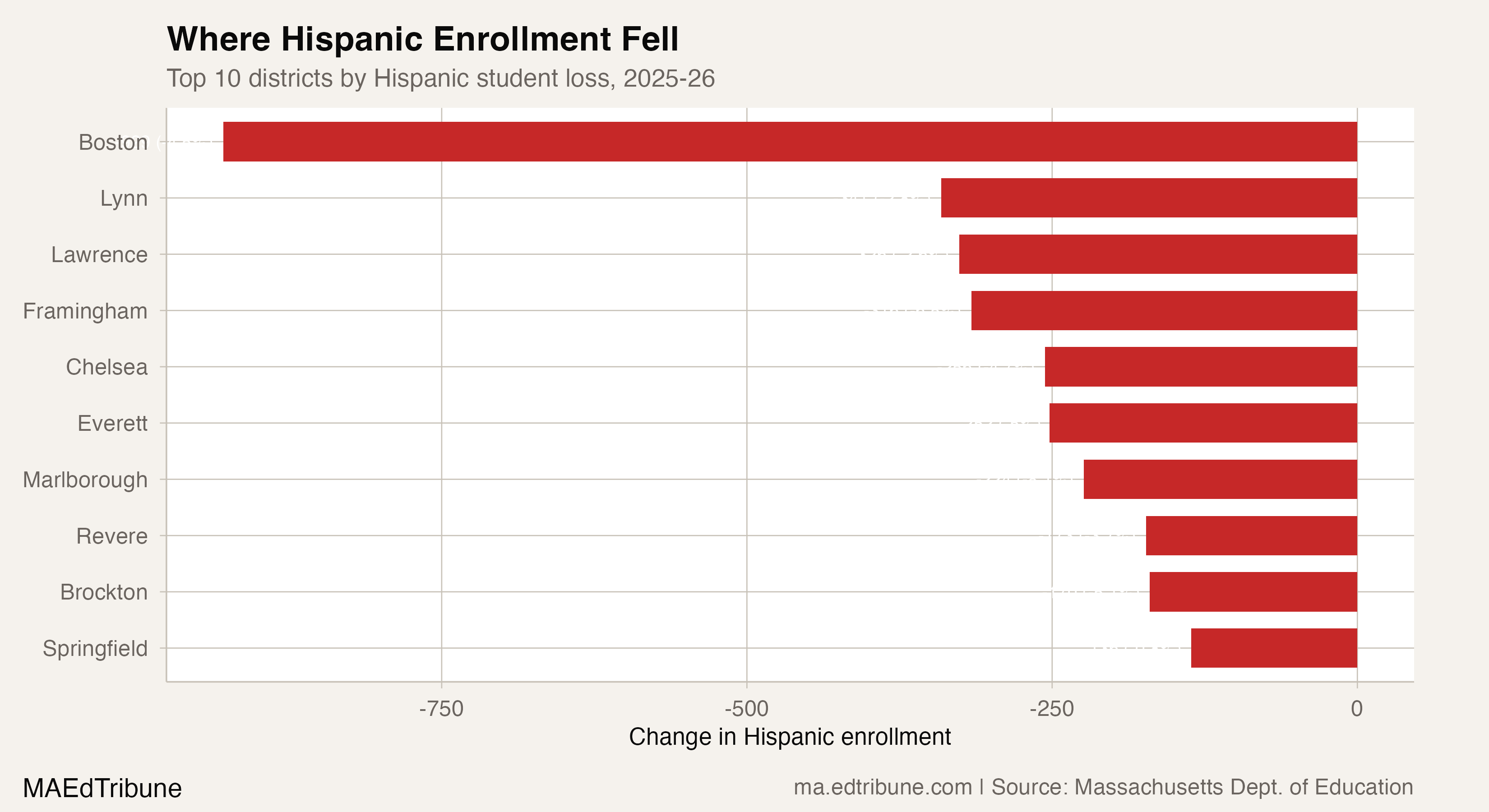
The decline was not evenly distributed. It concentrated in the same gateway cities that had been the engines of Hispanic enrollment growth for decades.
Boston↗ET lost 929 Hispanic students, dropping from 20,650 to 19,721, a 4.5% decline. Lynn↗ET lost 341, Lawrence↗ET lost 326, Framingham↗ET lost 316, Chelsea↗ET lost 256, and Everett↗ET lost 252. Fourteen gateway cities combined to lose 3,503 Hispanic students. Gains in smaller and suburban districts offset only a portion: Lowell↗ET gained 86, and vocational-technical schools picked up modest numbers.
The geographic pattern is pointed. These are Massachusetts' immigrant gateway communities, where Hispanic enrollment has historically been fueled by migration from Puerto Rico, the Dominican Republic, Guatemala, Honduras, and Brazil. Districts where more than half of all students are Hispanic, including Lawrence at 94.7%, Chelsea at 89.9%, and Holyoke↗ET at 81.6%, saw some of the steepest percentage losses.
Marlborough↗ET, where 58.3% of students are Hispanic, lost 224 students, an 8.1% decline, the largest percentage drop among districts with more than 2,000 Hispanic students.
The Enforcement Effect
The most likely driver of this reversal is federal immigration enforcement, which intensified sharply in Massachusetts beginning in January 2025. Multiple school superintendents have pointed to ICE activity as the primary factor.
Chelsea Superintendent Almi Abeyta told WBUR that families were leaving not only the city but the country:
"Parents are saying, 'Well, we're leaving ... we don't want to live where there's ICE on the streets, so we're leaving Chelsea.'" — WBUR, September 2025
Chelsea tracked where its departing students went. Of roughly 990 who transferred out since October, about a quarter enrolled in other Massachusetts districts, another quarter left for Honduras, Guatemala, and Colombia, and about half moved to other U.S. states, including Florida, Arkansas, Alabama, and South Carolina. School staff reported that families were relocating to states where they perceived less immigration enforcement presence.
Lynn Superintendent Molly Cohen described the consequences in fiscal terms:
"We are seeing fear. We are seeing instability. And we are seeing the financial consequences of that instability land squarely on the districts serving our most vulnerable students." — GBH News, March 2026
In Framingham, the enrollment decline triggered proposed elimination of 84 staff positions, including a dozen ESL teachers across elementary and middle schools. Superintendent Bob Tremblay cited "the fear of Immigration and Customs Enforcement, ICE, in the community" as a factor in the district's loss of 719 students overall.
A Parallel Signal in English Learner Data
The Hispanic enrollment dip did not occur in isolation. English learner enrollment, which overlaps significantly with Hispanic students, fell by 6,889 statewide, from 127,673 to 120,784. It was a sharp reversal: from 2022 to 2025, Massachusetts had been adding an average of 8,100 English learners per year.
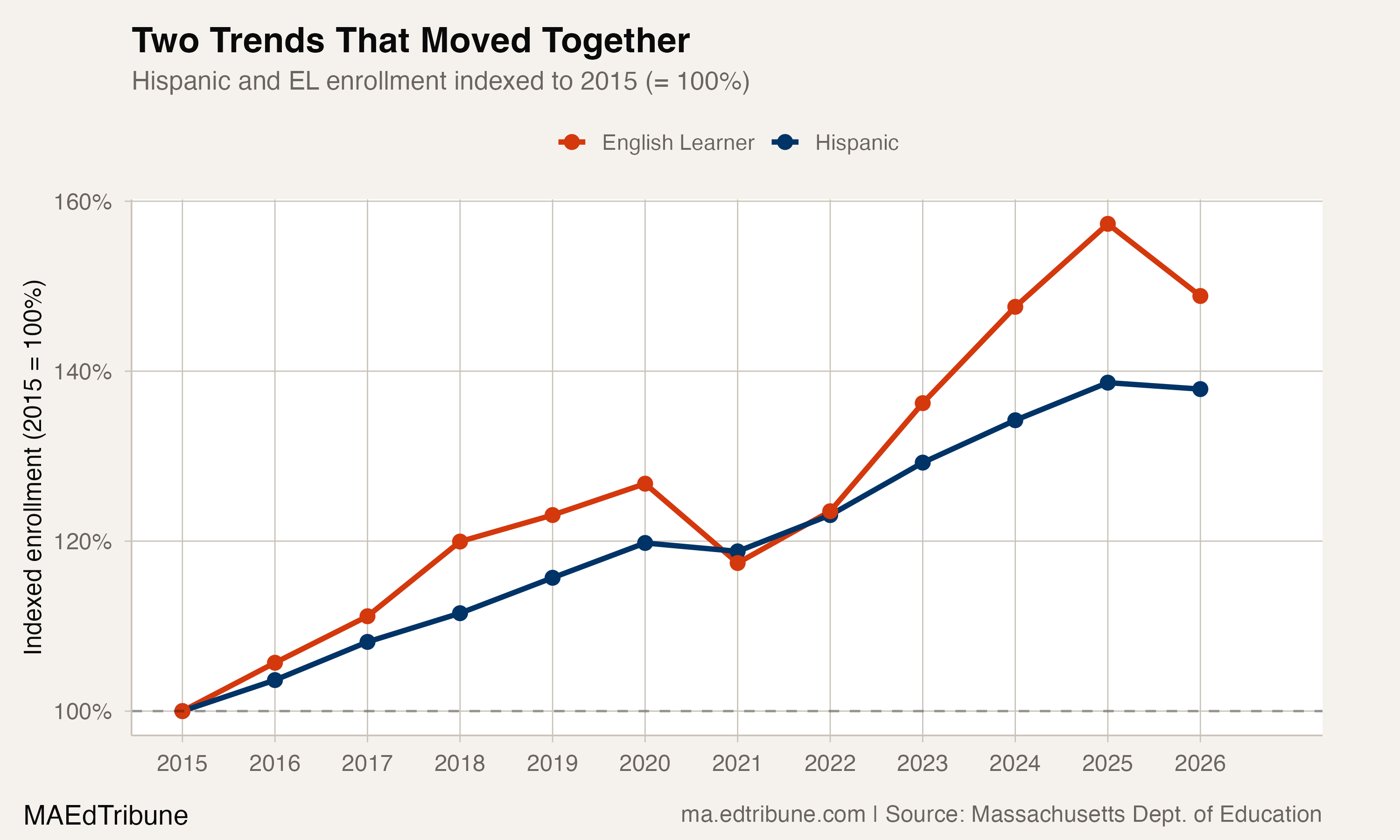
The two trends have tracked each other closely since 2015, and both fell simultaneously in 2020-21 (COVID) and again in 2025-26. The English learner decline was proportionally steeper, a 5.4% drop compared to 0.5% for Hispanic enrollment overall. That gap suggests the losses were concentrated among more recently arrived families, who are more likely to be classified as English learners, rather than among established Hispanic households whose children are English-proficient.
Boston Superintendent Mary Skipper attributed the district's decline to "a decrease in international immigration to the district," noting that Boston's birth rate also fell nearly 15% between 2017 and 2021.
Other forces at work
Immigration enforcement has the most direct evidence behind it, but two other forces are pulling in the same direction.
The first is the national slowdown in immigration itself. Net international migration to the United States peaked at 2.7 million between July 2023 and June 2024, then fell to 1.3 million the following year, a 53.8% drop the Census Bureau called a "historic decline." Massachusetts' net international migration dropped from 77,957 to 40,240 in the same period, according to UMass Donahue Institute analysis of Census data. Fewer arrivals means fewer new students, regardless of enforcement activity. This is a structural shift, not a behavioral one, and it would affect enrollment even in the absence of ICE operations.
The second is cost of living. Massachusetts has among the highest housing costs in the country, and Chelsea school officials reported that families cited both ICE sightings and affordability as reasons for leaving. Separating the enforcement effect from the cost-of-living effect is not possible with enrollment data alone. Both push in the same direction.
The Structural Mismatch
The fiscal consequences fall hardest on the districts least equipped to absorb them. Chelsea projected a $5.7 million budget shortfall from its enrollment loss. As School Committee member Sarah Neville noted: "We might have fewer students, but we still have the same amount of school buildings and we still have the same electrical bills."
Statewide, Massachusetts lost 15,442 students in 2025-26, falling to 900,490, its lowest enrollment since 1994-95. Hispanic students accounted for 1,298 of that decline. White students accounted for 14,256, a 3.0% drop that has continued uninterrupted for years. The difference: white enrollment decline reflects long-term demographic contraction. Hispanic enrollment decline, after a generation of nearly unbroken growth, reflects something new.
Springfield's two-year signal
The COVID dip of 1,690 Hispanic students in 2021 reversed the very next year with a rebound of 7,306. This time, the forces pulling enrollment down, federal enforcement policy and reduced immigration flows, show no signs of reversing. Net international migration to the U.S. is projected to fall further, to about 321,000 between July 2025 and June 2026.
Springfield↗ET, the state's third-largest district at 68.1% Hispanic, lost 136 Hispanic students in 2025-26 after losing 229 the year before. Two years ago, the district was still gaining. Chelsea tracked where its departing families went: about a quarter enrolled in other Massachusetts districts, a quarter left the country, and half moved to Florida, Arkansas, and Alabama. The 33 districts where Hispanic students are already the majority are watching Springfield's numbers to see what their own will look like in fall 2026.
Detailed code that reproduces the analysis and figures in this article is available exclusively to EdTribune subscribers.
Discussion
Sign in to join the discussion.
Loading comments...