In this series: Massachusetts 2025-26 Enrollment.
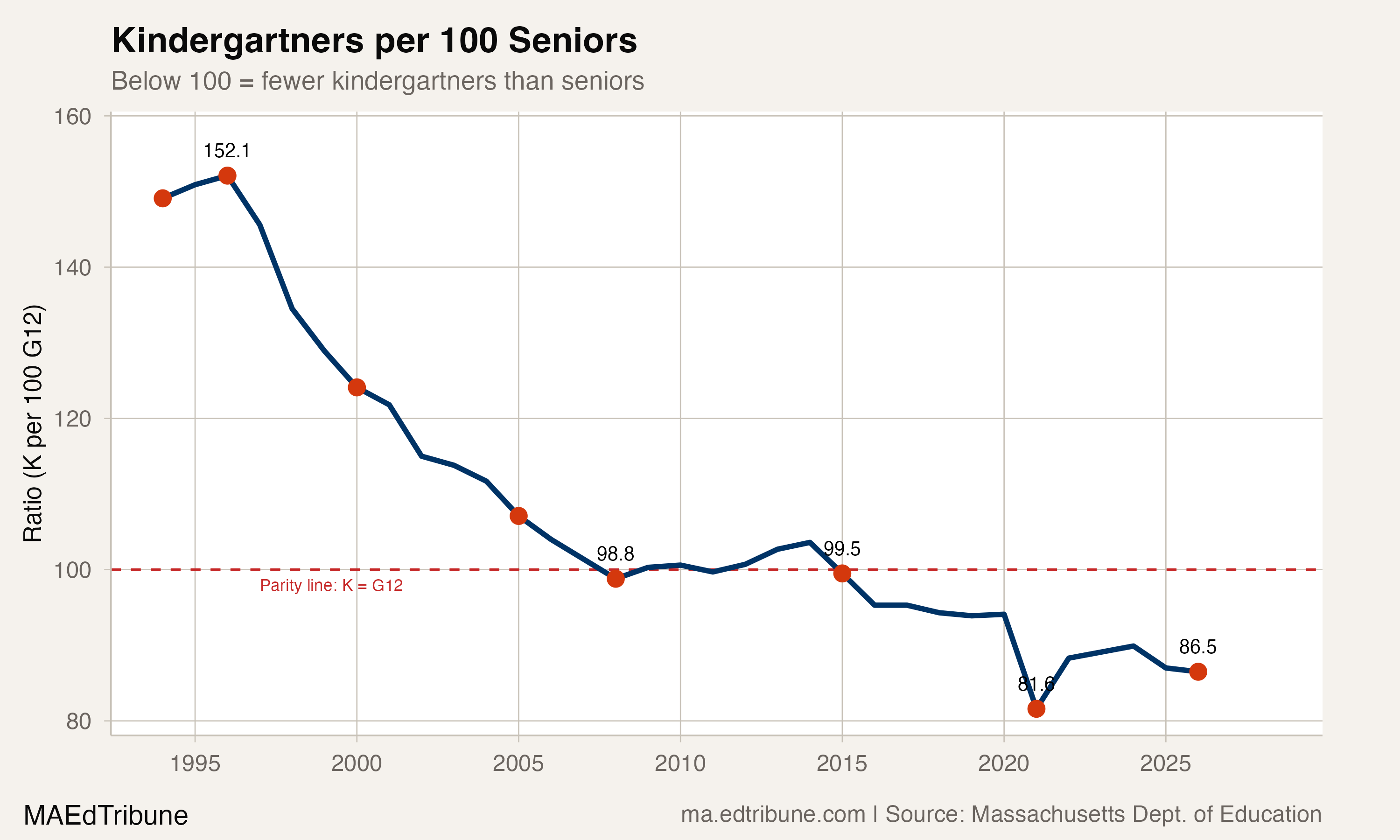
In 1996, Massachusetts had 152 kindergartners for every 100 seniors. In 2025-26, it has 87.
That number, 86.5 to be precise, means 60,871 children entered kindergarten in 2025-26 while 70,385 prepared to graduate. The state enrolled 9,514 fewer five-year-olds than eighteen-year-olds. In a system where every kindergarten class becomes a future senior class, the arithmetic is merciless: every grade from K through eighth is now smaller than the class of 2026, and each cohort entering the pipeline locks in lower enrollment for the next 13 years.
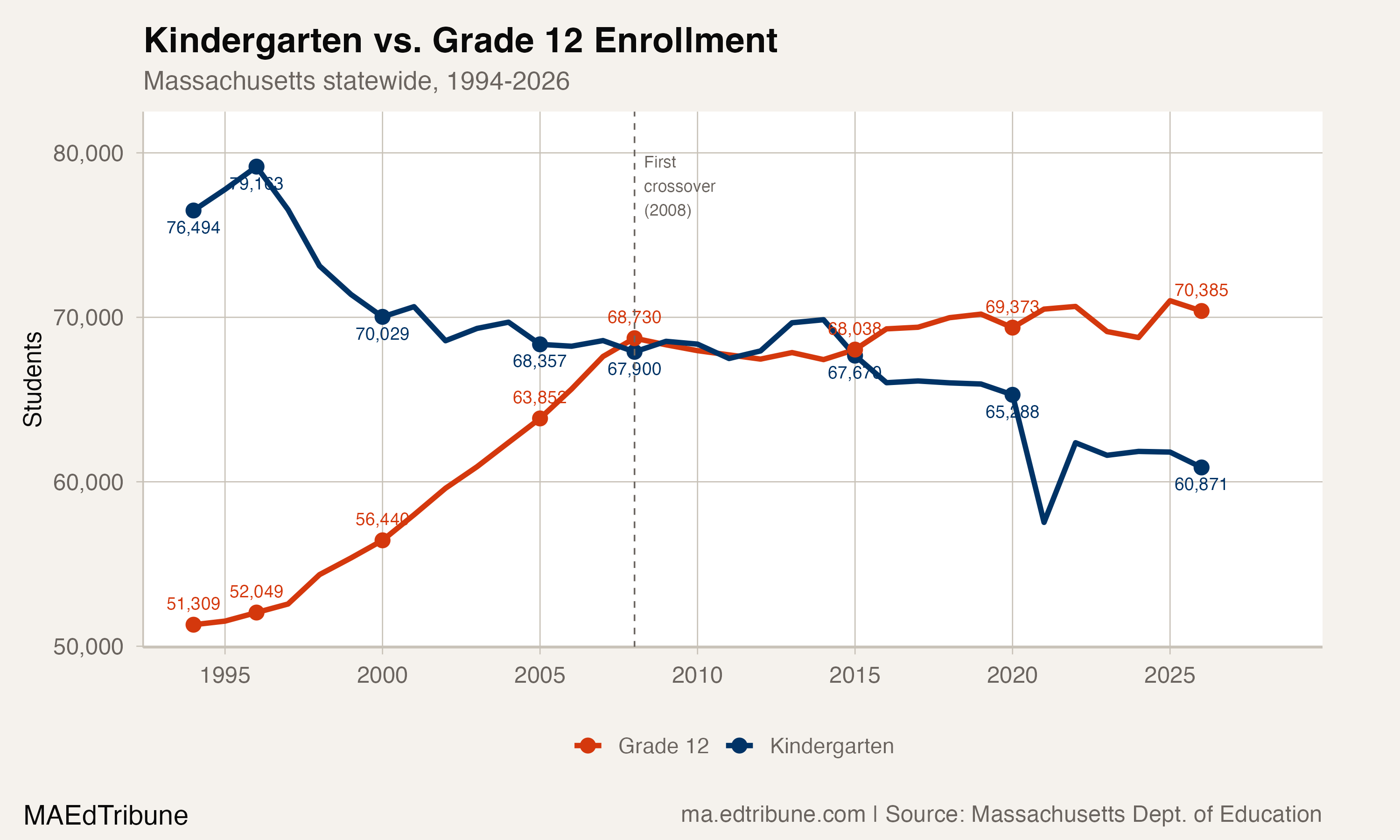
Massachusetts first crossed the inversion threshold in 2008, when kindergarten enrollment of 67,900 dipped below grade 12's 68,730. The state has been below parity in 12 of the last 12 years. This is not a temporary dip. It is the new structure of public education in the Commonwealth.
A 30-year collapse at the bottom
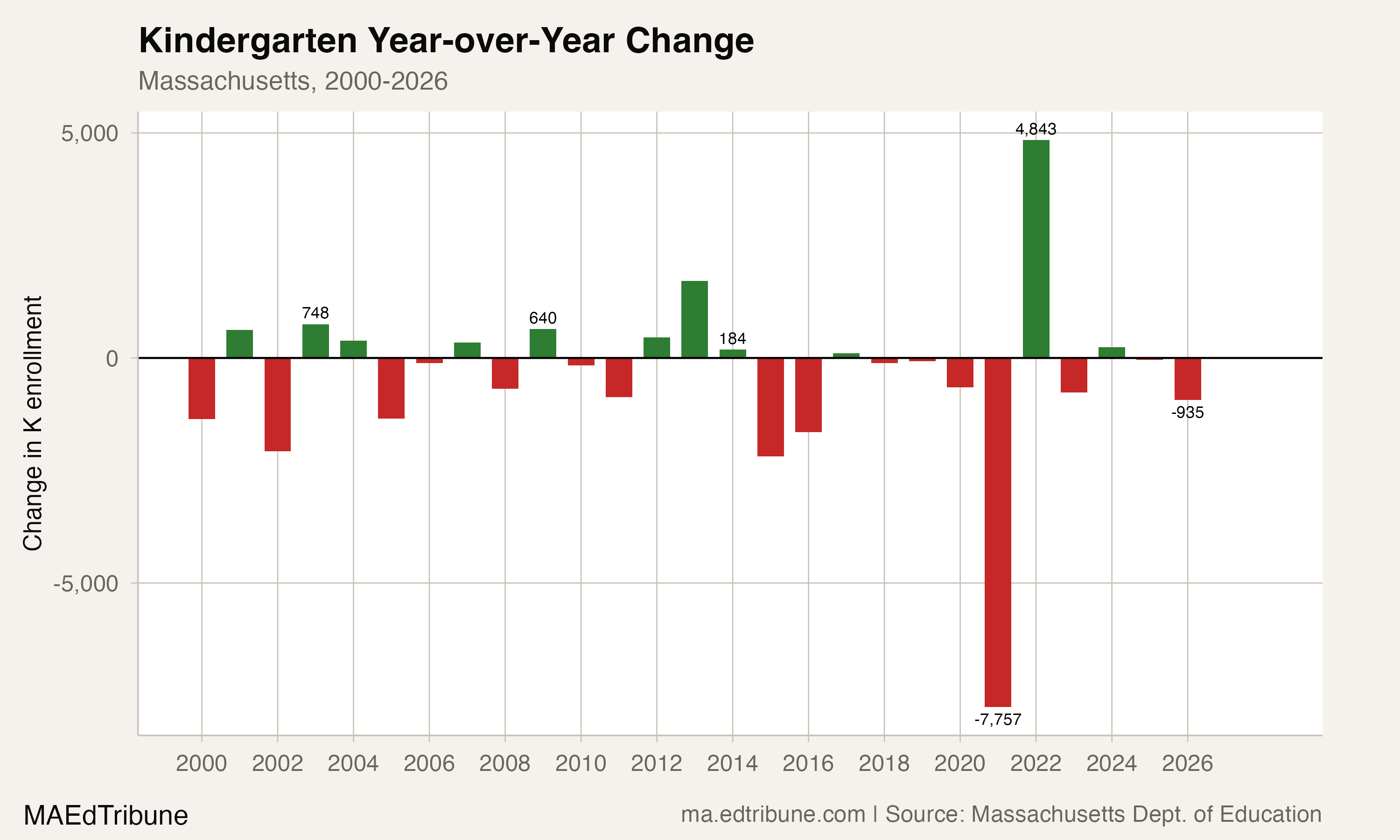
Kindergarten enrollment peaked at 79,163 in 1996, when the echo boom's last large cohorts were entering school. It has fallen 23.1% since, losing 18,292 students. The decline accelerated after COVID: kindergarten dropped 7,757 students in a single year (2021), an 11.9% plunge, and has never recovered to pre-pandemic levels. In 2026, at 60,871, it sits 4,417 below the 2020 count of 65,288.
Grade 12, meanwhile, has moved in the opposite direction. Seniors numbered just 51,309 in 1994 and climbed steadily as the larger cohorts of the 1990s aged through the system. The senior class peaked at 71,010 in 2025 and remains elevated at 70,385, a 37.2% increase over the 33-year span.
The two lines crossed in 2008 and have been diverging since.
The staircase tells the story
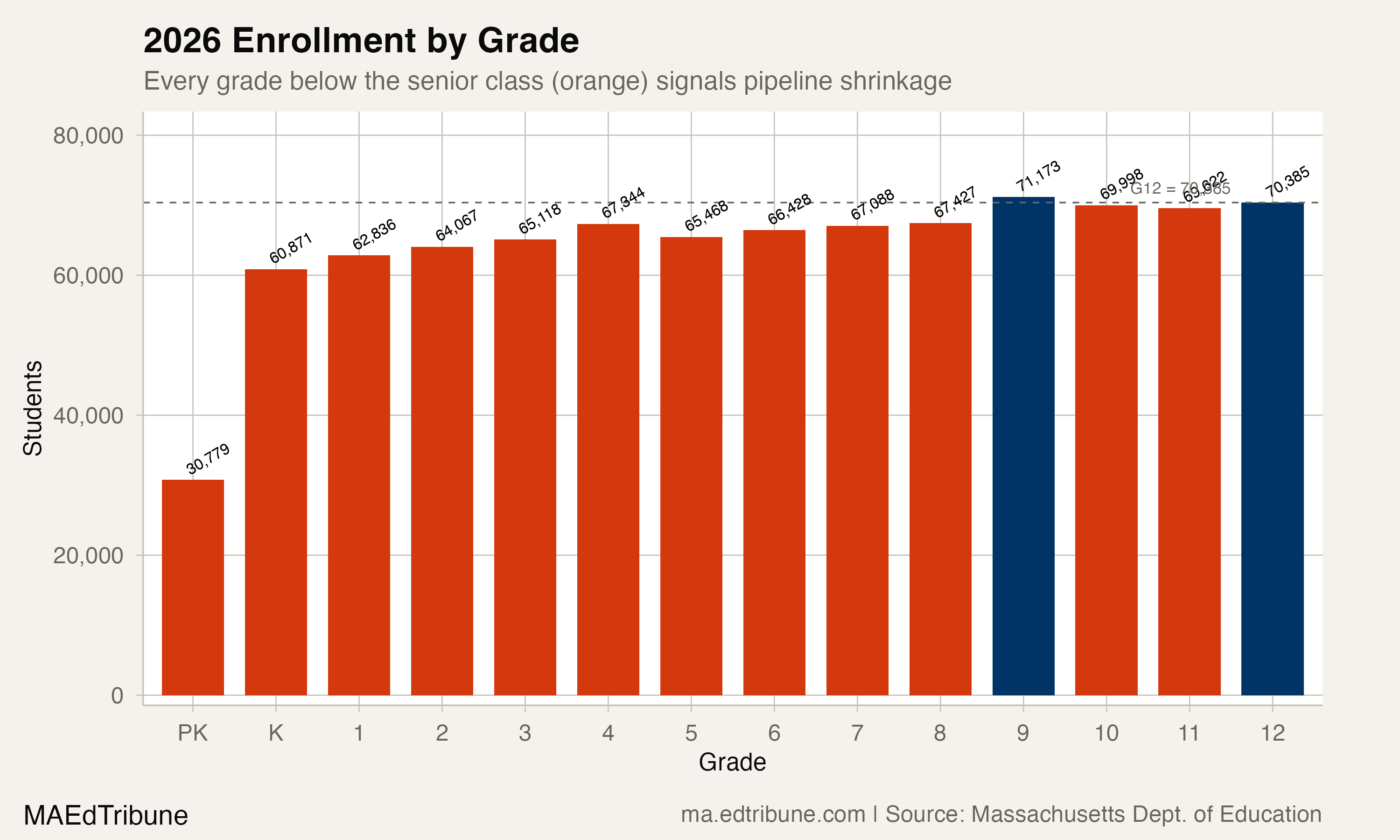
A snapshot of every grade in 2026 reveals the damage. Only grade 9 (71,173) exceeds the senior class. Every other grade from kindergarten through eighth falls short, and the deficit widens as the grades get younger. First grade is 10.7% below grade 12. Third grade is 7.5% below. Kindergarten is 13.5% below.
This means the senior class of 2038, the 2025-26 kindergarten cohort, will arrive at grade 12 roughly 9,500 students smaller than the 2026 senior class, even before accounting for attrition.
Where the inversion cuts deepest
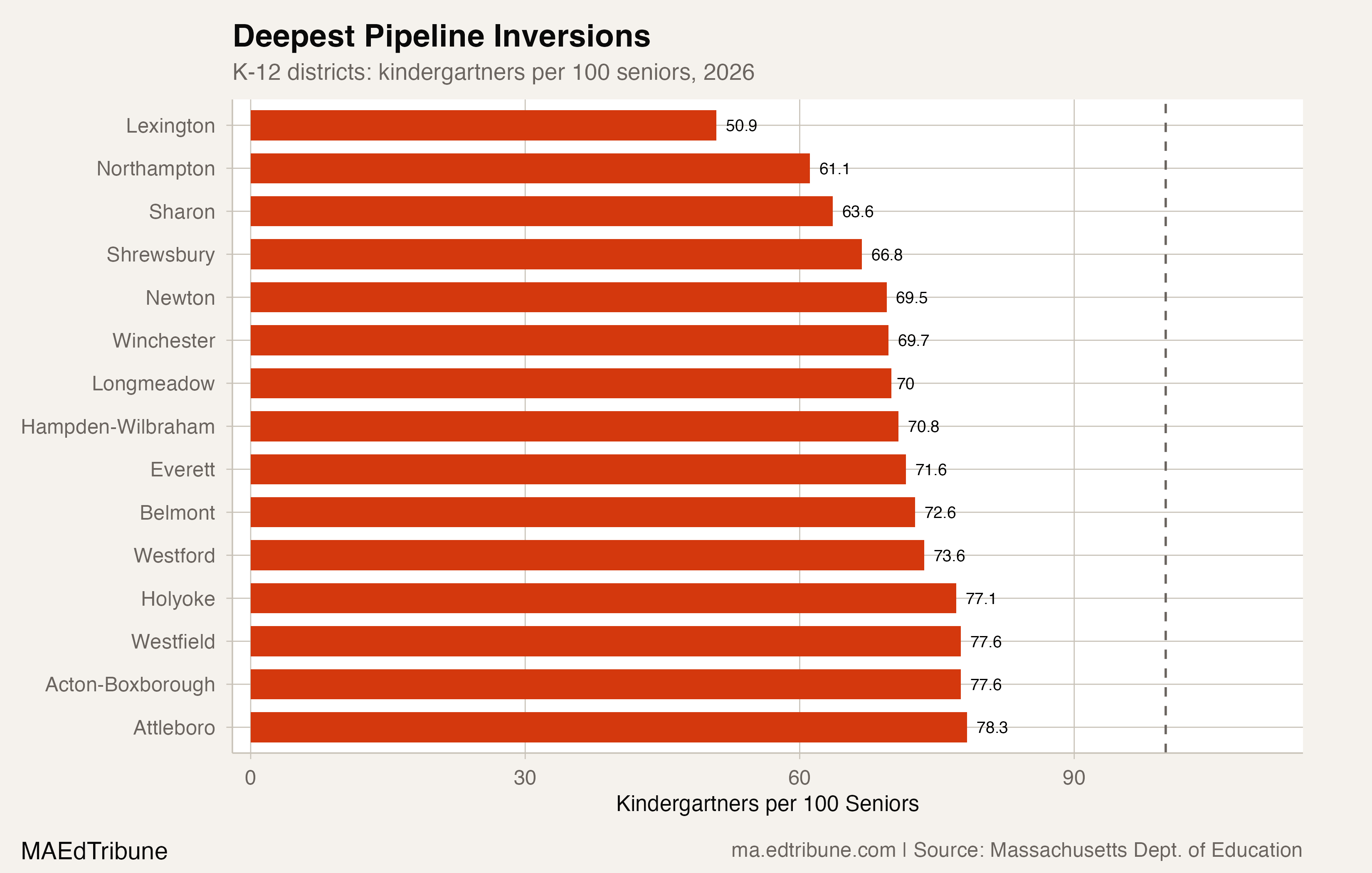
The statewide ratio of 86.5 masks wild variation at the district level. Among 90 K-12 districts with at least 200 seniors, 54, or 60%, now enroll fewer kindergartners than twelfth graders.
Lexington↗ET has the deepest inversion among brick-and-mortar districts: just 50.9 kindergartners per 100 seniors, with 305 kindergartners and 599 seniors. Shrewsbury↗ET follows at 66.8, and Newton↗ET, one of the state's largest suburban systems, sits at 69.5 with 302 fewer kindergartners than seniors.
The pattern concentrates in affluent suburbs. Winchester (69.7), Longmeadow (70.0), Belmont (72.6), and Acton-Boxborough (77.6) all show ratios in the 70s or below, districts where housing costs have pushed young families out and where the existing population has aged past childbearing.
The exceptions are instructive. Fall River↗ET enrolls 140.5 kindergartners per 100 seniors. New Bedford↗ET is at 139.1. Lowell↗ET sits at 129.3, and Springfield↗ET at 105.3. Gateway cities with lower housing costs, immigrant communities, and younger populations still generate enough kindergartners to feed the pipeline. Boston↗ET, despite absorbing more immigrants than any other Massachusetts district, has already inverted: 3,248 kindergartners against 3,677 seniors, a ratio of 88.3.
Even Worcester↗ET, with its large refugee and immigrant community, is approaching the line at 99.1, with just 16 students separating the two grades.
Why the bottom of the pipeline keeps shrinking
The most direct explanation is demographic. Massachusetts births fell from 92,461 in 1990 to 66,442 in 2020, a decline of 28.1%. The children entering kindergarten in 2026 were born in 2020 or 2021, years when COVID further suppressed an already-declining birth rate. The state has the fourth-lowest fertility rate in the nation, driven by housing costs, delayed childbearing, and a highly educated population that tends toward smaller families.
Immigration has provided a partial buffer. K-to-first-grade retention ratios consistently exceed 100%, meaning more students show up for first grade than were in kindergarten the year before, as immigrant families enter the system after the K entry point. In 2023, 104.4% of the kindergarten class reappeared as first graders the following year. But this offset has been weakening: the ratio fell to 101.7% in 2025, and the recent drop of 7,000 English learners in 2025-26, attributed in part to immigration enforcement, suggests the buffer may be eroding further.
Kindergarten is the early warning system
The year-over-year trajectory of kindergarten enrollment has been negative in nine of the last 12 years. The COVID crash of 2021 (-7,757) was an outlier, and the 2022 rebound (+4,843) recaptured most of those missing students, but the underlying trajectory has resumed its downward march. The 2026 loss of 935 students, a 1.5% drop, is unremarkable in isolation. In context, it represents the continuation of a decline that predates the pandemic by two decades.
Elementary enrollment (grades 1-5) has already absorbed the damage: it fell 28,753 students, or 8.1%, between 2016 and 2026. High school enrollment dropped just 2.9% over the same period because it is still cycling through the larger cohorts born in the mid-2000s. That buffer will expire. As the current elementary classes age into high school, the senior class will begin shrinking for the first time since the 1990s.
The buildings are already half-empty
The fiscal and operational consequences are visible across the state. The Massachusetts School Building Authority assessed nearly 1,600 school buildings in its 2025 survey, part of its ongoing effort to benchmark capacity utilization. Recent reporting indicates half of surveyed schools now operate below 80% capacity, more than double the rate in 2010.
"We have too few resources spread across too many schools, making it harder to deliver on strong student outcomes." — Boston Superintendent Mary Skipper, WBUR, Dec. 2025
Boston↗ET has announced plans to close or merge 17 schools by 2030. More than three dozen schools statewide have closed or consolidated since the pandemic. Rural western Massachusetts districts are weighing mergers, with the proposed Gill-Montague, Pioneer Valley, and Warwick consolidation illustrating both the pressure and the resistance: Warwick's school committee voted 4-1 against joining.
60,871 kindergartners, 13 years to go
The 2026 kindergarten class will move through the system for the next 13 years. Roughly 103% of them will appear in first grade next fall, bolstered by late entrants and immigrants, but no amount of mid-pipeline growth has altered the fundamental trajectory. The classes entering Massachusetts schools are smaller than the classes leaving them, and have been for nearly two decades.
Half of the state's surveyed school buildings already operate below 80% capacity. Lexington has 305 kindergartners and 599 seniors. The Massachusetts School Building Authority assessed nearly 1,600 buildings in 2025. A Pioneer Institute analysis projected declines through 2030. Given that the state just lost 15,442 in a single year, those projections may already be conservative. The senior class of 2038 is already sitting in kindergarten classrooms. Count them.
Detailed code that reproduces the analysis and figures in this article is available exclusively to EdTribune subscribers.
Discussion
Sign in to join the discussion.
Loading comments...